
10 Tips on Prayer From St. Teresa of Avila
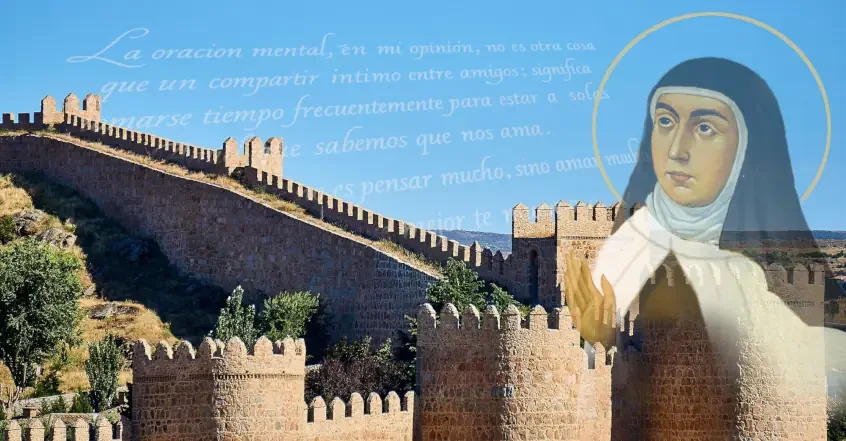
What art or science is more important in life than prayer? Through prayer, we can reach the happiness of eternal life with God. Is there a higher skill we can learn? Technology and the greatest masterpieces will fade away, but the beatific vision will never pass. For such an undertaking, then, it is well worth finding a trusted teacher. Someone who knows the path upwards and can teach us to persevere in it—such a guide is St. Teresa of Avila.
Though she is one of the greatest mystics of all time, her prayer life did not fully click until her forties. This is heartening. It is never too late to begin. Today, we consider some of her best suggestions on prayer.
Abbreviations of St. Teresa’s Works: The Way of Perfection = Way, The Book of Her Life = Life, The Interior Castle = IC
1. Silence and Solitude Help Prayer
“It is well to seek greater solitude,” she says, “so as to make room for the Lord and allow His Majesty to do His own work in us” (Way, 31:7). Removing external hindrances is a prerequisite for prayer to succeed. It is like a student who seeks a quiet corner in the library to focus on only his or her studies. As Jesus says, “When you pray, go into your room, shut the door, and pray to your Father who is in secret; and your Father who sees in secret will reward you” (Mt 6:6).
In other words, it is not necessary to find a deserted island in order to pray well. A corner of one’s room suffices, provided it’s quiet and conducive to recollection. “However quietly we speak,” St. Teresa explains, “He is so near that He will hear us: we have no need of wings to go in search of Him but have only to find a place where we can be alone and look upon Him present within us” (Way 28:1).
Why seek silence? Suppose you are in a crowded bus station speaking to a friend on the phone. What do you do instinctively? You will likely seek out a quiet spot to hear your friend and communicate with him. So likewise, if prayer is a two-way street of listening and speaking to God, then silence is the best atmosphere.
2. God Dwells Within Us
Once we’ve freed ourselves from external distractions, the next step is to understand that God dwells within us. This theme appears constantly in Teresa’s writings. She understands that God dwells in the center of her soul as a King in his castle; “If I had understood as I do now that in this little palace of my soul dwelt so great a King, I would not have left Him alone so often” (Way, 28:11). Consequently, she says that those who can remain with God in their souls, “Will journey far in a short time” (Way 28:5).
Coupled with faith in God’s presence is the need to trust in His love. This is vitally important, because, as she wisely points out, “Love begets love” (Life 22:14). Realizing God’s love prompts me to reciprocate. “How clear your declaration, my Lord! How clear it is, the love you bear us!” (Way 27:4)
3. Humility Bolsters Prayer
From the perception of God’s presence and love, Teresa recommends humbling oneself. This is not a matter of groveling like a hedgehog but a simple recognition of our littleness. God loves to see us as small children before Him. La Madre observes, “What I have come to understand is that this whole groundwork of prayer is based on humility and that the more a soul lowers itself in prayer the more God raises it up” (Life 22:11).
4. Attentiveness Is Vital
As with most spiritual masters, the holy Mother recommends attentiveness; “A prayer in which a person is not aware of whom he is speaking to, what he is asking, who it is who is asking and of whom, I do not call prayer however much the lips move” (IC 1:1:7).
It is encouraging to know that La Madre struggled with a wandering mind. She explains, “This intellect is so wild that it doesn’t seem to be anything else than a frantic madman no one can tie down” (Life 30:16).
She found various ways to control her distracted mind, such as reading a spiritual book, cultivating calmness, recalling God’s nearness, gently ignoring distractions, and reciting a vocal prayer slowly, such as the Our Father. The proximate preparation for prayer is likewise crucial. If I have been listening to the news for an hour then try to enter prayer, I will likely be bombarded with distractions. The mind needs quieting first.
5. Prayer Is Not Thinking Much
Prayer is not an intellectual analysis or philosophical investigation. For Teresa, the whole thing boils down to love. “In order to profit by this path and ascend to the dwelling places we desire, the important thing is not to think much but to love much, and so do whatever best stirs you to love” (IC 4:1:7).
Again, she says, “I'm not asking you now that you think about Him or that you draw out many concepts or make long and subtle reflections with your intellect. I'm not asking you to do anything more than look at Him” (Way 26:3).
St. Jean Vianney illustrates this method well from an old farmer he saw praying before the tabernacle. Impressed by the farmer’s absorption, St. Jean asked him one day what he said in prayer. The farmer responded with a twinkle, “He looks at me and I look at Him.” This poor farmer found the essential prayer: no words, just love.
However, the brain is not useless for prayer—far from it. Our reasoning and imaginative powers can surely serve as a springboard. Nonetheless, this should be a starting point and not the whole of prayer. Two persons in love don’t need reasons to love. They simply love.
|
6. Prayer Is a Habit
Whoever mastered a musical instrument without habitual practice? Teresa likewise affirms that prayer succeeds through habit. “One needs no bodily strength for mental prayer,” she says, “but only love and the formation of a habit” (Life 7:12). Again, “The habit of recollection is not to be gained by force of arms but with calmness” (IC 2:1:18). The saints became saints because their prayer was habitual.
7. Ascesis Helps Prayer
“Prayer and self-indulgence don’t go together” (Way 4:2). The word asceticism comes from the Greek term áskesis, which means training or exercise. The marathon runner understandably lives a disciplined lifestyle to keep fit for the contest.
The idea of training crosses over easily for the so-called spiritual athlete. Most major religions have some variation on the premise, “Deprive the body, feed the soul.” While many saints took this to extremes, St. Teresa advocates a balanced approach. Her nuns embraced austerity but did not go to extremes. Practices such as fasting help clear the mind, calm the soul, and make spiritual realities come alive. With a stuffed belly and dull mind, one is inclined more towards sleep rather than prayer.
8. Prayer Means Love
“Prayer is an exercise of love” (Life 7:12). Love is the activity of the blessed in heaven—faith and hope are obsolete. Not so with love. The stronger our charity on earth, the higher our place in heaven.
Yet how does one exercise love? For many, the consideration of Jesus’ Incarnation, life, death, and resurrection, is sure-fire kindling. Others find giving thanks for blessings received is a great help. Whatever it may be, St. Teresa recommends exercising the will: "Accustom yourself continually to make many acts of love, for they enkindle and melt the soul" (Maxim 52). A simple method of exercising love is to write out an acronym of five things for which you are especially grateful. Then spend the rest of the day giving thanks.
9. Prayer Needs Courage
Many people begin to pray with enthusiasm but arrive at a wall at some point: “I don’t feel anything—I’m bored as can be.” We feel tedium at prayer because nothing seems to be happening. Yet, did we perceive consciously our physical growth? As only time reveals development in the natural realm, how much more should we expect slow growth in our spiritual life? Teresa thus advocates courage, “We must have a determined determination to never give up prayer” (Way 21:2).
For her, the goal of the way is to reach the fount of Living Water (i.e. union with God). Having tasted this delightful fountain, she exhorts her nuns to travel resolutely until they reach the goal. “Take my advice,” she says, “and do not stop along the road but, like the strong, fight even to death in the search, for you are not here for any other reason than to fight. You must always proceed with this determination to die rather than fail to reach the end of the journey” (Way 20:2).
Why does she advise such resoluteness? She gave up prayer as a young nun because of a sense of unworthiness before God. Realizing her past mistakes, she recommends not losing heart. “How I wish our reason would make us dissatisfied with this habit of always serving God at a snail’s pace! As long as we do that we shall never get to the end of the road” (IC 3:2:7).
10. Prayer Builds Friendship
For La Madre, prayer means developing a friendship with God. “Mental prayer, in my opinion, is nothing else than an intimate sharing between friends; it means taking time frequently to be alone with Him who we know loves us” (Life 8:7). Again she says, “Believe me, you should remain with so good a friend as long as you can…Do you think it’s some small matter to have a friend like this at your side?” (Way 26:1)
Friendship involves appreciation and frequent communication. “Whoever lives in the presence of so good a friend and excellent a leader, who went ahead of us to be the first to suffer, can endure all things. The Lord helps us, strengthens us, and never fails; He is a true friend” (Life 22:6).
Summary of St. Teresa's Method
St. Teresa’s method of prayer emerges from the awareness that God is a Person. She approaches Him as Father, Beloved, Spouse, His Majesty, and most notably, Friend. Her writings explain how to develop this personal relationship. All ascetical practices, attentiveness, and effort are a result of this awareness. May St. Teresa’s heavenly wisdom and intercession lead us on the way to friendship with God.
Reading St. Teresa's Collected Works
While many greatly admire the selected writings of St. Teresa of Avila, few are motivated to read all of her works. This is due perhaps to the amount of material, but also the depth of her spiritual doctrine. However, her works are well worth the effort to assimilate. Toward this goal, we have assembled a one-year reading plan based on the Kavanaugh/Rodriguez translation (note: her maxims are found in the Peer’s edition). You may find the reading plan here.