
Elijah - Prophet of Carmel

Every Carmelite looks to the prophet Elijah as a spiritual father. In the articles below we will follow the cycle of this dynamic prophet of the Old Testament. His story is narrated in the Books of Kings, beginning with his sudden appearance, and following Elijah in all his journeys, living with the prophet of Carmel through the highs and lows of his ministry. It is a journey which culminates in his experience of God on Mount Horeb. The story comes to its dramatic close as Elijah crosses the Jordan river and ascends in a fiery chariot to the God whom he has served his whole life with love and zeal. We hope that you find his life and story not only interesting, but instructive about a life always lived in the presence of God. He is the ideal of every Carmelite. These articles are an attempt to share that ideal with you.
Is it You...?
Re-Encounter
Elijah announces that he is going to meet Ahab… He reassures Obadiah with an oath: "As the Lord of hosts lives, whom I serve, I will present myself to him today." (1 Kgs 18, 13). Upon seeing the prophet the King asks: "Is it you, you disturber of Israel?" (1 Kgs 18, 17).

King Ahab of Israel
Not the happiest of greetings. The Hebrew word used here is okheri and denotes the idea of one who causes disturbance or stirs up trouble. ( Faithlife Study Bible, footnote: 1 Kgs 18, 17). Ahab names Elijah as a disturber of the peace - a troublemaker. The king blames all his troubles on the prophet. He projects the disturbance both within himself and without in his kingdom onto Elijah. Ahab wants to lay hands on him just as hands are laid onto the scapegoat on the day of atonement. Clearly, Elijah is the king's number one enemy. Later Ahab will greet the prophet with: "Have you found me out, my enemy?" (1 Kgs 21, 20).
Elijah counters quickly with an answer to the king's query: "It is not I who disturb Israel, but you and your father's house, by forsaking the commands of the Lord and you by following the Baals." (1 Kgs 18, 18). The true source of all the disturbance is the apostasy of the king who has lead the people into the worship of foreign gods.
Summons

Elijah the Prophet
Now, the issue comes to a head. Elijah is ready to confront all the people in a kind of liturgical showdown. The Lord God will enter into a contest with Baal. The result of the contest will be to demonstrate who exercises true authority over the heavens and the rains. God through Elijah is challenging Baal, "the cloud-rider" in his own domain. The Lord will demonstrate that dominion belongs to him alone. Polytheism was virtually universal throughout the cultures of the ancient near east. Israel's monotheism was unique among these peoples and kingdoms. Israel was called to exclusive worship of the Lord. On Mount Sinai, God announced: "You shall not have other gods beside me." (Ex 20, 3). This commandment is a decree stating that no other gods exists except the God of Israel. God demands Israel's exclusive worship and allegiance. Elijah will once more summon the people to the exclusive worship of God, recalling them to covenant fidelity and allegiance to the Lord. (NABRE, footnotes: Ex 20, 3; 1 Kgs 18). The summons follows:
"Now summon all Israel to me on Mount Carmel, as well as the four hundred and fifty prophets of Baal and the four hundred prophets of Asherah who eat at Jezebel's table." (1 Kgs 18, 19).
Note in the summons itself how the odds are stacked up against Elijah. He is one man and he alone will face all the prophets of Baal and Asherah. That is 850 against 1. It seems that Elijah has no chance at all. Yet, as Elijah's name indicates the Lord is his God! He stands always in his presence and is before his face. Another contrast is immediately apparent. Elijah speaks of all these pagan prophets as men who have eaten at the table of Jezebel. I wonder what the fare was like in these years of drought, or did they feed sumptuously as the rest of the population starved. Most likely all these men were foreigners and not Israelites. Elijah, on the other hand, has survived on the meager means placed on the table of the widow of Zarephath. God put food on that table and sustained the whole household. God raised the widow's son from death, having heard the prophet's desperate prayer. For years Elijah has witnessed God's powerful providence. Perhaps, it is this experience that is at the heart of Elijah's present confidence. He is ready to take on Jezebel and her prophets because God is with him and he knows it.
The place of the summons is arranged: Mount Carmel. "So Ahab summoned all the Israelites and had the prophets gather on Mount Carmel." (1 Kgs 18, 20).
Back to the Original Question

Lucas Cranach the Younger - “Elijah and the Prophets of Baal” (Attribution: Dguendel, CC BY 4.0 <https://creativecommons.org/licenses/by/4.0>, via Wikimedia Commons)
So, who is it that is disturbing the peace? Who? God has stirred up the heart of his prophet and has caused unrest in the hearts of his people. It is not man who does these things, it is God! God wars on the hearts of those who belong to him, and will drive out of the hearts of his people all that is contrary to his will. Just think of Jesus in the Temple with the whip of cords driving out the money-changers and tradesmen. The reason for Jesus' action is given by John: zeal for his Father's house has consumed him. Jesus desires to set the whole Earth on fire - he wishes that it were already ablaze. He has not come to bring peace but the sword. The Gospel forces all who hear it to choose sides. Elijah is tired of the people limping around with two opinions. He is now going to force the question: "Whose side are you on?" It is God who disturbs the false peace of a superficial prosperity. Israel will truly prosper when it returns to the Lord.
The Return of Elijah
The days of drought are numbered
"…that I might send rain…"

The drought has stretched out for some time. The text notes: "Long afterward, in the third year…" Three years is a long time to go without water. The narrative explains that "the famine in Samaria was severe." Perhaps after so much time and all the hardship the drought has caused, King Ahab will be ready to listen and be more docile to Elijah and his call to conversion. God is ready to provide relief. He wants to send rain over the land. Everything is dying or has died. The Lord God has demonstrated his power over Baal in his own domain. The Lord rules over the heavens. Only the God of Israel can make it rain and give life to the parched earth. Baal is being cast down.
Furthermore, Jezebel is furious about the rebellion that Elijah has incited against the cult of Baal. She hunts down the prophets of the Lord and slaughters them in an attempt to cow the rival party into submission. In the meantime, Elijah has effectively disappeared. It is remarkable that he has remained hidden in Zarephath, a town so near to the borders of Israel. He must have spent much of his time in reclusion in the room reserved for him in the household of the Widow.
It is now time for Elijah to leave his solitude
The word of the Lord comes to the prophet. God commands him: "Go, present yourself to Ahab…" It is a mission of mercy. Although Israel has not yet repented, God takes the initiative and extends his mercy to his people. Words from the mouth of Hosea speak of God's compassion and will help us understand God's present move towards his sinful nation:
"How could I give you up, Ephraim, or deliver you up, Israel? How could I treat you as Admah, or make you like Zeboiim? My heart is overwhelmed, my pity is stirred. I will not destroy Ephraim again; For I am God and not a man, the Holy One present among you; I will not come in wrath." (Hos 11:8).
God's love is stronger than Israel's sin. His love holds on and will not let go of his firstborn, the son he brought out of Egypt. He calls his people Ephraim, a term of endearment, which recalls the blessings bestowed upon Joseph and his sons. The Lord will not deliver up his people. The heart of the Lord is overwhelmed and his pity stirred. Pity translates the word nihumim in Hebrew. It could also mean comfort or comforting. In the RSV it is translated as compassion. The root word in Hebrew is nhm a verb which means to regret; to be sorry; to console oneself; comfort. It seems as if God, witnessing the suffering caused by the drought, regrets and is sorry for the punishment placed upon Ahab and his kingdom. It is as if his mercy acts against his justice. God is now ready to console and to comfort.
Benedict XVI explains that God's love for man is totally agape. The reason is that it is given freely in a completely gratuitous manner, without any previous merit, but it is also a love which forgives. Commenting on the verse from the prophet Hosea, the holy father writes that Israel committed "adultery" in her idolatry and broke covenant with God which means that the Lord should judge and repudiate her. This is where God shows himself to be unlike man. In his forgiving love, God reveals himself to be God and not man:
"God’s passionate love for his people—for humanity—is at the same time a forgiving love. It is so great that it turns God against himself, his love against his justice. Here Christians can see a dim prefigurement of the mystery of the Cross: so great is God’s love for man that by becoming man he follows him even into death, and so reconciles justice and love."
[Benedict XVI, Deus Caritas Est, #10 (Vatican City: Libreria Editrice Vaticana, 2005).]
Once again, God is ready to present himself to Ahab in the person of his prophet Elijah. The scene is being set for the final confrontation between the Lord and Baal - between Elijah and the prophets of Baal on Mount Carmel. The message from the Lord to the king and to Israel is: "I want to send rain… I want to bring relief to your suffering." Implicit in the text is a plea: "turn to me and be healed." Will they hear or will the heart of the people be sluggish, their ears dull, and their eyes closed? (cf. Is 6:10).
The Return of Elijah
Elijah is ready to correspond with God. There is no resentment towards Ahab, only a willingness to present himself once more to the king. The prophet could have been quite disagreeable in his forced exile. And yet, all that mattered to him was obedience to the word of the Lord. While Elijah found himself in the home of a widow in a foreign land, Ahab sought him desperately. What resulted was a veritable manhunt. I imagine notices for his arrest being posted in every public place. Perhaps, running a bit like the following:
Wanted Dead or Alive
Elijah the Prophet
At Large and Dangerous
Reward for his Capture
As Elijah makes his return, he encounters the figure of Obadiah - a powerful political figure in the kingdom of Ahab, second perhaps only to the king as the master of the royal palace. We are told that he greatly revered the Lord and used his influence to protect God's prophets from Jezebel, hiding a hundred of these faithful servants to the Lord by fifties in caves, also supplying them with food and water. We can only imagine the difficulty and the risks to which Obadiah subjected himself. His life would have been forfeit had Jezebel discovered his efforts to protect these men.
In the present scene of the narrative, Obadiah and Ahab are out on a joint expedition searching for grazing lands in which to pasture the king's livestock which were dying from the effects of the drought and the famine. Of note is that the king takes extreme care for his horses and mules in the stated conditions. We might ask, what about the people? Don't they need food and water? This self-concern will lead to Ahab's doom in the future during the Naboth affair. For now, Obadiah and Ahab divide the territory and explore separate regions of Israel. Obadiah meets Elijah as he goes his way. The meeting, like Elijah's initial confrontation with Ahab, is both sudden and abrupt. Obadiah, despite the dignity of his office and in his surprise, falls prostrate. We can hear the gratitude in his discovery of the man of God when he asks, "Is it you, my lord Elijah?" We can hear relief in the voice of Obadiah… recognizing Elijah he falls to the ground before him in an act of humble submission.
Elijah is here
The relief quickly passes and changes to anxiety as Elijah charges Obadiah with the task of returning to his master Ahab to inform the king of his return. Elijah responding to Obadiah's question "is it you?…" says: Yes. Go tell your lord, 'Elijah is here!' The statement is somewhat provocative: Elijah is here! The tension of the text reinforces the effect of Elijah's words. In the Hebrew there is a wordplay hinneh 'eliyahu. The sentence means both "Elijah is here," and "Behold, YHWH is my God." (NABRE, 1 Kgs 18:8, footnote). Elijah is informing Ahab that he has arrived and that the Lord is his God! The Lord is on his side as he presents himself before Ahab. Elijah does not waste words. He says everything at once. The line in the sand is already being drawn.
Obadiah hesitates because Ahab has been searching high and low for the prophet throughout the years of the drought. The king's servant explains: "As the Lord, your God lives, there is no nation or kingdom where my lord has not sent in search of you." Ahab even made these nations swear an oath that they themselves had not found Elijah the prophet within the confines of their kingdoms. To break such an oath could have led to armed conflict. Elijah's whereabouts was a matter of State - the most important business of the king. Obadiah is worried that the Spirit of the Lord will carry Elijah away as he informs the king of the return, only infuriating Ahab further in his fruitless search for the wanted prophet (in the event that Elijah would slip away once more). Elijah reassures Obadiah with an oath: "As the Lord of hosts lives, whom I serve, I will present myself today." There is no more running from Ahab. It is time to confront the king and bring the matter of Israel's faith in the Lord to a resolution. Carmel is the next stop…
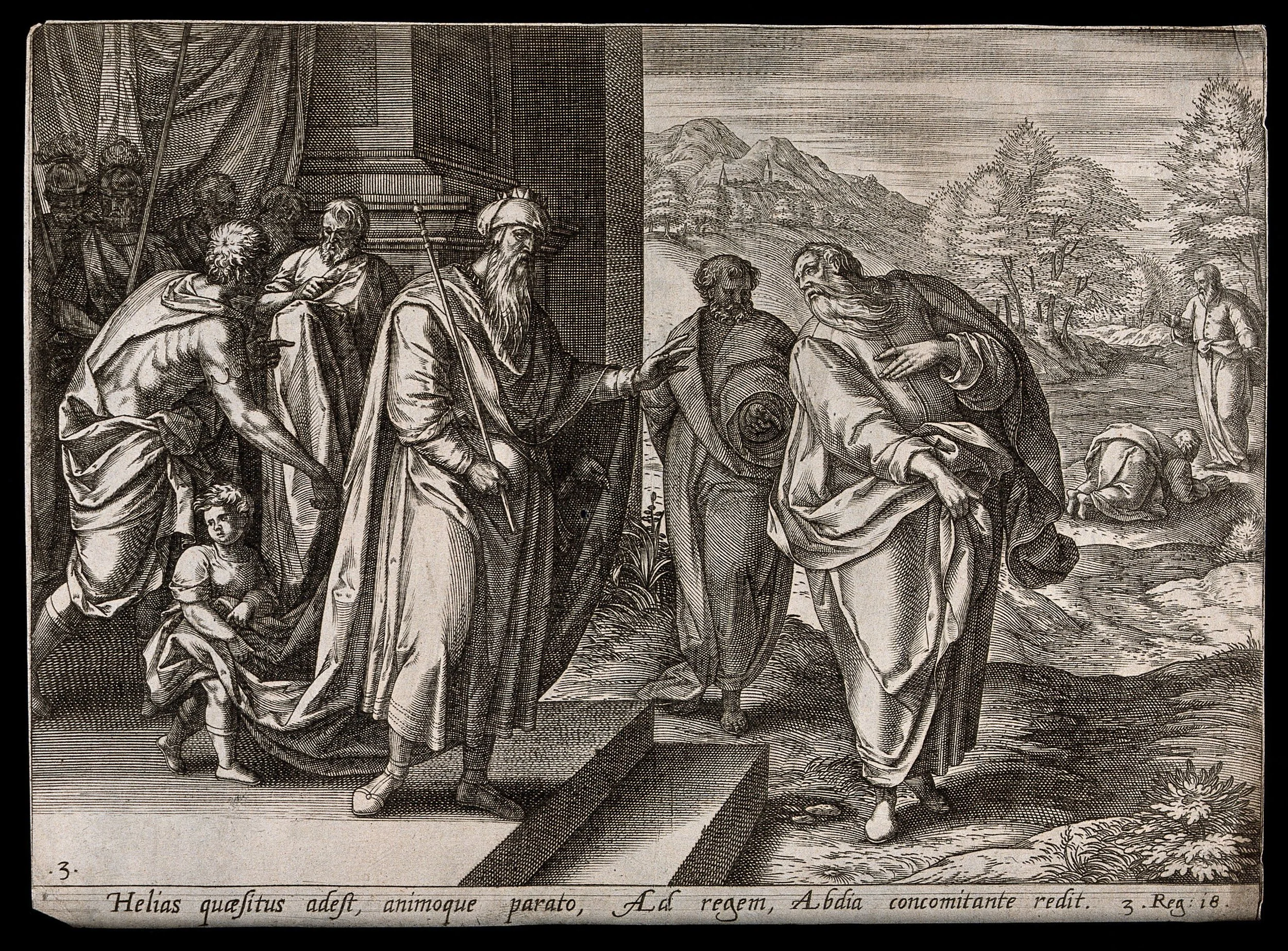
Elijah returns, with Obadiah, to confront King Ahab a second time (cf. 1 Kgs 18). In the background on the right we see Obadiah falling prostrate as he greets the man of God.
elijah… sending signals? of what?
The return of Elijah signals God's return to his people. God withdrew the gift of rain to punish the infidelity of Israel. Now God desires to relieve their suffering. The Lord makes himself present in the return of his prophet to the land of Israel. Elijah comes as much needed relief. Returning to the moment that Obadiah discovers Elijah, we recall his gratitude for the prophet's sudden reappearance. The name Obadiah in Hebrew means "worshiper or servant of the Lord." Obadiah represents the few who had remained faithful to the Lord in this time of apostasy and trial. There were also the hundred prophets that Obadiah rescued from Jezebel. When Elijah, on Mount Horeb, despairs of his efforts to convert the people, God informs him that he is not the only one left among Israel who had remained true. God states that there were seven thousand who did not bend the knee to Baal or kiss him with the mouth. God would spare them from the avenging swords of Hazael, Jehu, and Elisha. Obadiah and this small group of believers are the remnant of Israel. They are the faithful minority who refused to apostatize along with the majority. They are the few who will escape divine judgment. God brings relief to the kingdom of Ahab on their behalf. It is also for the faithful few that God shows his favor and protection. Elijah is sent for their sake. The Lord will not abandon the remnant. The faithful few can say with Elijah as he presents himself to Ahab: "Behold, YHWH is my God!"
Introducing St. Elijah
We begin with an exercise in what is called lectio continua (meaning “continuous reading”). It is a typical way of reading the scriptures with a monastic mind and heart. It takes commitment and a patience which is grounded in obedience. I keep going to the text even if I do not want to, even if I don’t like what it has to say because it challenges or find that it is not particularly inspiring. It is an intentional choice which helps to settle thoughts on one passage over a long period of time, allowing for a more profound experience of enrichment in the faithful reading of the Sacred Scriptures. Instead of reading short passages from different parts of the Bible in a haphazard manner, a particular book is chosen which is then read from start to finish.
Our focus now will zero in on what is called the Cycle of Elijah in the books of Kings (1 Kgs 17 – 2 Kgs 2). It is not a whole book from the Bible but it is a significant portion of the narrative in the two books of Kings. In fact, it is at the heart of the narrative. There is a reason for that: Elijah and Elisha appear as charismatic leaders who will guide Israel in the vacuum of responsible leadership. In this and following articles, we will enter into the exciting story of Elijah’s ministry as a prophet in the northern kingdom of Israel. I suggest that you read the whole story for yourself so that you will get the most out of these reflections.
We are not choosing these passages at random. Elijah is the spiritual father and leader of Carmelites. For centuries, his story has provided inspiration for all who number themselves among the sons of the prophets, that is every Carmelite. In praying with Elijah, we hope to receive some portion of his spirit in our own service of the Lord God.
The narrative in 1 Kings 17 commences with Elijah’s sudden appearance before king Ahab… His presence startles us! Pause and let the experience of the surprise wash over your consciousness. Where did he come from and who is this mysterious figure who boldly confronts the king of Israel without any apparent provocation?
1 Kings 17,1 narrates only the details of his personal name and origins. He is “Elijah the Tishbite, of Tishbe in Gilead.” The suddenness of the prophet’s appearance gives the impression that this is a peculiar kind of intervention – a divine intervention, God acting directly in the history of his people through the instrumentality of his prophet. This is God reaching out to correct… to chastise and punish the sin of his straying children, but the Lord is also reaching out to heal, lift up and strengthen. God is a Father and a physician.
Standing before Elijah in the place of Ahab, I ask myself how do I feel knowing that God can act so directly in my own life? Maybe, I didn’t know that he could, or would want to act, so immediately in my own life. On the one hand, the interruption could be annoying but on the other hand it is a deeply reassuring reality to know that God cares enough to approach me in love, to confront my sinfulness and call me back to himself. Now, that is the security of true love! Having this kind of God and Father, I know that I am safe! My heart rests in this truth for a moment…
Prophets are not usually our favorite people in the world. They challenge us and call us to reform. Who are the prophets in my life? A family member, a friend, someone in the workplace, a complete stranger? Maybe, the prophet was a priest who said something in a good confession that completely changed my way of thinking. I pray, “help me God to receive your messengers of grace when they come.”

Elijah from the Hebrew means: “My God is the Lord.” In his own person and by the name that the prophet bears, Elijah makes a statement before Ahab and the kingdom of Israel. Elijah himself is God’s prophetic utterance – God’s own response to his people. God sends Elijah to tell the king and Israel that the Lord is their God. The prophet is sent to bring about a conversion, a change of mind and heart. God, Father to “his firstborn son” (Ex 4, 22), must touch the hearts of all his sons and daughters, turning them to him. He will do so through Elijah who “arose like a fire,” and whose “word burned like a torch!” (Sir 48, 1).
Let’s review for a moment the nature of an intervention. An intervention is “the act or an instance of intervening; such as: the act of interfering with the outcome or course especially of a condition or process (as to prevent harm or improve functioning); the interference of a country in the affairs of another country for the purpose of compelling it to do or forbear doing certain acts; and finally an occurrence in which a person with a problem (such as a drug addiction) is confronted by a group (as of friends or family members) whose purpose is to compel the person to acknowledge and deal with the problem.” (Intervention, Merriam-Webster.com Dictionary).
God, in sending Elijah to Ahab, is doing all of the above. Ahab, by marrying a foreign queen from a pagan nation, has allowed the people to stray into idolatry by his example. It is worth noting that in the history of God’s people, the way that the king prays is the way that the people will pray. If the king is a faithful king, his people will remain faithful. If the king is unfaithful, then the whole nation is likely to break covenant with the Lord.
God is intervening in the process of secularization consequent of Israel’s idolatrous behavior – behavior, which in the end, will lead to exile. God does not want his people to go down that path of self-destruction, of annihilation. God is interfering in the politics of his people. They are supposed to be a nation peculiarly his own – a kingdom of priests. Elijah will eventually have to confront and deal with the prophets of Baal who enjoy favor in the royal court and eat at the table of queen Jezebel, the king’s wife. Ahab, in short, has problems and God wants him to deal with them. Elijah is cutting Ahab off at the pass…
Why Elijah? A man from Tishbe? Where is Tishbe in Gilead anyway? (It might help to look at a map at this point.) Who is Elijah but an apparent nobody? The logic in the choice of Elijah seems to display God’s perennial wisdom in choosing the foolish and what is weak to shame the wise and those who consider themselves strong. The apostle Paul explains:
“For consider your call, brethren; not many of you were wise according to the flesh, not many were powerful, not many were of noble birth; but God chose what is foolish in the world to shame the wise, God chose what is weak in the world to shame the strong, God chose what is low and despised in the world, even things that are not, to bring to nothing things that are, so that no flesh might boast in the presence of God.”
– 1 Cor 1, 26 – 30
We now come full circle. Elijah’s name means: “My God is the Lord”. A prophet from an obscure region of Israel will bring the powers that be in the northern kingdom to a standstill. No one will be able to boast in the presence of God. Elijah will prove forcefully in the events to now unfold in his ministry that the Lord, he is God! A God in whose presence all Israel stands. The text moves me to stand and to quietly acknowledge the presence of God. I resolve to carry this reverence of mind and heart with me as I move into the business of the day.
Like Elijah we must be prophets in our own time. Today, I am going to remind myself of this need to witness by repeating continually in my heart the words “My God is the Lord”. Today consider your call – a call to proclaim Jesus as the Lord of your life! He is God!
As the Lord God Lives
Prophecy – To Be Before God
The office of prophecy in Israel signifies a reality that has various meanings; and yet, before all else it is a stance before God. We see this in the person of Elijah, especially as he announces himself to Ahab in their first encounter.
A stance? By that word, I mean a real standing before the face of God – signifying an intimate encounter with the Divine. God is immediately present to his prophet by his imminence; he is close. This is the God who is “I Am.” As Cardinal Ratzinger would put it in his Introduction to Christianity: God reveals himself as “Being-for.” God, in so many ways, tells his people that he is God for them. God says, “I Am” here for you… (pg. 128). Yes, prophecy is a way of being before God… of being present to God who is already present to the individual and to his whole people. As St. Paul teaches, when speaking to the Athenians: “he is not far from each one of us, for ‘In him we live and move and have our being.’” (Acts 17, 27—28). This takes some thought. God, and for that matter Elijah, are not Ahab’s adversaries. This confrontation is not adversarial. God and his prophet are for Ahab and the kingdom. Elijah and the Lord God are Israel’s best promoters. It’s worth thinking about; because, sometimes, we think God is against us when things do not go our way. God is not standing in our way when he comes before us. The Lord is simply being present in love to the creature he has created. Take a moment to be before him… and let him be God for you!

For a prophet, especially like Elijah, this sense of always living and moving in God is particularly acute. The profession of the prophet is “to be” always before God. The prophet’s being is always radically directed to God and his presence. For Carmelites, we see how Elijah’s opening statement summarizes our entire vocation as religious.
“Where shall I go from your Spirit? Or where shall I flee from your presence?” (Ps 139, 7).
The action and movement within the narrative of Elijah’s doings, his comings and goings, are all prompted by God. Elijah is living within the framework of salvation history, which means the prophet is simply following God’s design for his people as it unfolds in time. God’s word and wisdom will direct the whole course of Elijah’s career. He is truly a man of God. The word of the Lord is a powerful force in the mind of Elijah. It seizes him at times and is the motive behind each step that he takes in his journeys:
After his initial encounter with Ahab, we are told that “…the word of the Lord came to him…” to direct him to the brook Cherith; from the wadi, Elijah is once again directed by a divine utterance: “…then the word of the Lord came to him…” and off he goes to the widow of Zarephath. After years of drought, it comes time to confront Ahab once more: “After many days the word of the Lord came to Elijah, in the third year…” and the contest is initiated by Divine command. As soon as Elijah offers the sacrifice on Mount Carmel, the word of the Lord takes the prophet in hand and seizes him: “And the hand of the Lord was on Elijah; and he girded up his loins and ran before Ahab to the entrance of Jezreel.” About a 15-mile run – a marathon sustained under the impetus of the Spirit! An angel instructs the desolate man of God in the wilderness as he flees the death threats of Jezebel, the angry queen… and God will speak to Elijah on Mount Horeb: “and there he came to a cave, and lodged there; and behold, the word of the Lord came to him, and he said to him.” In the Naboth affair, God pronounces sentence over king Ahab and Jezebel by speaking directly through Elijah: “then the word of the Lord came to Elijah the Tishbite…” Ahaziah comes to rule Israel after the death of his father Ahab and he too falls into the temptation of idolatry. Elijah is sent to confront this young king with a signal from God: “but the angel of the Lord said to Elijah the Tishbite…” Finally, it is time for Elijah’s departure and he is once more sent under the influence of God’s word: “…the Lord has sent me as far as Bethel… to Jericho… to the Jordan.” (1 Kgs 17,2; 17,8; 18,1; 18,46; 19,5-8; 19,9; 21,17; 2 Kgs 1,3; 2,2; 2,4; 2,6).
From start to finish Elijah is always under the direct influence of the word of the Lord: his hand upon him, his angel guiding his course. Elijah cannot operate except in response to the Word. We can assume that the very first confrontation with Ahab was also initiated by the Word at work in the mind and heart of the prophet. This then is the first feature of prophecy that we note in the career of Elijah – a complete openness to the Word of God. He runs in the way of God at his word. A prophet is one to whom God speaks directly, and the prophet in turn hears. His duty upon hearing, is to obey the divine utterances. There is almost a personification of the Word in these visits to the prophet, as if Elijah were experiencing God in a personal manner.
What is a Prophet?
Fr. Simeon, in his commentary on the Gospel of Matthew entitled Fire of Mercy Heart of the Word, defines a “prophet” (προφετης– from the verb προφεμι = to speak before) not as one who says things before they happen (interpreting the prefix προ - in the temporal sense); but, rather as one who goes before the face of God proclaiming his words and his will (the prefix in the spatial sense). (Vol. 1, pg. 70). To speak of a stance before God, or to stand before God, is to speak of going before the face of God. In the second moment, the prophet goes forth (still under the gaze of God, i.e., remaining before God / abiding in his presence) to proclaim his words and his will. And this is what Elijah is now doing as he stands before Ahab. By his own presence, Elijah brings the king of Israel to a face-to-face encounter with God.
Elijah declares before Ahab: “As the Lord the God of Israel lives, before whom I stand…” (1 Kgs 17, 1). Elijah is making a stand. He stands before God to serve him; but also, to pray, and finally to stand before the people. “For the Lord your God has chosen him out of all your tribes, to stand and minister in the name of the Lord, him and his sons forever.” (Dt 18, 5). He is God’s chosen instrument to serve him in this time of crisis – to call Israel back to the true worship of God. Elijah comes from his place of prayer to stand before God’s people who is represented in the person of the king. In this case Elijah stands with God and against Israel in their idolatry. Elijah is declaring that God cannot stand such infidelity, and will no longer tolerate it. God will now address the problem, and put his foot down. The prophet as God’s “stand-in” will become a stumbling block in the path of the king and his people. Elijah will prevent them from going any further down the path on which they are treading – a path that will lead to exile – a “standing apart” from God.
The first words out of the mouth of Elijah are: “As the Lord the God of Israel lives…” The prophet utters the divine name Lord (YHWH). This was the name given to Moses when he asked God what to say to the sons of Israel about the One who sent him to them. Elijah reaffirms the faith of Israel. He provides his credentials and presents himself as the Lord’s official representative. As an ambassador to the Divine, Elijah represents the God who lives (and is not dead like the idols of Baal and Asherah). God is: “I Am Who I Am.” The Lord has come to assert his rights over his people: “But this command I gave them, ‘Obey my voice, and I will be your God, and you shall be my people; and walk in all the way that I command you, that it may be well with you.’” (Jer 7, 23). God desires nothing more than the well-being of his people. Their spiritual health, as a kingdom and nation, depends upon whether or not they find themselves before God – to stand always in his presence. They will live insofar as they acknowledge that God lives and is living in their midst. Elijah speaks in order to call to obedience.
By these same words Elijah indicates that a formal oath is to follow. God is about to speak judgment over his people and over the false Gods they worship. And the only thing Israel can do is to stand before their God who loves them with a jealous love – who will not permit his children to stand anywhere else except in his presence. In this first encounter the prophet of Carmel has placed Israel before the living God! We too stand before the living God.
Neither Dew Nor Rain
Elijah and His Prophetic Oath:
"…there shall be neither dew nor rain these years, except by my word…" (1 Kgs 17, 1).
Elijah takes upon himself a formal oath. With the words, “As the Lord God lives…”, he solemnly invokes God to assert the truth of his present claim. The prophet will demonstrate that the living God and not Baal is the author of all life. The land of Israel will now languish as famine strikes under burden of the drought. It is a punishment for Israel's infidelity. God is chastising his children for having forsaken the covenant he made with their ancestors at Sinai. Elijah's words are a remote preparation for a renewal of that very covenant which will take place on the heights, not of Sinai, but of Mount Carmel.
Elijah is not only speaking to Israel, but he is also verbally challenging the strength of Baal. It is not the Canaanite deity who has power to open and to close the heavens. This is the prerogative of the Lord God of Israel. A line is drawn in the sand. What side will the people take? How long will they limp along with two opinions? It is a decisive moment. Let us place ourselves with Elijah in the present scene and ask this question in prayer: "Are there any among the false gods of the nations that can bring rain? Or can the heavens give showers? Are you not he, O Lord our God? We set our hope on you, for you do all these things." (Jer 14, 22).
Elijah wants Ahab and all God's people to turn into their hearts and ask this very same question. The prophet will use the drought as a means to provoke prayer out of parched souls. They must learn to acknowledge the Lord, the only God, and to set their hopes on him; for only he can give them the rain that they seek. The rain for which they will pray is not just water for the land which will become like an arid desert, but divine life for their souls.
Rain, A Blessing From Above:
(cf. “Rain” in Catholic Bible Dictionary; ed. Scott Hahn. New York: Doubleday, 2009.)
Briefly turning to the Sacred Scriptures, it is worth reflecting on the spiritual significance of rain. God waters the earth to give it life and as such it is an invaluable gift. God himself is compared to the blessing of rain. When the heavens open, it is perceived as a blessing and occasions a moment of joyful celebration. Turning to other gods for this precious gift was a supreme act of infidelity. Only God who created the heavens and the earth can open the skies to give rain or withhold it. The issue of rain becomes the matter for Israel's conversion. Rain symbolizes the grace that will be given that will cleanse the heart of God's people and give it new life.
Water in Israel is a precious resource - a necessary element in the daily life of the people living in that land. Rain was a tremendous blessing that comes from God who is in the heavens. In Deuteronomy, we hear this promise: "The Lord will open to you his good treasury the heavens, to give the rain of your land in its season and to bless all the work of your hands…" (Dt 28,12).
In the Psalms, God who is King of his people is compared to the blessing of rain: "May he be like rain that falls on the mown grass, like showers that water the earth! In his days may righteousness flourish, and peace abound, till the moon be no more!" (Ps 72, 6-7). The words of this Psalm were firstly a prayer spoken by king Solomon for his own sake that he might be life and peace for his kingdom. Solomon serves as a type of the Messiah King to come. Jesus will be rain that comes from heaven which brings the blessing of righteousness. God always wanted to be king over his people. They spurned his dominion and chose a king among men like the other nations. And yet the Davidic kingdom, while broken, would be restored by God's Son, the true Solomon. Through his Christ, God is now able to shower down his favor and exercise his loving dominion over all his people.
For a largely agricultural society, the yearly rains were essential; and, as such, were occasions for great rejoicing. We find an example of joyful expression for the blessing of rain in the book of the prophet Joel: "Be glad, O sons of Zion, and rejoice in the Lord, your God; for he has given the early rain for your vindication, he has poured down for you abundant rain, the early and the latter rain, as before." (Joel 2, 23).
Israel became hard-hearted in its idolatry, turning to other deities for a gift that can only come from the hand of God. What Jeremiah would say applies: "They do not say in their hearts, 'Let us fear the Lord our God, who gives the rain in its season, the autumn rain and the spring rain, and keeps for us the weeks appointed for the harvest.'" (Jer 5, 24). The northern kingdom could no longer discern the source of all their blessings. They lost the most fundamental virtue of religion: "fear of the Lord." They no longer acknowledged the God who guides the course of the seasons. So, God had to shut up the heavens by the mouth of Elijah. Will the people now lift their eyes to heaven, and call upon the name of the Lord?
The Drought, A Covenant Curse:
Among the many curses of the Old Covenant drought was considered among the most horrible. We hear God speak of this curse in several places:
"…and I will break the pride of your power, and I will make your heavens like iron and your earth like brass…" (Lev 26, 19).
"And the heavens over your head shall be brass, and the earth under you shall be iron. The Lord will make the rain of your land powder and dust; from heaven it shall come down upon you until you are destroyed." (Dt 28, 23-4).
Thinking about the nature of this particular covenant curse, it is clear that Elijah is not playing games. God, through his prophet, takes up a gamble to play for "keeps." Baal, Jezebel, and her prophets will prove to be the losers.
Several examples of hardship are given to show just how heavy a blow God is making against Ahab and his kingdom. The first example is to be seen in the prophet Elijah himself. The brook in Cherith will run dry forcing the man of God to move on and to trust in the meager means of a widow in gentile territory. The drought has also struck the land where the widow lives in Zarephath. She is reduced to nothing. She has a few sticks of wood, a little bit of oil and meal - the scarce remains of her resources, which will be used for one final meal for herself and her son and then "they will die." The famine was so severe in Samaria that King Ahab and Obadiah his chief servant would scour the whole kingdom for water and grass so as to keep the livestock from dying. Because of the hardship that the drought has caused, Ahab searches desperately for Elijah so as to take revenge on him for uttering judgment over the land and the people. It is an unhappy time! The drought has real consequences: the life of the land is being sucked out of the earth as all the water evaporates into thin air. All the hardship is due to the fact that Israel played the harlot, committing adultery against God as they served Baal: "Therefore the showers have been withheld, and the spring rain has not come; yet you have a harlot's brow, you refuse to be ashamed." (Jer 3,3).
The declaration of the drought is nothing other than a statement of the consequences for unfaithfulness to the covenant made with God on Sinai. Ahab, along with Jezebel, has been promoting the cult of a dead idol (who is mute and deaf) and cannot respond on any level to the desperate need that the drought has created. Baal is powerless before the living God. And the Lord wants his people to turn to him for life.
Athirst for God:
God is creating a thirst in the land. It cries out: "O God you are my God, I seek you, my soul thirsts for you; my flesh faints for you, as in a dry and weary land where no water is." (Ps 63, 1). Israel has become a dry and weary land. There is no water. The arid terrain reflects the state of Israel's soul. Do the people know why they thirst, or why their souls are parched? The text of the Psalm indicates that this is not just a physical thirst but one that is spiritual. The Psalm uses the word Nephesh, a Hebrew term, which in its literal meaning signifies the throat; neck; or breath. The word can be used for any living being. The soul is nothing other than "a living thirst" for God and the waters of divine life and grace. Israel's people are experiencing such a thirst as the water disappears from wadi and well. As a body they are a wide-open throat! It took a drought of the land for them to realize that their souls were already in drought - spiritually, the souls of God's people were without the waters of grace. It is interesting to note that the response of David who is praying this Psalm is to look upon the Lord in his sanctuary, beholding his power and glory. (Ps 63, 2). Maybe, just maybe, the people will look with their king to the Lord God and behold his power and glory.
Returning to the main point of Elijah's oath. The only reason for the prophet to make this solemn invocation, as he takes the stand, is to witness to the Lord God who lives. It is only the God of Israel who has power over the heavens to make it rain. God has already told his people in the wilderness:
"And if you will obey my commandments which I command you this day, to love the Lord your God, and to serve him with all your heart and with all your soul, he will give the rain for your land in its season, the early rain and the later rain, that you may gather in your grain and your wine and your oil. And he will give grass in your fields for your cattle, and you shall eat and be full. Take heed lest your heart be deceived, and you turn aside and serve other gods and worship them, and the anger of the Lord be kindled against you, and he shut up the heavens, so that there be no rain, and the land yield no fruit, and you perish quickly off the good land which the Lord gives you." (Dt 11: 13-17).
Elijah, in uttering this initial prophetic oath, is telling the people to "take heed" and to return to the Lord their God before it is too late. The drought is a mercy. It is a sign that something is wrong. The people will only look to heaven when they realize that it has been shut to them. Then they will ask the prophet to pray and the rains will come…
By the Brook Cherith
In past articles, we introduced the prophet Elijah and witnessed his initial encounter with Ahab, the king of Israel. He confronted the king for his infidelity to the Lord and announced a devastating drought. He has become a national threat and so God will provide him a means of escape: the Lord will hide his prophet in the brook Cherith…
Departure:
The first command that Elijah receives after his encounter with King Ahab is to:
“Depart from here and turn eastward…"(1 Kgs 17, 3).
God instructs his prophet to leave the scene of confrontation and to find a solitude which the Lord will show to him. Elijah begins a journey of faith with the Lord very much like the journey that the patriarch Abraham had made long before him in the land Canaan. The father of the Hebrew peoples was led out of his homeland of Ur into a country which he did not know. The journeying in itself in these instances of salvation history is a kind of divine pedagogy by which God teaches trust in his loving care. Elijah will begin his first lesson in abandonment to Divine Providence. In cases such as these, God never permits the use of roadmaps (imagine no GPS!). The word of the Lord is guide enough! There are many figures in the Old Testament who had to travel in such a manner.
Moses in his flight from Egypt to Midian, for example, comes to mind immediately. Moses seeing the plight of his people and witnessing firsthand the injustice of Pharaoh’s policy of oppression against the Hebrews, stands up to an Egyptian aggressor caught in the act of beating one of his own. Moses kills the unnamed Egyptian, hiding him in the sand. Fearing retaliation on the part of Pharaoh, Moses ventures into Midian, northwest Arabia, where he will spend 40 years. In other words, he will go East. This will not be lost time for the future leader of God’s people. It will be a time of learning: he will marry, begin a family, wait for God’s direction, and become a shepherd. Solitude is time away from all that is familiar. It is space in which God and his unfamiliar ways are contemplated. It seems that all God’s prophets come to recognize the following truth:
“…my thoughts are not your thoughts, neither are your ways my ways, says the lord...” (Is 55, 8)
Before moving on from the example of Moses and his personal plight, it is worth noting God’s attentiveness. God attends not only to Moses but also to the whole Hebrew nation. Moses could not hide from God just as Adam and Eve could not hide from God. Divine solicitude seeks out the lost and the frightened. God overcomes our fear by coming to us. God made the human person (you and me) for himself, and he knows each one of us intimately – we are fearfully, wonderfully made (cf. Ps 139). God knows us and follows all our movements. We can never escape him because he enfolds us in his love and surrounds us with his presence:
“Where shall I go from your spirit? or where shall I flee from your presence? if I ascend to heaven, you are there! if I make my bed in Sheol, you are there! if I take the wings of the morning and dwell in the uttermost parts of the sea, even there your hand shall lead me, and your right hand shall hold me.” (Ps 139, 7-10)
Elijah must now place himself in the hand of the Lord his God, who will lead him. God’s right hand and the strength of his grasp are images of his ability to act powerfully in the lives of those under his watchful eye. To be spiritual, one must realize that you can never be outside the all-encompassing presence of the Spirit. Heaven is not high enough, Sheol not deep enough, not even the expanse of the Seas or the distance of lands on the face of the Earth can separate us from the presence of God. This is important to understand because a three-year drought is about to begin in Israel. God will not fail his prophet. The Lord will provide. God has Elijah covered.
Elijah does not flee out of fear. That will come later under the threat of death coming from Queen Jezebel. Now as the prophet of Carmel begins his journey to Cherith, he responds in obedience to the Word of the Lord which has come to him. Elijah has already declared himself to be the servant of the Lord. God is the One before whom he stands. That he is the servant of the Lord is proved true by his “immediate and meticulous obedience to the divine word.” (New Jerome Biblical Commentary, 1 Kgs 17, 2-7).
God Provides Because He is the Lord:

As we follow the story of Elijah, we will notice how his journey will correspond in certain aspects with Israel’s time of wandering through the wilderness – the forty years during which God taught, and formed his people into a holy nation (i.e., a people who obeyed his word). When the people murmured in the desert against Moses and Aaron about the lack of food, Moses would complain:
“…what are we? Your murmurings are not against us but against the Lord” (Ex 16, 8).
So, the complaint about the want of provisions in the desert was ultimately directed against God – a demonstration of the people’s lack of faith. God responds:
“I have heard the murmurings of the sons of Israel; say to them, ‘At twilight you shall eat flesh, and in the morning, you shall be filled with bread; then you shall know that I am the Lord your God” (Ex 16, 12).
The drought which Elijah has now called upon the land of Israel is a divine utterance. God speaking through the mouth of his prophet brings about this time of hardship. He will make Israel a desert land (…and the desert will become a Carmel – “a garden wilderness”). It will become a classroom in which faith and trust in the Lord alone are learned. Will Ahab and the kingdom of Israel turn to God in their time of want, or will they turn to the Baals? In the meantime, Elijah demonstrates in his person the proper attitude – confidence and adherence to God’s command with simplicity and trust. He takes up his place by the wadi Cherith, he dwells there, and drinks from the brook while the ravens feed him “bread and meat in the morning, and bread and meat in the evening”. Most importantly, the prophet did not complain although the food was brought to him by animals which were considered under Hebrew custom to be unclean. Elijah teaches us to trust and to wait in solitude. God provides by mysterious means. He will not allow his faithful servants to go without the necessaries of life (natural and supernatural).
The Widow's Mite
In our last article on the prophet Elijah, we left him in the wadi Cherith sustained by the water running through the desert ravine. At this point in his journey, he received his daily portion of bread from the mouths of the ravens sent by God to feed the prophet of Carmel. We will now see how God’s providence continues in the life of Elijah, in very unexpected ways…
When the Water Runs Dry

"After some time… the wadi ran dry…" (1 Kgs 17, 7)
As the days of drought continue to draw on in length, the water levels of the wadi begin to decrease. The course of the stream does not flow as swiftly. Pretty soon there is more bank than stream. The water continues to disappear as the bed of the wadi Cherith appears. The stream bed turns into a mess of mire and mud, and is now completely undrinkable. Elijah knows that he has to move on in order to survive, but he does not leave the wadi Cherith until the word of the Lord comes to him. Elijah continues to remain in a spirit of total abandonment. In some sense, the dryness is setting him free. There has to be a detachment even from the water which God provides. Elijah, in freedom of spirit, will move on… He is ready for God to lead him.
Getting up to Go
"Arise, go to Zarephath of Sidon and stay there. I have commanded a widow there to feed you." (1 Kgs 17, 9)
The word of the Lord does come and the divine command surprises Elijah: he is supposed to Arise and go to Zarephath to find a widow who will care for him. It is a long journey (ca. 100 miles) into gentile territory, a region traditionally hostile to the people of Israel. Yet, it will be in this foreign land that the prophet enjoys the hospitality of a widow, becoming a member of her household. God's providence works in a mysterious way. Elijah trusts, he does not argue with God at the seeming impossibility of his demand. The prophet gets up and goes and seeks out the help of a helpless widow.
As Elijah arrives at the entrance of Zarephath he sees the widow of whom God spoke. He watches her silently as she picks up sticks on the ground. She is going to build a fire. The wood she gathers are branches fallen from the trees which have withered up in the heat. Everything is brown and dry. The bright sun, shining in the blue and cloudless sky, continues to bake the land. Despite the heat bearing down on her brow and back, the widow dressed in her black garments of mourning continues resolutely in her task. God has commanded her to provide.

Elijah finally speaks. Is he breaking custom by asking this woman for a cupful of water? It doesn't matter, God commanded him to seek out her hospitality. She willingly assents to the request and goes to fetch water for the man of God. Perhaps, she is hoping for a prophet's reward? Elijah pushes her hospitality to the limits when he asks for bread to eat. The widow admits the limits of what she is able to provide. She and her son are on the verge of death. There is nothing in her cupboard except for a handful of flour and little oil in a jug. Elijah responds: "Do not be afraid. Go and do as you have said. But first make me a little cake and bring it to me. Afterwards you can prepare something for yourself and your son. For the Lord, the God of Israel, says: The jar of flour shall not go empty, nor the jug of oil run dry, until the day when the Lord sends rain upon the earth." (1 Kgs 17, 13-14).
Despite the impossibility of the demand the woman goes and does as Elijah had said. Elijah, the widow and her son, along with her household will live from hand to mouth for the remaining period of the drought. God will not fill the jar of flour to the top nor will the Lord make the jug of oil overflow its own brim. Instead, the Lord will provide what is sufficient for the day. Just like the manna in the desert. The Israelites were only supposed to collect enough for the present day. The miracle is that the widow trusted, and provided for all. God responded to her faith and did not let the jar of flour go empty or the jug of oil run dry. God works in unexpected ways and through unexpected means. Of all people, the widow and her mite became the means by which God would sustain his mighty prophet.
Being Unafraid
"Do not be afraid. Go and do as you have said." (1 Kgs 17, 13)
At the heart of the narrative is Elijah's encouragement: "Do not be afraid." The widow is intimidated by the thought of her poverty. The famine has left her destitute and she is resigned to die along with her son. We can only imagine how the widow felt, knowing that not only her death but also the death of her son was imminent. Elijah addresses her fear: "Do not be afraid..."
It is easy to give into fear in the experience of poverty and to hold onto what we have, for dear life. To feel limits, both material and spiritual, is a concrete reminder that human life is contingent. Everything depends upon the material resources that keep us alive: food, clothing, housing and the other necessities of life. It is hard to think that most of the world lives without the basic provisions necessary for life. It is hard to think that many people go to bed hungry every night.
Elijah makes a promise. He is confident in the God who has already provided for him in the wilderness. He prophesies: the jar of flour shall not go empty, nor the jug of oil... When we feel empty and without, it is precisely in that moment to go and do as God commands. Sometimes, we do not feel like we have anything to give; and yet, we must not be afraid of our personal poverty. That would be a temptation to self-reliance and evidence a spirit of self-interest. Rather, in our personal poverty, we need to see the very condition in which the Holy Spirit works. Truly, blessed are the Poor in Spirit for it is then that the Spirit of God reigns over the soul.
Thinking of this blessing – to be poor in spirit – we should ask God for the same freedom to trust that we see in the prophet of Carmel, praying: “Lord, I want to trust like Elijah and the widow who helped him in his time of need. I pray that I will be confident of your providence, surprised by the means that you use to care for me.” In times of want, whether the need is temporal or spiritual, we should not forget the goodness of God. In prosperity we do tend to forget God, and we get self-reliant. But then a time of difficulty arises and, in the adversity there is an opportunity to remember God and turn to him.
As a Carmelite religious, I am grateful for my own life of vowed poverty. It provides the opportunity to always live from the hand of God. I do not need to take care of myself, and it is an absolute necessity that I not give into a spirit of acquisition by which I would freely reach out and take for myself – to provide for myself. So, I ask God to help me to love poverty and to remain poor. Every Christian must learn to follow Christ with this same kind of simplicity and trust.
The Widow’s Might:
The widow a foreigner and a gentile, the prototypical example of the poor in Old Testament literature, in a complete reversal of roles is the one who provides out of her own want for the prophet Elijah. It is a reminder for all of us who may or may not have the means to provide for the poor, the hungry, the naked, and the homeless. With whatever means we possess we are to give... God will bless and multiply whatever we offer in the name of charity. We should stop and pray for a moment: “Jesus, I pray for the widow's might. I do not want to be afraid in the face of my own poverty. There are so many people who need you. I want to bring you to them, who are the Bread come down from Heaven; food for the life of the World. Amen.”
See Your Son is Alive!
"Now indeed I know that you are a man of God,
and it is truly the word of the Lord that you speak."

Woodcut for "Die Bibel in Bildern", 1860, by Julius Schnorr von Carolsfeld (1794–1872), Public Domain, via Wikimedia Commons
We continue to follow Elijah in his journeys. In our present meditation, we find him still living with the widow of Zarephath and her son. Unfortunately, tragedy has struck the home of the widow as her son suffers from a mysterious illness and dies. The prophet is called to account. Will Elijah be able to do something about this horrible situation in the life of this widow, who has shown him such great hospitality at the command of God?
The Widow's Son Dies:
I imagine the woman sitting in a room of her house on the lower floor. Her child lays upon her lap. She attends to every breath in his illness. The breathing becomes more labored and then there is the death rattle. Her pain is to watch her child struggle for life and to die there in her arms (the widow seems almost a type of Mary who at the foot of the Cross watched her Son Jesus suffer and struggle until he breathed his last breath).
Elijah remains in his room on the upper level. Perhaps, the suffering of the woman and her child is too much for him to bear. Is he afraid of breathing in himself the illness of the widow’s son? Does he feel helpless? Maybe, he just wants to give the woman space in her great suffering. He finally comes down the stairs and is greeted by the woman's anger. He is a guest in her house and she understands that the "man of God" has brought disaster upon her for her guilt. She asks, "why?" It is a challenge: "Why have you done this to me, man of God? Have you come to me to call attention to my guilt and to kill my son?" Elijah does not respond. There are no words because he too does not understand these tragic circumstances.
The Heart of the Prophet is Moved with Compassion:
The prophet is moved to take the child from his mother in an act of compassion. He is lifting the burden, the weight of the dead body which is the widow's son. He will carry the lifeless child to his room and present him to the Lord God. Only God has power over life and death. It is the God of Elijah who has the ability to restore this son to his widowed mother. After all, this widow has nothing else in this world. Her son was the only thing between her and total destitution. Elijah feels responsible. He calls upon his God. Remember, Elijah's name means "the Lord is my God." Elijah, trusting his intimate ties to the Lord, prays in supplication: "Lord, my God, will you afflict even the widow with whom I am staying by killing her son?"
The prayer of Elijah is revealing. He bears in his heart the burden of having caused affliction not only in this widow's home but also in all the land of Israel. Although it was Elijah's duty to pronounce sentence over Ahab and his kingdom by calling a drought upon Israel and the surrounding region, the prophet cannot but help to feel the pain of that sentence. It is a kind of vicarious suffering which is reparative. He suffers on behalf of the people. The change of heart which we will see in Israel will be the result of the miracles, the prayers, and the sufferings of Elijah. All these work together to make the ministry of Elijah truly effective before the people; such that, he will come to be known as a man of God. There is no greater distinction than to be known as God's friend and servant.
Elijah's actions are mysterious at this point. He stretches himself three times over the child who is lying lifeless on his bed. It almost seems as if the man of God wants to lay down his life for the life of the child - to exchange his life for the child. He prostrates himself over the child in an act of extreme distress. He has no other way to demonstrate to God his total inability. "If only the child would rise!," is Elijah's thought as he removes himself each time from the child. (Jesus would eventually lay down his life for us and take it up again in order to bring us to new life with him. Jesus states: "I am the good shepherd. A good shepherd lays down his life for the sheep... I am the good shepherd, and I know mine and mine know me, just as the Father knows me and I know the Father; and I will lay down my life for the sheep... This is why the Father loves me, because I lay down my life in order to take it up again. No one takes it from me, but I lay it down on my own. I have power to lay it down, and power to take it up again. This command I have received from my Father." cf. Jn 10: 11, 14-15, 17-18). Elijah is not God but a man of God. He cannot restore life himself, but his word is powerful enough to find a hearing in the presence of the Lord.
The Breath of God:

The Prophet Elijah Raises the Widow’s Son from Death by Louise Hersent, Public domain, via Wikimedia Commons
Elijah calls out to the Lord: "Lord, my God, let the life breath return to the body of this child." The Lord hears the prayer of Elijah and the life breath returns to the lifeless form of the boy and it gives him new life. In the Genesis account of man's creation, we hear how God forms man out of the dust of the ground and blows into his nostrils the breath of life. God's own Spirit is in the divine breath and enters into the man to make him a living being. Man's life then is not only natural but above all supernatural - not just physical but spiritual. The life breath is the principle of man's being. When the sins of men increase beyond repair, God decides to withdraw that breath: "My spirit shall not remain in human beings forever, because they are only flesh." (Gen 6: 3). The consequence of God's withdrawal is that the lifespan of man decreases dramatically: "Their days shall comprise one hundred and twenty years." (as opposed to the 969 years of Methuselah, cf. Gen 5: 27; 6: 3).
There are other instances where the divine breath is imparted to give life to the human person. We could recall for instance Ezekiel's vision of the dry bones. The Lord God commands the prophet to prophesy over the bones: "Thus says the Lord God to these bones: Listen! I will make breath enter you so you may come to life. I will put sinews on you, make flesh grow over you, cover you with skin, and put breath into you so you may come to life. Then you shall know that I am the Lord." (Ezek 37: 5-6). Ezekiel prophesied and the bones came together with a thunderous rattle. The bones were then embodied but they did not come to life because there was no breath in them. The Lord instructs his prophet once more: "Prophesy to the breath, prophesy son of man! Say to the breath: Thus says the Lord God: From the four winds come, O breath, and breathe into these slain that they may come to life." (Ezek 37: 9). Ezekiel did as he was commanded and the breath entered them and the bodies of the slain came to life and stood on their feet as a vast army!
Jesus, after his resurrection would breathe upon his disciples in?... where?... the upper room! He imparts the power to forgive sin to his disciples with the words, "Receive the Holy Spirit" so that they might bring those who were dead in sin to life in the Spirit. Elijah's miracle points to this event, showing us where the source of all life for the children of men comes... the Holy Spirit, the Breath of God.
A Man of God:
We are now at a turning point in the narrative. Miracles demonstrate the power of God. They often accompany the word of the Lord to confirm its truth. The legitimacy of a prophet was determined by two factors: 1.) their predictions were fulfilled; and, 2.) their prophecy conforms to the known revelation of God. ( Catholic Bible Dictionary, ed. Scott Hahn, PhD, "Prophet"). Deuteronomy illustrates the issue: "Should you say to yourselves, 'How can we recognize that a word is one the Lord has not spoken?', if a prophet speaks in the name of the Lord but the word does not come true, it is a word the Lord did not speak. The prophet has spoken it presumptuously; do not fear him." (Dt 18: 21-22). Every word Elijah has spoken up to this point has had its fulfillment. The woman is convinced: "Now indeed I know that you are a man of God, and it is truly the word of the Lord that you speak."
I can only imagine how Elijah felt when he could say to the widow: "See! Your son is alive." There is a parallel here to the raising of the son of the Widow of Nain in Jesus' own ministry.
God is asking us also, as his disciples, to truly be men and women of God. We must be authentic, practicing what we preach. We must also show a genuine concern for those who ask for our prayers. We cannot live in isolation. The whole Church must be present to us in our times of silence, solitude, and prayer. We must exhibit the compassion of God in our lives.
The statutes of the hermitage speak well to this point:
"Our way of life is monastic and eremitical. It is ordered to the contemplation of God in silence and solitude. It is not, on that account, less fraternal or apostolic, for the whole Church is present to us in our solitude. Although we are separated in space from the congregation of the faithful, yet we are bound together with them all by love in the unity of faith; though they are absent in the flesh, they are near at hand in the mystical unity of the Church."
(Statutes of the Carmelite Hermitage of the Blessed Virgin Mary, #8).
With Elijah let us pray for the healing of our own world. We pray that God may raise us all up in renewal through life in his Spirit.