Light for the Way, Love for the Wayfaring

St. John of the Cross
John Paul II in speaking to the bishops of Austria said: "Your first duty as pastors is not projects and organizations, but to lead your people to a deep intimacy with the Trinity.” (as cited by Thomas Dubay in Deep Conversion/Deep Prayer, pg. 5). The fact is that it is extremely hard to find a good spiritual director. Priests are very busy with their daily responsibilities in the parishes they serve. The demands on them have only increased in recent years. And yet, the words of Pope St. John Paul II remain true. The first responsibility of a shepherd of souls is to lead the sheep under his care to divine intimacy, to guide them to a place where they will find rest and safety in God, especially in a world so filled with dangers.
John of the Cross understood the primacy of this duty in his own life as a Priest and Carmelite. He spent many hours in the confessional, and in directing persons in all walks of life. Light for the Way, Love for the Wayfaring is intended as a response to the need for finding good spiritual direction. It is a straightforward exploration of the teaching of St. John of the Cross as it is distilled in his Sayings of Light and Love. They were originally written for people under his care as a spiritual guide. They are an answer to real questions about prayer and the interior life. For this reason, his advice is perennial. As you explore the following articles, it is our hope that you find light for your own journey and the love necessary to persevere in prayer.
The benefit of turning to St. John of the Cross for spiritual direction is that he has been named the Doctor Mysticus by the Church. He is the universal teacher of the mystical life and has traveled roads of prayer that very few have found themselves, much less had the courage to remain upon so as to arrive at the end which is union with God. In John of the Cross, you will find a guide, a companion and a support. Please take a moment to pray with all that he has to say, you will not regret the time and effort needed to pierce these pearls of great price.
"One Human Thought"
Sayings of Light and Love, #35
God’s Thoughts (Of You!)
Before we talk about the nature and worth of one human thought, I would like to speak for a little bit about the thoughts of God. As we will see, this is a pretty difficult thing to do. Who can possibly pretend to know the mind of God? However, God is placing an invitation into our hands at this very moment through our considerations. He is inviting us to think with his own mind.
The Lord is inviting each of us to consider his thoughts and his ways. But why? Because we think too little of God and what is more, we think wrongly of him. We second guess God, we doubt him, and are afraid of his judgments. Really, we hold him in very low esteem. Our estimates of his love for us fall very short of the reality. It is sinful to doubt God’s love for us, plain and simple. So, from Isaiah we hear:
“…let the wicked forsake his way, and the unrighteous man his thoughts; let him return to the Lord, that he may have mercy on him, and to our God, for he will abundantly pardon. For my thoughts are not your thoughts, neither are your ways my ways, says the Lord. For as the heavens are higher than the earth, so are my ways higher than your ways and my thoughts than your thoughts.” (Is 55:7-9)
The text is pretty clear. It is impossible for the human person to penetrate the mind of God. One of God’s thoughts far surpasses any one of our own thoughts or all of our thinking as a whole. His ways are far beyond our own. We are earthly and God is heavenly, his ways and thinking supernatural and divine and ours natural and human. Clearly, we need to learn to think of God differently. But first we must just think of him and his love for us.
The Rule of St. Albert, the guiding document for Carmelite Life tells the religious of Carmel to guard the heart with a holy thought. We will set our minds now on one consideration only – a thought which we may find unbelievable but quite true. What is that thought? Well: “God loves you!” This is not just positive thinking. Nor is prayer simply the power of looking at the brighter side of things. [1] Prayer and meditation, if it is to be real, must be based in the truth – that is in reality. We have to see things (i.e. understand with the intellect) things as they are. As it is, God is thinking of you at this very moment. In so doing, he has willed you into existence by his eternal thoughts of you. He did not happen to think of you by chance. You are not a mistake; rather you are an unrepeatable work of his loving wisdom.
God is Looking (at You!) | Another Thought…
John of the Cross speaking of God’s glance explains: “for God to look is for him to love.” (Spiritual Canticle, St. 32, 3). As we consider God’s thoughts, we must also take time to think about this one fact: God is looking at you right now. Let him behold you, let him love you! Is it hard for you to remain under his loving gaze? We are trying to find out what is behind those eyes which are beholding us at this very moment. We want to know God’s thoughts.
Do you feel like he is looking right through you? Afterall, God has the power to look into the human heart. He does not just see the appearance of things (cf. 1 S 16:7). We can ask of God as he looks: “Do you have eyes of flesh? Do you see as man sees?” (Jb 10:4). God’s eyes are not the eyes of another man or woman and his look is not merely human. The Lord sees in a divine manner, that is, he sees as God. He looks upon us always… from our birth and even from our first moments in the womb. We cannot hide from him. There is no place too dark for him or too distant. With the psalmist we declare:
“O Lord, you have searched me and known me! ...Your eyes beheld my unformed substance; in your book were written, every one of them, the days that were formed for me, when as yet there was none of them. How precious to me are your thoughts, O God! How vast is the sum of them!” (Ps 139:1, 16-17).
We ask God to search and know our hearts to try and test our thoughts. Knowing his thoughts, how can we not think of him continually?
Human Thought
(What are You Thinking About?)
The Human Person
The Human person is defined as: “an individual substance of a rational nature” (Boethius). This means that thinking is essential to being human. It is at the essence of who we are as individual persons before God and other persons, both angelic and human. We are created in the image and likeness of God. The interior world of thought points to this very fact and it separates us from the rest of earthly creation. To understand ourselves more completely, we need to look into our thoughts.
Human Thought | A Definition
Let us begin with a definition or two. “The terms thought and thinking refer to cognitive processes that can happen independently of sensory stimulation.” [2] The most usual forms of thought and thinking are judging, reasoning, concept formation, problem solving, and deliberation. The realm of human thought also encompasses other mental processes like considering an idea, remembering in the memory, or imagining with the imagination. In the widest sense, thought may be understood as any mental event which consists in a form of thinking, including perception and unconscious mental processes. [3] It is important to know what we are thinking and how much we engage in this activity. Knowing these things will help us to perceive how central thinking is to our way of being human.
There is a myth going around the world wide web which claims that the average person has 70,000 thoughts per day. If this is true, and not myth, that means you and I are capable of 3,000 thoughts per hour or 50 per minute – roughly just under one per second. Other popular figures propose: 15k; 60k; 12k to 50k. None of these estimates seem to come with a citation. [4]
According to another source, the average person will have about 6,200 thoughts per day. [5] It is safe to say that counting our thoughts is an inexact science. Even so, just think about your thinking. A few moments will provide you with enough evidence that we are thinking all the time, awake and asleep (if you count dreaming as a mental event, constituting a thought process). Boethius’ definition seems most accurate. The human person is an individual substance of a rational nature. Thinking is essential to our being a man or a woman.
What does this mean? It means that our thoughts are very important. Given that we spend so much lifetime in this activity, it might be worth asking: what are we thinking about? Such a question, and the examination of our thoughts, is not a useless or mindless activity – a waste of time. Philosophy speaks of the importance of such musings. I’ll never forget one of the first lessons I learned in philosophy: “the unexamined life is a life not worth living”, a saying attributed to Socrates and recorded by Plato in his Apology.[6] We are going to take the time now to examine our thoughts and ask what is the true worth of all our thinking?
[Nota Bene: Our main enemy to thoughtfulness or what is more popularly termed mindfulness is scrolling on devices, social media, and other forms of mindless wasting of time.]
The True Worth of Human Thought
St. John of the Cross has much to say about human thought. He highly prizes this activity. In fact, human thought is so precious in his mind, that he explains that it belongs to God alone. This teacher on the mystical life will instruct us to fix our thoughts on God continually. From his Sayings, we hear:
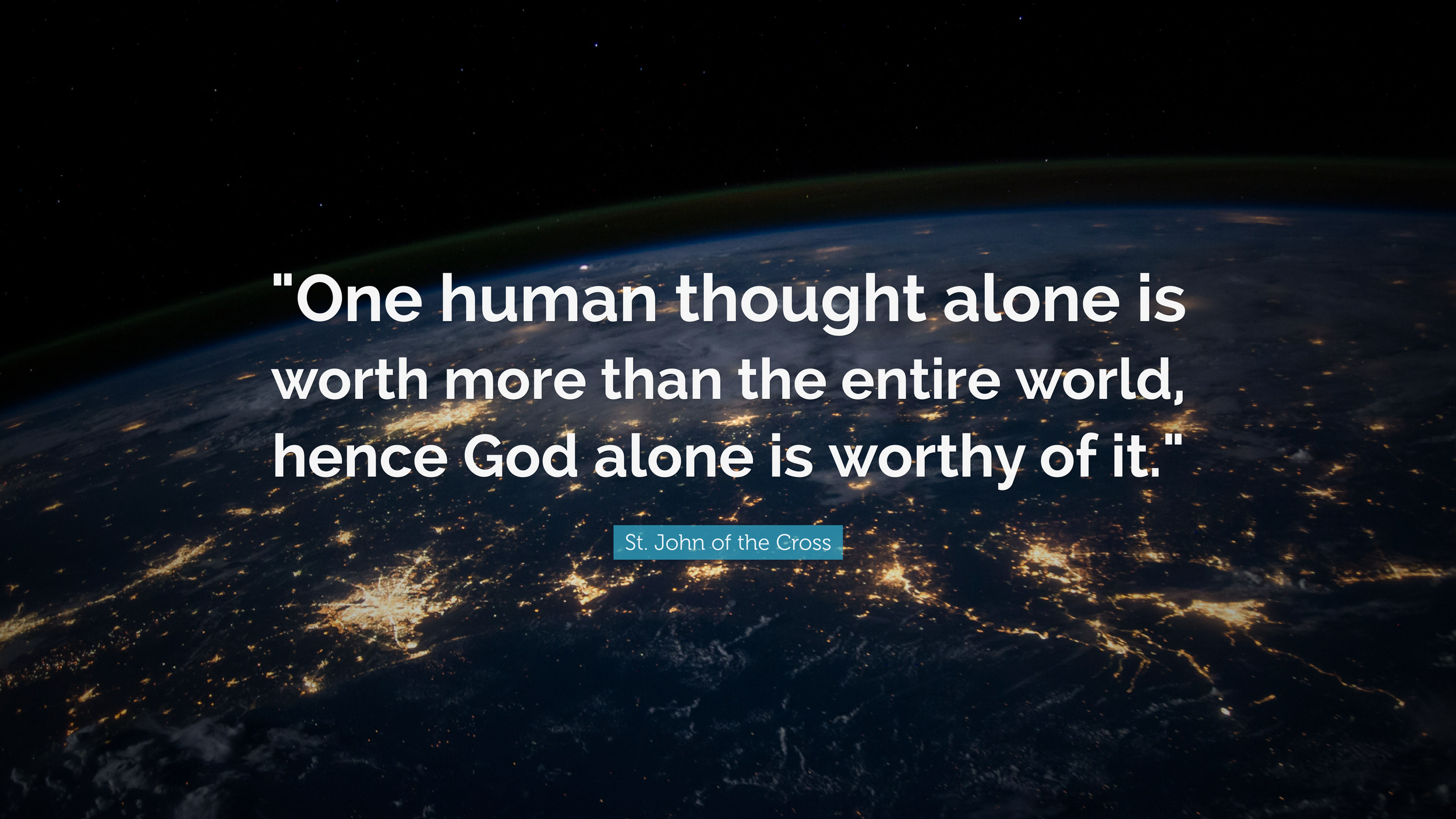
“One human thought alone is worth more than the entire world, hence God alone is worthy of it.”
Sayings of light and Love, #35
In our first saying from St. John of the Cross, we have to remember that we are unique among God’s creatures, in that we are made in his image and likeness. We are images of God’s own Word and Wisdom. Unlike the rest of creation, we have the ability to think and reason. The human person has received this gift so that he or she might always be thinking of God, calling him to mind, and speaking to him. These thoughts are precious to God, so much so, that they mean more to him than all of the beautiful universe put together! Remembering God becomes a precious gift which we can offer Our Father in Heaven every moment of the day.
This is not all. John of the Cross continues to unfold the true worth of human thought in the following:
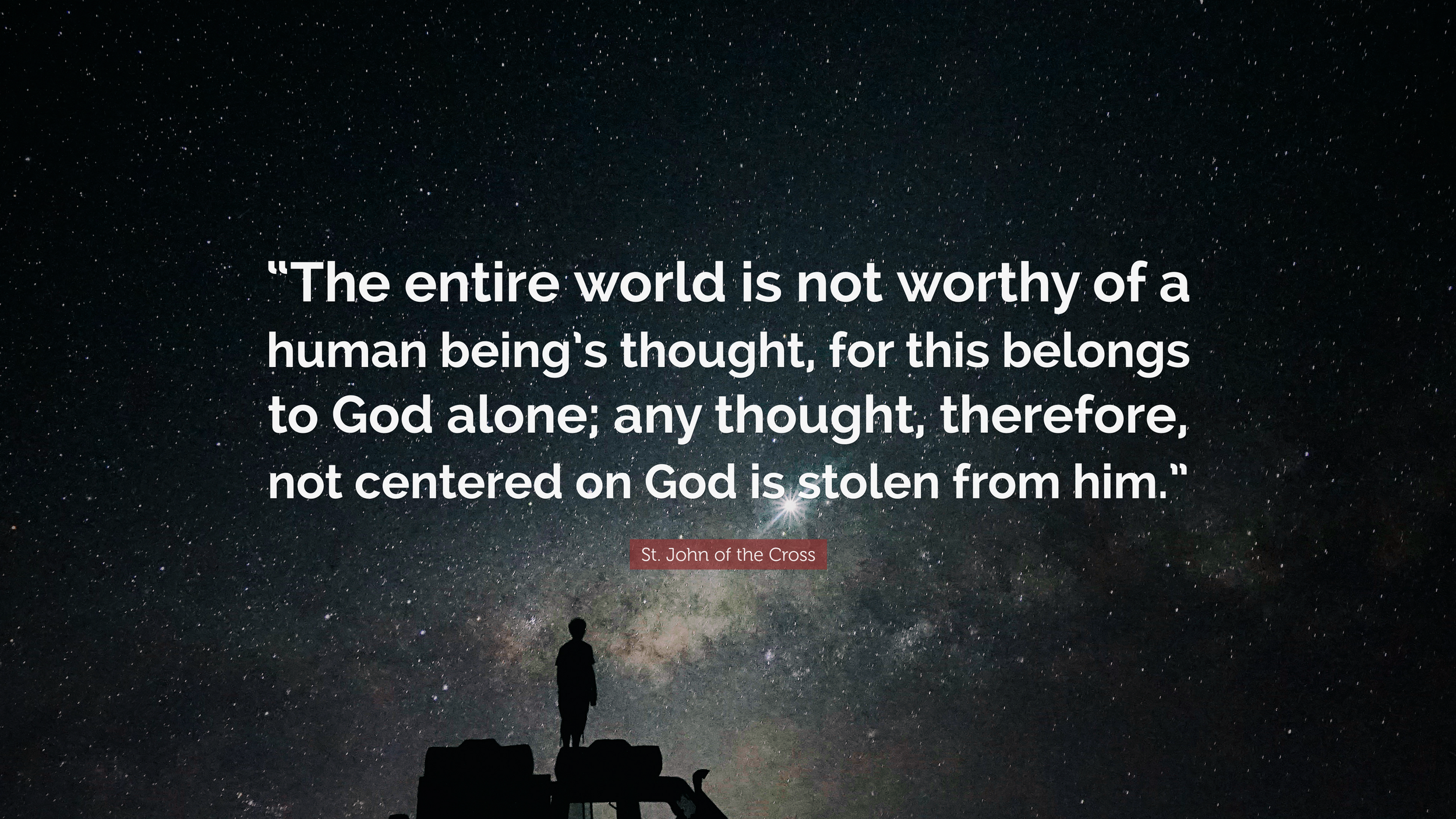
“The entire world is not worthy of a human being’s thought, for this belongs to God alone;
any thought, therefore, not centered on God is stolen from him.”
Sayings of Light and love, #116
Sayings of Light and Love, #116.
This is a hefty statement: any thought…not centered on God is stolen from Him! Who would want to steal from God? That sounds almost impossible. And yet, this is what is so amazing about human freedom. We can keep from God what is most precious to him. How do we do such a thing? By refusing to acknowledge God as God. Some will even purposely disbelieve in his existence. Others ignore his commands by thinking and doing what they want without any regard to his Law. On a more ordinary basis, there is the refusal to pray or the issue of getting so caught up in activity that we forget God and neglect the practice of his presence. We doubt God or we are afraid of him. We think wrongly of God in difficulties, trials, temptations, and sufferings, blaming God for all the evil that we are faced with in this world.
A little note before moving onto another insight: …the entire world is not worthy of a human being’s thought… We think about all kinds of things pertaining to human life: food, clothing, our possessions, jobs, study, recreations. Well, the list could go on and fill the whole world. Guess what? A lot of this thinking is absolutely useless. All the anxiety and worry are just not worth it!
The Relationship between thought and Love
At the heart of John of the Cross’ Saying, is the association between love and thought. To think of another is to love that person. This is true, as we have already seen above, when God thinks of us. It is also true when we think of him. God loves me when thinking of me, and I love him when I am thinking of him. As he said to some saint somewhere (I think St. Catherine of Siena): “Think of me, and I will think of you!”
Next musing: Recall how many thoughts we have in a day. How many are centered on God? We lack focus. We zero in on the natural and never look to the supernatural in our life. Our minds are too full of distractions, preoccupations, worry, anxiety, and self-concern. If we allow our thoughts to run away from the remembrance of God, we are literally running away with gifts that could be given to him. There is nothing more recollecting than making an act of faith. Taking moments throughout the day to remember God is a wonderful way of making a return to the Creator who has given us everything. In an instant, with one thought, you could give something to God that is worth more to him than the whole world. Think about that for a moment!
Thinking of God (Prayer)
Here are some ways by which we can make thinking of God a habit of life:
Lifting Heart and Mind to God when rising from Sleep. In the morning, when waking after a night of rest, we may offer our first thoughts of the day to God, by lifting up mind and heart to him as we get out of bed. (This practice could include a Daily Offering to the Sacred Heart of Jesus, and a Daily Consecration to the Blessed Virgin Mary. A perfect example of this kind of prayer is the Breastplate of St. Patrick… “As I Arise Today, etc.”)
Daily Mass. There is no better way to start the day. For those who do not go to daily Mass, I challenge them to try it out. Trust me, you will notice the difference.
Daily Prayer at set times. By this I mean morning and night prayers, the Angelus, the Rosary, devotions, and even the Liturgy of the Hours.
Meditation, especially on the Sacred Scriptures. The daily readings for those who will be going to Mass that day is perfect material for prayerful reading. Lectio Divina is a time-tested form of meditation, which serves as a basis for the gift of contemplation. It is also a great way to learn admiration for God and his works.
Spiritual Reading. Read about the saints and learn from them how to love God. Find good books on the practice of prayer. Works of theology, too, will help us to train our thoughts on God.
Practice of the Presence of God. This is a wonderful practice for busy people. If you get used to this way of prayer, you will find yourself thinking of God in every and any situation… at all times!
Mental Prayer.[7]
Short Prayers. To be used in association with the practice of the presence of God.
This is just a short list of ways in which you might form the habit of thinking of God. Remember, just one thought is enough to give God a gift worth more than the whole world. If you are not at the point of thinking of God continually, start somewhere, and just think of him! He is already thinking of you and will never cease to do so. He loves you! Give God a gift today which is greater than all the world, a gift which is worthy of God alone.
Endnotes
[1] I once had a conversation about prayer with a medical technician at a health clinic. I was recommending it as a remedy when facing the troubles of our times. The tech, quickly taking everything in that I was saying, exclaimed: “There is nothing like the power of positive thinking.” I was surprised and didn’t know what to say. The woman had no concept of the supernatural character of prayer – that when we pray, we are actually talking with God. Prayer is not simply the power of positive thinking! How often did thinking positive thoughts undo the negatives in your life? Prayer is not self-coaching! Prayer is a gift which places us in a loving dialogue with our Creator. He is waiting for you. Go to prayer!
[2] Wikipedia contributors. “Thought.” Wikipedia, 16 Mar. 2025, en.wikipedia.org/wiki/Thought.
[3] Ibid., Thought.
[4] Neuroskeptic. “The 70,000 Thoughts per Day Myth?” Discover Magazine, 19 May 2020, www.discovermagazine.com/mind/the-70-000-thoughts-per-day-myth.
[5] Murdock, Jason. “Humans Have More Than 6,000 Thoughts per Day, Psychologists Discover.” Newsweek, 15 July 2020, www.newsweek.com/humans-6000-thoughts-every-day-1517963. (A statistic published in a paper entitled Nature Communications by a team of psychology experts at Queen’s University in Canada).
[6] Wikipedia contributors. “The Unexamined Life Is Not Worth Living.” Wikipedia, 20 Jan. 2025, en.wikipedia.org/wiki/The unexamined_life_is_not_worth_living.
[7] St. Therese’s description of her mental prayer as a child: “I think!” [“At this time in my life nobody had ever taught me how to make mental prayer, and yet I had a great desire to make it. Marie, finding me pious enough, allowed me to make only my vocal prayers. One day, one of my teachers at the Abbey asked me what I did on my free afternoons when I was alone. I told her I went behind my bed in an empty space which was there, and that it was easy to close myself in with my bedcurtain and that “I thought.” “But what do you think about?” she asked. “I think about God, about life, about ETERNITY… I think!” The good religious laughed heartily at me, and later on she loved reminding me of the time when I thought, asking me if I was still thinking. I understand now that I was making mental prayer without knowing it and that God was already instructing me in secret.” (Story of a Soul, Ms. A, pgs. 74-5)]
"Christ is Mine and All for Me"

Prayer of a Soul Taken with Love, Sayings of Light and Love # 27
If you could ask for anything from God, what would it be? Did you know that you could ask him for it All? At least this is what John of the Cross teaches us in his famous “Prayer of a Soul taken with Love.” After the exclamation cited above, the Mystical Doctor asks the following question, accompanying it with an answer in the form of a loving demand: “What do you ask, then, and seek, my soul? Yours is all of this, and all is for you. Do not engage yourself in something less or pay heed to the crumbs that fall from your Father’s table. Go forth and exult in your Glory! Hide yourself in it and rejoice, and you will obtain the supplications of your heart." ["Prayer of a Soul Taken with Love," Sayings of Light and Love, #27]. If our hearts conform themselves to this strong counsel, we will find for ourselves the glory of divine love. This prayer promises a great deal.
We cannot possibly continue our meditations on the Sayings of Light and Love without spending some time commenting on this celebrated prayer. The prayer captures a moment of loving flight in God. John of the Cross, in these powerful "supplications of the heart," describes the exultation of a soul in God through love. They represent on some level the ultimate desire of anyone who is traveling on the path of prayer. Along the Way, we all hope for a taste of this kind of love. We pray to be taken with love.
Background
When reading the lives of the saints we become used to the fact that they often enjoyed special favors from God as they worked for the cause of his Church and the spread of the Gospel. For example, thinking of St. Teresa of Jesus (Avila) we immediately recall her ecstasies, revelations, locutions, and raptures of love given as gifts which would help her in the mission of founding monasteries of Carmelite nuns.
It is sometimes hard to relate to the saints in these moments of extraordinary spiritual favor, which are truly supernatural experiences of God and his gifts. However, we must not forget that the saints are no different from us. They too carried the weight of our frail and fallen human nature. This means that they would have experienced darkness, desolation, dryness and distraction in prayers - even moments of doubt and discouragement. Just read about how Teresa felt in the hours following her first foundation of St. Joseph's in Avila, or the spiritual poverty she mentions as she settles down to begin her spiritual masterpiece, the Interior Castle.
Closer to our current meditation is the life and example of St. John of the Cross. Here is a snippet from a letter, describing the period just following his captivity in the prison cell in the Carmine of Toledo (a monastery belonging to the Carmelite friars of the Ancient Observance).
"Jesus be in your soul, my daughter Catalina. Although I don’t know where you are, I want to write these lines trusting that our Madre will send them on to you if you are not with her. And if it is so—that you are not with her—be consoled with the thought that you are not as abandoned and alone as I am down here. For after that whale swallowed me up and vomited me out on this alien port, I have never merited to see her again or the saints up there. God has done well, for, after all, abandonment is a steel file and the endurance of darkness leads to great light. May it please God that we do not walk in darkness!"
[St. John of the Cross, Collected Works of St. John of the Cross, Letter 1 (to Catalina de Jesus, discalced Carmelite Baeza, July 6, 1581), p. 736.]
John of the Cross writes these lines feeling both abandoned and alone. Here is the man who was strong enough to survive nine months in a cramped cell shrouded in spiritual darkness. He compares the room in which he was imprisoned to the belly of Jonah's whale. It swallowed him up and spit him out on foreign shores. Brave Fray John is bewildered in the strange port in which he has landed. He does not despair; rather, he explains the good of being abandoned. He says that the loneliness acts like a steel file. Enduring spiritual darkness leads to great light. And yet, he does not wish such experiences on anyone praying: "May it please God that we do not walk in darkness!"
St. John, as a man of prayer experienced periods of both light and darkness - periods of fullness and of emptiness. He is the master of what is called the Nada and the Todo… the Nothing and the All. He teaches us that God is to be found in both the All and the Nothing, because he is Everything to us! Each of us must learn to say: Christ is mine and All for me!
Times of abandonment, of dryness, darkness, along with trial prepare us for the fullness of God, for the All. God makes room for himself by emptying our hearts of all that is not of him. Spiritual darkness too, is a preparation for God's overwhelming light. The dark night it is exactly what we are now describing. God by drawing us through painful purifications and self-emptying is overwhelming the one traveling the path of prayer and union with divine light. Yet, in the passage towards the brightness of Divine Union with God through love, it seems only like darkness to us and not the fullness of love. Rather it feels like the opposite, that we are nothing and have been rejected. The experience raises some doubts and hesitations to be addressed. In addressing them we will see that God is our "All" in the experience of "the Nothing" (i.e., the perception of nothing in prayer, in life and in relationships, in ourselves, in our works and accomplishments). When everything fails us, it is then that God becomes our All.
Hesitations in making the Ascent of Love:
Sin, Labors, & Suffering
Before we are capable of saying the bold things which we find in the prayer of a soul taken with love, we must first address initial hesitations. Yes, there are things in our life-experience that hold us back from being taken up in love. What are these blocks to love? What prevents the ascent, our being taken by love to the summit of Mount Carmel (a symbol for Divine Union). The prayer itself suggests three hesitations: attachment to sin, the refusal of love's demands, and the fear of suffering.
The first answer that comes from the lips of St. John of the Cross as he makes this prayer with us is: sin. He asks, "Lord God, my Beloved, if you still remember my sins in such a way that you do not do what I beg of you, do your will concerning them, my God…" What is it that the soul desires in making such a request? The mystical doctor is placing a request in our own mouth, a petition for union with God through love. This is the greatest desire of every human heart. The soul taken with love is asking to be free from sin by the exercise of God's goodness. God, in the greatness of his love, will be known through our sinfulness by showing us his great mercy. John of the Cross is giving God the freedom to do whatever he needs to do in order to free us from our sins. The evil of sin binds us and prevents us from being taken captive by love. God frees us from the bondage of sin in order to bind us to himself in the union of love. All sin is a block to love. God removes this obstacle in his great mercy and we beg him to do so… to remember us in his steadfast faithfulness. To be honest with you: this is a poetic request for what God needs to do in the dark night. A terrifying request, but one we must beg the Lord to accomplish in our journey of prayer. (See Book One of the commentary on the Dark Night for a more complete discussion for the need of spiritual purification.)
Freed from sin, the soul asks for something else. What else? Well, works of love are also needed in the ascent of love. The soul in this prayer asks for such works: "…if you are waiting for my good works so as to hear my prayer through their means, grant them to me, and work them for me…" If we ask God, he will do that which we ourselves cannot do. What does this prayer reveal about our powerlessness? We are not able to love God as he deserves. God must give us his own love if we are to love him with the strength necessary for divine union. This is key. Let God love you and perform for you the works of love that are needed for arriving at the summits of the spiritual life.
The prayer shows us something else about being taken up in love. Namely, that there is no love without suffering and no suffering without love. Think for just a moment: was there any time in your life that you failed to show love because you were afraid of the suffering involved in loving? The suffering could have been something like the terror of being truly vulnerable before another. Whatever it was, love costs and it demands everything. Look at the Cross of Christ to see the truth of this statement. Love suffers for the other. Maybe that thing which is holding us back from being drawn up into love is the refusal to suffer for love. The soul must pass through suffering before it arrives at the delights of love. This probably gives us pause. Yet, in removing this hesitation the soul courageously asks: "…and the sufferings you desire to accept…let it be done." Love casts out all fear of suffering and of the Cross and is willing to work hard. St. Augustine remarks: love makes all labor light!
Our Mite and the Might of God's Love
Throughout the works of St. John of the Cross the recurring theme of love is apparent. It is the one thing necessary for union with God along with the gift of faith. These two theological virtues give the soul all that it needs to approach God as he is, and to be united to him. For our Carmelite Saint, we fail most often to reach the heights of Divine Union because our love for God has very little strength. We must be strong in love and generous of heart in responding to the invitation to Divine Intimacy. Question: what do we do in our poverty?
St. John gives an answer and shows us a way forward to loving union with God. Simply put, ask God to give you the love you need. As the soul looks at its own loving deeds or lack thereof, it makes this tremendous request:
"…if you are not waiting for my works, what is it that makes you wait, my most clement Lord? Why do you delay? For if, after all, I am to receive the grace and mercy that I entreat of you in your Son, take my mite, since you desire it, and grant me this blessing, since you also desire that. Who can free themselves from lowly manners and limitations if you do not lift them to yourself, my God, in purity of love? How will human beings begotten and nurtured in lowliness rise up to you, Lord, if you do not raise them with your hand that made them?"
[Prayer of a Soul Taken with Love, Sayings of Light and Love # 27]
God desires to exalt each of us in his love, even to love us as if we were the only person to love in this world which he created. Remember that if you were the only one in the world who needed redemption, God's Son would still have gone to the Cross just for love of you. This is the ultimate truth: God does take us to himself. That is why he sent his Son into the world to dwell among us - to lift us up to himself by Jesus' death on the Cross. From the Gospel of John we hear:
"For God so loved the world that he gave his only-begotten Son, that whoever believes in him should not perish but have eternal life." (Jn 3:16)
Jesus promises:
"And I, when I am lifted up from the earth, will draw all men to myself." (Jn 12:32)
God overcomes our poverty by becoming poor, pouring into our emptiness the wealth of his love. God in an outpouring of total love flows into our nothingness with his All, his Son Jesus Christ. If we acknowledge that we are bankrupt, God can do anything with our surrender in love. God can even take us up to himself in the union of love. Just when we thought that there was nothing for us, we discover that all things are in God who becomes our whole desire and love. Why? Because God will not take away from us what he has given: his Christ. If Jesus, is for us who can be against us? The soul now asks of itself: "With what procrastinations do you wait, since from this very moment you can love God in your heart?" How is such love possible? It is because Christ is mine and all for me! What else could we possibly want?!
"A Word from John of the Cross"

Sayings of Light and Love, Prologue
The Sayings of Light and Love by Saint John of the Cross read like, or rather, speak as a Word from an Abba in the deserts of Ancient Egypt, where all monasticism finds its origins. These “words” were cherished by the disciples of these spiritual guides, who sometimes had to wrench them out of their monastic mentors.
The sayings were always directed to an individual at a particular moment for a very specific need or lesson. The disciple, after receiving a word from his Abba, would sometimes hold onto that single piece of advice for the rest of his life. It would become a guiding word. This was the case for at least two reasons. First, the Abbas were always reticent to speak or teach because of the silence and humility of their monastic commitment. Second, the words being short pithy statements were not always accessible in their meaning in the first instance of being uttered. It took time to unpack the significance of the saying; and then, when understood, it took a lifetime to live it out in the concrete.
Spiritual guidance is an art. Some call it the art of arts for there is nothing more beautiful than a soul created in the image and likeness of God. John of the Cross knows that the art of spiritual direction must be undertaken with skill and delicacy. Although John of the Cross offers advice in bite-sized statements, they are never casual or careless. They are insights that hit the mark and get right to the heart of the matter. Nor are these maxims mere sound bites to catch the attention of the mind for a moment. We really have to try to listen, and assimilate the word spoken so as to receive substantial spiritual nourishment – nothing less than God’s light and love for the soul as it journeys by faith on the way of prayer. Listen now to the prologue of the Sayings:
“Lord, you love discretion, you love light, you love love; these three you love above the other operations of the soul. Hence these will be sayings of discretion for the wayfarer, of light for the way, and of love in the wayfaring. May there be nothing of worldly rhetoric in them or the long-winded and dry eloquence of weak and artificial human wisdom, which never pleases you. Let us speak to the heart words bathed in sweetness and love that do indeed please you, removing obstacles and stumbling blocks from the paths of many souls who unknowingly trip and unconsciously walk in the path of error…” (Sayings of Light and Love, Prol.)
This is just an initial word from St. John of the Cross. As you read the Sayings of our Father in Carmel, hopefully you will find light for your spiritual journey, and the strength of love to make that journey. Perhaps, there is a word among his many sayings intended just for you, that speaks to your heart, and that will guide you in the way of prayer for a lifetime.
"Love - Pure and Simple"

Sayings of Light and Love #2
In the preface to the Acts of the Apostles, Luke writes that Jesus “presented himself alive after his passion by many proofs, appearing to them during forty days.” (Acts 1, 3). That first paschal season was a privileged time for the early Church. Jesus let himself be encountered in an overwhelming manner by his disciples. These appearances were so many proofs of his love for those who believe in him – who follow him in faith.
Jesus continues to show himself to his Church, that is to us, we who are disciples in our own present times. He goes out to meet us in all the ordinary events of our day. Jesus wants us to find him. In order to discover our risen Lord, we must search with simple and pure love.
It is easy to miss him because we make things so complicated or look beyond the ordinary and hope for the extraordinary. The Lord is in your daily chores, you can find him in your own home, in the midst of the bustle of the workplace, revealed in the simple joys that are passed by because we are moving too quickly to enjoy the little things. You will find him in the random encounters that happen with the people who fill your life. The Risen One is waiting for you in a tabernacle in the quiet of the Church. If you go looking you will find Jesus everywhere. You will discover so many proofs of his love for you.
Love simplifies the way we look at things. We learn how to keep our eyes on him in everything. John of the Cross asks a rhetorical question. He knows the answer to what it is that he is asking. He knows that Jesus is the one whom our hearts desire above all else. In his language: Jesus is our All. In him you will find all that you can desire. Will he show himself to you if you set out on this search? Yes, of course! Jesus loves you - pure and simple!
"Good Feet, Courage, and Tenacity"
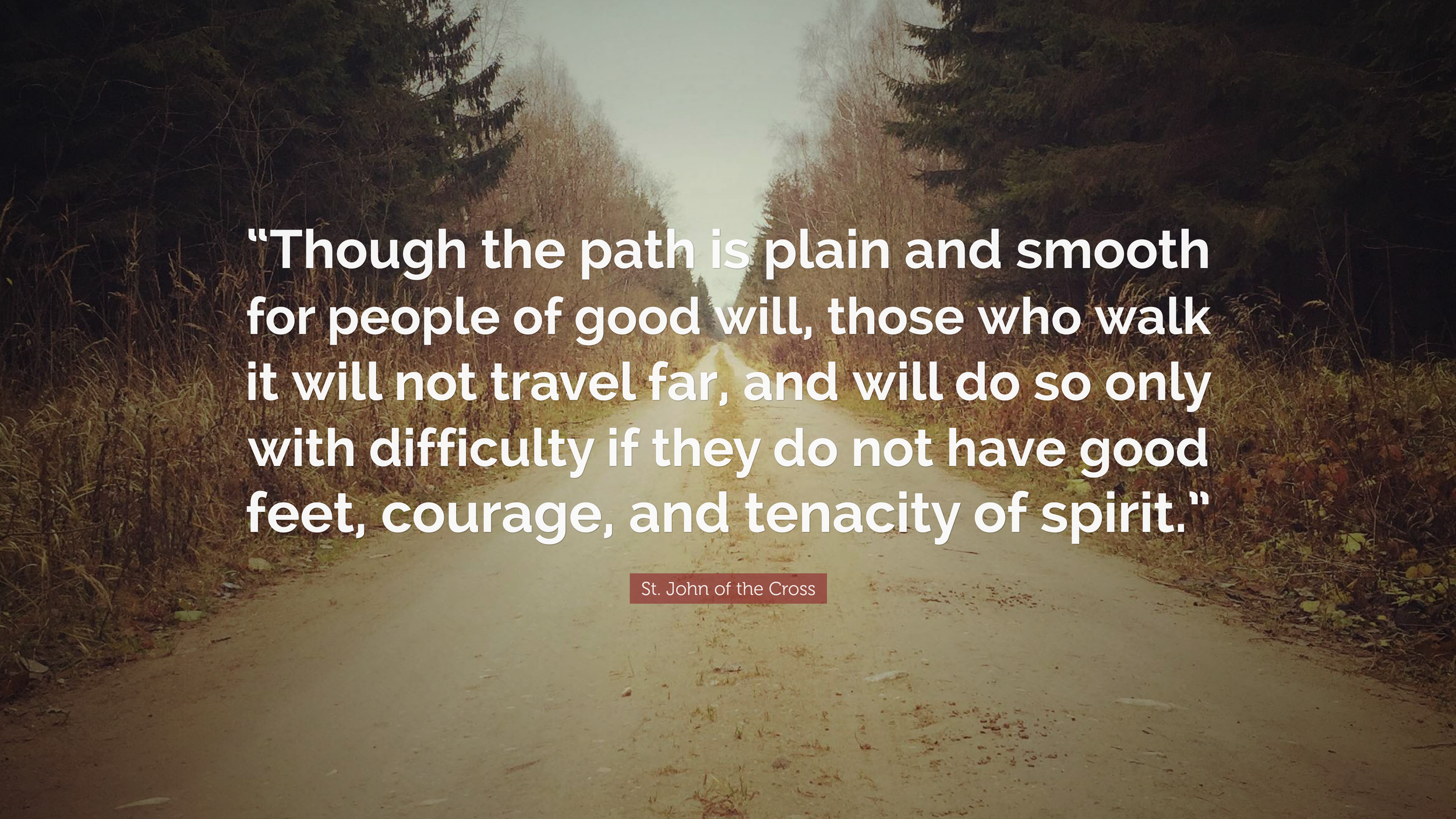
Sayings of Light and Love, #3
Elsewhere, John of the Cross will speak of faith as “the feet” by which one journeys to God (Spiritual Canticle 1, 11). The image is a symbol of the theological virtue which is responsible for our believing in God and in all that he has said and revealed to the human family. By faith we commit ourselves entirely to God by the way that we live. Faith makes it possible for each of us to give the assent of our whole being to the God who reveals himself to us (CCC #143, #1814). It is the power to go to God! It is faith which submits mind and heart (intellect and will) to God who loves us and gives himself to us in a loving exchange.
Sometimes faith will ask a great deal. Heroic virtue is absolutely necessary on the way of prayer which leads to the heights of Mount Carmel (the mountain being the image which John of Cross uses to signify Christian perfection). Good will is not enough to get to the top of the mountain. Tenacity, the ability to hold on when the floor drops out beneath our feet, is a necessary requirement for the mountain climber. One needs more than well-placed intentions. What is needed are well-placed footholds and a firm grip. The analogies all say the same thing. We have to embrace God in faith with all the strength that we can muster! This is trust expressed in the obedience of faith… We are going to follow God wherever he leads us even if it means traveling in unknown territory. God expands our horizons moving us beyond our comfort zones.
Difficulties are bound to arise in prayer, but we must meet these with faith, tenacity of spirit, and courage. To have sturdy feet, then, for this journey means to have a faith that stands fast. Courage, in the sense that the mystical doctor uses it here, intends a heart that responds generously in the face of adversity. In other words, the life of prayer is not meant for the faint of heart. Finally, as we find ourselves climbing the sheer face of the mount of perfection, we need to learn to cling with our whole being to God. The idea here gives new meaning to the words:
“Hear, O Israel: The Lord our God is one Lord; and you shall love the Lord your God with all your heart,
and with all your soul, and with all your might.” – Dt 6, 4-5.
To believe God is an act of love. We demonstrate the strength of our love for God by going to him with faith. Unbelief on the other hand is a failure to love God with all that we are. Faith tells us that we can give to God all that we are, body and soul.
The last word goes to St. Teresa of Jesus who sums it all up, as she explains that we will not arrive at the fountain of God’s delights without “determined determination.” She would have us die on the way of prayer rather than turn back from its practice. The light from our present saying is to: never give up! Keep praying even when the going gets tough. Pray for the gift of faith and you will find strength for going far along the path of prayer. In the end, the Way of Prayer is the Way of Faith.
"In Company with the Strong"

Sayings of Light and Love, #4
In the experience of suffering, the assumption is usually that God has abandoned us. Suffering is a privation of one kind or another. Because of some affliction in body, mind, or soul, we feel that we are being deprived of the happiness that we desire and for which each of us was made. Furthermore, in our suffering, it is easy to give in to the impression that we are all alone - that no one understands or could relate to what it is that we are going through at this difficult moment. This may be true, simply because there is something very intimate about suffering which cannot be communicated to another. If the pain is extreme it may also seem that everyone and everything is failing us. The privation caused by suffering is an evil, but it does not go completely unredeemed. The word from John of the Cross today bears within it some very good news. There is some benefit to suffering, trial, and temptation. Our present question is: "what good can come out of suffering?"
John of the Cross is here to answer this question about suffering. One of the reasons, this Carmelite mystic appealed to me immediately in my first reading of him over 16 years ago, was his ability to speak to the issue of suffering so universal to us all, providing some meaning in the experience. I came to learn, reflecting on his sage advice and the example of his own life, that human suffering is not just a negative. In fact, there are many positives in our trials, discomforts, and desolations. St. John of the Cross helps us to understand the meaning behind this mystery of human existence. He knows what suffering is all about.
Let's start with the example of his life. There are many instances of privation and suffering in John's life from the poverty of his childhood to his final illness in Ubeda. We will focus on the most important one: his time in the prison cell of Toledo. One night in December, St. John was returning from the nun's monastery of the Incarnation in Avila, where he was serving as chaplain, to his residence on the same property. Suddenly, he was abducted, blind-folded and brought secretly to the Carmelite Monastery of calced friars in Toledo.
He was imprisoned under the pretext of living as a recalcitrant religious, a friar "rebellious and contumacious." John of the Cross was placed in a cell where there was barely enough room to stand. The cell was no more than six feet wide and ten feet long. There was one window (no more than two inches wide) towards the ceiling of the room from which some light and a little air would come. The cell was freezing cold in the winter and blazing hot in the summer. It was a place of darkness and utter squalor. He was placed on a diet of bread and water. On Fridays and other days, he was brought to the refectory where he was beaten with a discipline, each of the 85 friars of the community taking turns while reciting the Miserere (Psalm 51). John of the Cross would bear the scars on his back from these episodes for the rest of his life. These calced friars tried everything, from bribery to feeding him false information about the failure of the reform, in order to get him to renounce his life as a discalced Carmelite - a way of life which he had begun with St. Teresa of Jesus. He would remain faithful and persevere through it all, escaping nine months later during the octave of the Assumption of the Blessed Virgin Mary.
John's experience of suffering would span the spectrum of the physical and the psychological and move even into the depths of the spiritual. During that period of physical and emotional privation and darkness, he would experience a dark night of the spirit. God's presence vanished and he felt alone and abandoned. He did not even have the support of prayer and was refused the ability to celebrate Mass. He prayed his Divine Office by what little light came from the tiny window of his cell. In short, his suffering was total. Like Christ on the Cross, John was suspended between heaven and earth without any tangible support from above or below. The experience of suffering in prison gave St. John of the Cross light and understanding about the nature of the spiritual night through which the soul must pass in order to arrive at union with God. In his commentary on the Dark Night he writes:
"They resemble one who is imprisoned in a dark dungeon, bound hands and feet, and able neither to move nor see nor feel any favor from heaven or earth. They remain in this condition until their spirit is humbled, softened, and purified, until it becomes so delicate, simple, and refined that it can be one with the Spirit of God, according to the degree of union of love that God, in his mercy, desires to grant. In conformity with this degree, the purgation is of greater or lesser force and endures for a longer or shorter time." (Dark Night II, 7, 3).
This is about as close as we will get to an autobiographical account of John's own suffering in Toledo. It says everything, however, demonstrating that his experience was not just a privation, a negative event without meaning or value. A positive good was born out of this event in the Carmelite mystic's life - union with God. Great darkness in the life of John gave way to great light.
We might pause now and ask ourselves once more, "what could possibly be the point of all that suffering?" St. Teresa will be the first to reply when she exclaims that no one had suffered more for the discalced reform than her little Seneca, St. John of the Cross. Teresa may have described him as "half a friar" (due to his diminutive stature) but Fray John never did anything by half measures! He gave his whole heart and soul to Carmelite religious life and the Teresian reform, dedicating himself to the exercises of the interior life and contemplation. He suffered for his dedication, and yet, it proved him true. All the suffering united him more completely to Jesus his Beloved and the Cross. In the Ascent of Mount Carmel, John of the Cross explains that Christ accomplished his greatest work on the Cross. In the complete annihilation of Christ on the wood of the Cross, in both body and spirit, Jesus worked the reconciliation of humankind to God. John would live out the paschal mystery in his own life and arrive at the most sublime state of interior grace by his suffering; union with God in the darkness. His poem Dark Night, written while in his prison cell, describes the significance of this period of trial: "O guiding night! O night more lovely than the dawn! O night that has united Lover with his beloved, transforming the beloved in her Lover." This is just a sketch to give an impression of the value of suffering in the life of the Christian - it leads to union with Christ! Trial and transformation are one in the person of St. John of the Cross. Trial, temptation, and suffering all leads to the transformation of the human person in God. It changes us… for the better!
The saying with which we started this reflection serves as a word of direction for times of trial and difficulty. The first lesson: we are weakness itself. It should amaze us, then, that we try so hard to rely on our own strength. Self-reliance is an illusion. The burden of suffering makes us rely on the only One who is strong, the Almighty. In suffering, the soul learns to live in God's company and to lean on him. The burden of suffering tells us that God is close. When we are free of the burden, it just might mean that we have thrown off the yoke and run from the company of God. Jesus says: "…my yoke is easy, and my burden light." (Mt 11, 30). The yoke of the Cross is light and easy because Jesus bears the greater part of the suffering. God abides with the afflicted. Jesus knows what is in your heart and what it is that you suffer. He suffers in us and with us. You are not alone in your suffering! Do not be tempted to throw off the Cross. In patience remain in the trial and trust with silent love; for "virtue and strength of soul grow and are confirmed in the trials of patience." Suffering is not a privation. It is the boon of great goods - the greatest gifts of God, a sign of his love for us and union with him.
"When Evening Comes..."

Sayings of Light and Love, #60
As Fall continues and Winter begins to announce its arrival, there are many reminders that the year is coming to an end. The seasons of the year teach us about life. The lesson plan assigned to us for today, however, is: life comes to an end, and in the perspective of that end we must evaluate what is most important as evening approaches. Before sounding too somber, we must recall that each day we witness the promise of resurrection with the rising of every new Sun. (The thought of Spring sustains me in the long Minnesota winters. It's not too early to think: "Spring!"). But still the fact remains, at the end of the day evening comes. There is a certain finality for each and every one of us in life. None of us can escape death. We must know too that with death there will be a final examination; what is called our personal judgment.
John of the Cross' statement, above, sheds light on what happens in the twilight. "When evening comes, you will be examined… in love." There are three moments in the instruction of the present saying: 1.) the moment of examen, 2.) the lesson of love, 3.) and that last instance of self- abandonment. There will be a time when we will have to make an account before God as to how we spent the Today of this present life. Secondly, there will be a review of love. And finally, the last moment arrives in which we abandon ourselves forever into the hands of God.
As many of you know, we are neighbors to a Jesuit Retreat Center. Some of the retreatants have commented in the past, especially as they get older, that for them retreat is: "cramming for the final exam." I usually laugh when I hear this because it sounds funny; but there is wisdom to be found in the humor.
Exams are part and parcel of life. Every student knows that at the end of a semester there is a final paper or exam designed to test what has come to be known throughout the school year. These are usually moments of great anxiety. I still remember the timed math tests that I had to take as a first grader… box dividers (to prevent cheating) and all! The panic rises every time I think of a clock ticking away as a project needs to be finished. I am a contemplative, in part, so that I could take on a new perspective no longer living for the clock but living for eternity. Here's the first piece of useful information in today's lesson plan: the human person is not created for time but for eternity. That eternity will be defined by how you live in time. With that in mind we have to ask, "what is a life lived well?"
To answer that question, one has to turn and think about what is most important. How do we evaluate the value of our own lives? Typical standards are set by the mindset of our own culture: educational background, job position, power, influence, money, what we own, where we live, what we wear, who we know, life experience, and in the world of social media how many followers we have! The list could go on… But the question begs itself, are these genuine standards by which the value of a human person is measured? Do we measure the ones we love in this manner? Our spouses, our children, our friends, our neighbors, our communities?
St. Paul provides a clue about the true worth of every man, woman, and child before God:
"If I speak in the tongues of men and of angels, but have not love, I am a noisy gong or a clanging cymbal. And if I have prophetic powers, and understand all mysteries and all knowledge, and if I have all faith, so as to remove mountains, but have not love, I am nothing. If I give away all I have, and if I deliver my body to be burned, but have not love, I gain nothing."
- 1 Cor 13, 1–3
The Apostle is speaking about the more excellent way which we are able to follow as free persons. The human person is at his or her best when they follow the way of love. Learning to love is the most important lesson that we can learn before the eventide of life. The truth is, I am nothing if I do not love. Love is the genuine standard for quality of life. The opposite of this is to make some noise, to move mountains, to know everything, to do everything and be the best for my own sake. Self-love can creep into everything we do and destroy all that we accomplish even if we are doing great things for God, our families, our country, our employers and so on. We must not live for ourselves. God has programmed man and woman for the gift of self. Out of love, then, I must learn to give it all away for the sake of the Other - for God's sake and of all those whom we claim to love. To learn to love means that there has to be a process of unlearning our selfishness in all of its forms. John of Cross explains: "…Learn to love as God desires to be loved and abandon your own ways of acting." That's it! That's the key, self-abandonment - forgetfulness of self!
The course of readings within the liturgical cycle of the Church will begin to focus our attention on the last things (death, judgment, heaven, and hell). Among these texts, one stands out to give us concrete information about the way that God desires to be loved. The text: Mt 25, 31- 46. (Please take the time to read the whole text). It is the parable which concerns the judgment of the nations. The Son of Man comes in his glory with all his angels. From his glorious throne he will sit and judge all peoples of all times. The standard of his judgment will be love! Speaking to those who withstood the final scrutiny, those standing on his right after he separated the sheep from the goats, Jesus the King of Glory speaks his sentence:
"Come, O blessed of my Father, inherit the kingdom prepared for you from the foundation of the world; for I was hungry and you gave me food, I was thirsty and you gave me drink, I was a stranger and you welcomed me, I was naked and you clothed me, I was sick and you visited me, I was in prison and you came to me."
- Mt 25, 35-36
So, the final exam will be in love, or rather in acts of mercy. "The good life" is to be found in our neighbor who is in need. We are called to care for the person of Christ in the persons of the poor. This kind of mercy begins in our own home and in our own communities. The lesson is to learn to love one another because we see Christ in every human being. There are many things we could "do" for God. However, all he wants is for us to love him, the one thing necessary. There is no need to do any more.
One final thought. St. John of the Cross will speak of an essential disposition or attitude which must be acquired at prayer. He names it: "loving attentiveness." This is a spiritual activity by which we go to prayer out of love, setting aside all the other things which demand our attention in order to focus the gaze of our heart on God alone. This means that we unlatch the bonds of love created by desire and affection and reattach the strings of the heart to God. We learn to attend to God in faith and in love in the interior of our souls. Going to prayer is an act of love - a concrete way to love God with our time which is so precious to us. Consider the time in prayer as a necessary prerequisite for running the way of love. In moments of prayer, the reservoir of our hearts is filled. It is how God chooses to pour out his love into our hearts - through the gift of the Spirit. If you want to love, learn to pray within your heart finding in your deepest center a God who loves you more than the whole world itself. The evenings after a busy day are a good time to give to God. If you form this habit of heart, you will not be disappointed. You will learn this final lesson: "When evening comes, you will be examined in love." By this, I intend the gift of contemplation in which you discover with a single glance that God is looking at you… not judging you… but examining you in love!
To practice this loving attentiveness, St. John of the Cross provides his summary of perfection (a cheat sheet for the final exam!):
"Forgetfulness of created things, remembrance of the Creator, attention turned toward inward things, and loving the Beloved."
- The Sum of Perfection
What are we waiting for? We do not need to wait until the Sun sets before we start loving. Open your heart now to God and to those who are around you. Do not be afraid to love. This is what God desires for us and our lifetime on Earth. Teresa of Jesus remarking about death and judgment states that she cannot fear one whom she has loved all her life long. Final judgment is not something to fear if we spend our Today loving his majesty, the King of Glory. The only thing to fear is that you never took the risk to love.
"Contemplation is for the Birds?"

Sayings of Light and Love, #122
Over the years, I have met many people who have taken an interest in what is called "birding." I never would have known that such a hobby, as bird watching, could be so fascinating and enjoyable. Birding is not just for the experts. In fact, it is something which is quite prayerful and even contemplative. At the monastery there are many occasions for delighting in the sight and song of these little, winged creatures of God. As we will see, it seems that John of the Cross spent a great deal of time watching birds. He would often draw lessons from nature in order to teach about the spiritual life. The following saying is just such an example:
"The traits of the solitary bird are five: first, it seeks the highest place; second, it withstands no company; third, it holds its beak in the air; fourth, it has no definite color; fifth, it sings sweetly. These traits must be possessed by the contemplative soul. It must rise above passing things, paying no more heed to them than if they did not exist. It must likewise be so fond of silence and solitude that it does not tolerate the company of another creature. It must hold its beak in the air of the Holy Spirit, responding to his inspirations, that by so doing it may become worthy of his company. It must have no definite color, desiring to do nothing definite other than the will of God. It must sing sweetly in the contemplation and love of its Bridegroom."
- Sayings of Light and Love #122
John uses the image of a bird on the rooftop (in my imagination a song sparrow which, according to his description, fits the bill perfectly… pun intended) to describe a soul and the necessary elements characteristic of lofty prayer - what he names as highest contemplation. In summary, contemplatives are supposed to be high flyers. The only way to soar to God is by trying to become like the bird that he has in hand. The traits of the contemplative are five like that of the solitary bird and they are: detached, silent and alone, open to the inspirations of the Holy Spirit, mortified in desire and wanting only the will of God, singing always the praises of the Beloved.
The question is: how does one reach the heights of union with God? Detachment, mortification, silent love, and the movements of the Holy Spirit are all common themes of John's discussion on prayer and union with God. These are the elements of flying off to the heights of God and Christian perfection. The image of the bird perched in the highest place is expressive of the entire journey which is made in his ascetical treatise, the Ascent of Mount Carmel. The bird is the soul, its flight is contemplation, its song is the joy and delight of the experience of union with God. The sight of the bird in its lofty perch vividly illustrates the dynamism of detachment and freedom of spirit. John wants us to fly like this little bird and to sing his song. This means we have to take on the qualities of that sparrow which John of the Cross is describing. Take time to think about those qualities and ask God to give you wings, pointing you in the right direction by the inspirations of his Spirit. Learn to live in the company of the Holy Spirit and to be borne up by his breathings - that is his inspiration.
Here are a few more sayings which complement the present analogy and further illuminate the instruction of St. John of the Cross:
"A bird caught in birdlime has a twofold task: It must free itself and cleanse itself. And by satisfying their appetites, people suffer in a twofold way: They must detach themselves and, after being detached, clean themselves of what has clung to them."
- Sayings of Light and Love, #22.
In order to enjoy highest contemplation, purification of the soul is necessary. It will not fly until it has freed itself from all attachments. The things of this earth know how to cling to us. We have to learn how to shake off the bonds of these attachments. This kind of detachment leads to that feeling of being "as light as a feather." Everyone knows what I'm talking about. It's that feeling when something which the mind and heart have been bearing with great heaviness but has now finally been relieved. Our attachments create those burdens! Who wants to hold onto all that weight? St. John is telling us to throw off all the burdens of our desires and to take on lightness of soul. It feels good to shake off all that unnecessary weight and to fly like a bird. It is the desire for God that will make us fly, every lesser desire is just dead weight and will hold us back. Hence, the following observation:
"Those who do not allow their appetites to carry them away will soar in their spirit as swiftly as the bird that lacks no feathers."
- Sayings of Light and Love, #23.
Perhaps, when composing these sayings, John was watching a bird at the bird bath splashing around in the water and taking the time to preen its feathers before it took off with great speed, swiftly ascending in its flight towards the sun in the skies.
St. John of the Cross has also noted the following in his experience as a spiritual birder:
"It makes little difference whether a bird is tied by a thin thread or by a cord. Even if it is tied by thread, the bird will be held bound just as surely as if it were tied by cord; that is, it will be impeded from flying as long as it does not break the thread. Admittedly the thread is easier to break, but no matter how easily this may be done, the bird will not fly away without first doing so. This is the lot of those who are attached to something: No matter how much virtue they have they will not reach the freedom of the divine union."
- Ascent of Mount Carmel I, 11, 4
Here in the Ascent, John explains that you can have all the virtue in the world and yet it will not be enough to reach union with God so long as a single attachment remains. That attachment is the thread which holds the bird back from flying. His strong recommendation: "beat your wings as hard as you can and break that thread!" John wants all of us to be high flyers and he does not want anything, however small, to keep us from reaching the heights of union with God. Who doesn't long for the freedom that we see in the birds as they fly with lightness through the air?
Without being too lengthy in the present reflection (it would take time to unpack each of the features of the little bird perched in John's thought), it is worth just watching this bird… that is, to experience for a moment the joy of a spiritual birder. What does the sparrow in its song say to you about prayer? Wouldn't you like to possess his freedom to fly, and the joy of his song?
With these sayings, John of the Cross gives us a birds-eye view of the spiritual life…. Skies the limit! Contemplation is not for the birds; it is for souls created in the image and likeness of God! And God wants to give you wings…
"The Cross of Christ, the Glory of Christ"

Sayings of Light and Love, #102
This saying echoes the teaching of Jesus himself in the Gospel when he says to his disciples: "…and he who does not take his cross and follow me is not worthy of me." (Mt 10, 38). It is hard to hear Jesus say such things. This is one of his difficult sayings, and perhaps for us too, it is a terrible word - in the sense that it strikes terror into the heart. It is normal to experience fear at the prospect of the cross. It was a horrible instrument of torture and death in the time of Jesus, and for us it is no less a symbol of tremendous suffering. But we should not lose heart because we know, that by the Cross, Jesus won for us the glory of risen life in God. Going to his passion, Jesus cries out to his Father: "…Father, the hour has come; glorify your Son that the Son may glorify you…” (Jn 17, 1). The hour of Jesus is the moment of his suffering and death upon the Cross. The Father is glorified by the Son in that hour because Jesus is fully revealing the love of God for the world. From the heart of Jesus, from his open side, all the love of his Father would be outpoured for us, reconciling each and every one to God.
When Jesus predicts his passion for the first time, Peter objects and he begins to remonstrate with the one whom he has just confessed to be "the Christ, the Son of the Living God." (Mt. 16, 16). Jesus rebukes Peter telling him that he is "not on the side of God, but of men." If the message of the Cross was tough for Peter to swallow, we can be sure that it will be tough for us to get down as well.
The Cross of Christ teaches the one who follows Jesus a different kind of logic - an understanding which defies all worldly wisdom. Before his conversion Paul the Apostle, Saul, was violently opposed to the Way of Christ and the Cross, but would eventually become familiar with the power of this science and learn its lessons like no other. Writing to the Corinthians he explains:
"When I came to you, brethren, I did not come proclaiming to you the testimony of God in lofty words or wisdom. For I decided to know nothing among you except Jesus Christ and him crucified. And I was with you in weakness and in much fear and trembling; and my speech and my message were not in plausible words of wisdom, but in demonstration of the Spirit and of power, that your faith might not rest in the wisdom of men but in the power of God." — 1 Cor 2, 1-5
Paul only speaks the word of the Cross, preaching the Cross and Christ crucified. This is the Apostle's Gospel. It is a word which is significant to all the saints including St. John of the Cross. For God's closest friends, the Cross of Christ is their glory. St. Paul speaks to the point: "…far be it from me to glory except in the cross of our Lord Jesus Christ…" (Gal 6, 14). The Cross is the mystery that God used to unite the mystical doctor of Carmel to himself. John understood its significance and taught its value to all who would listen. That is what he is doing here in the above saying. No one can arrive at union with God without passing through the narrow gate. The weight of heaven's glory would be too heavy for us to bear unless we first learned to carry our cross in this life.
The key word in our saying this time as we travel the Way is "seek." Jesus promises that if you "seek… you will find." If you seek the Cross of Christ, you will find the glory of Christ. This does not mean we go looking for suffering and trouble in our life, but it does mean that we can expect as Christians a share in Jesus' own passion and death. Extraordinary penances will never compare to generous surrender to the crosses of daily life - bad health, loss, poverty, hunger, failure, humiliation, and setbacks. It doesn't make sense but these are the very things that lead to glory.
John's Word today seems hard only on the surface. Really it is an expression of encouragement. He tells us not to be down and depressed when suffering, but to look up and to rejoice because when we find ourselves on the Cross, we discover that we are lifted up from the Earth and are closer to Heaven - more united to Jesus. Once, St. John of the Cross had reason to be in the enclosure of a monastery of Carmelite nuns and he was moved to go and embrace "a great cross" in the center of the cloister. He prayed a few words quietly in Latin which the nuns could not understand. He repeated the prayer to them:
"…seek nothing but the bare cross, which is a lovely thing…"
(P. Crisogono, St. John of the Cross, p. 267)
This is what John wants us all to understand - the loveliness of the Cross! Through it we find the glory of Christ. John displays by his own example that we must not simply surrender passively to the crosses of life, but to seek the Cross and to actively embrace it.