
Pillars of Carmelite Life
It is our conviction as a Carmelite community that the chapel we are building is for Mary – to honor her, and thereby give glory to God. St. Teresa, when making a foundation, would always rejoice when she could reserve the Blessed Sacrament in the tabernacle of the chapel because it would be another place where God would be present in this world. In her own words: “…I was very happy because for me it is the greatest consolation to see one church more where the Blessed Sacrament is reserved…” (Foundations., Ch. 3, 10). Yet, in Carmel, we are not just building a physical structure. All the time, we are at work raising up a spiritual edifice to God. St. Paul speaks to the point: “Do you not know that you are God’s temple and that God’s Spirit dwells in you?” (1 Cor 3, 16). This is why a Carmelite vocation is so precious.

The Carmelite is another sanctuary where the Spirit of God can dwell. The heart of a Carmelite is an altar where the sacrifice of a life is made upon the heart to God. This is what the Apostle calls spiritual worship, a rational sacrifice (cf. Rom 12,1). I would be wrong to reserve such a reality to Carmelites only, because what I am saying is true of all baptized Christians. You also are a temple of God, and in your heart, you can worship and adore him at all times.
Carmel is Mary’s home and she it is, who builds up this place. If I may, I would like to apply a text from Proverbs to prove my meaning:
“Wisdom has built her house; she has set up her seven pillars. She has slaughtered her beasts, she has mixed her wine, she has also set her table. She has sent out her maids to call from the highest places in the town, ‘Whoever is simple, let him turn in here.’ To him who is without sense she says, ‘Come, eat of my bread and drink of the wine I have mixed. Leave simpleness, and live, and walk in the way of insight.’” (Prov 9, 1-6).
I find Mary here in the figure of Wisdom. With Mary’s help we are about to set up the columns of our chapel so that we can celebrate the Eucharist as a community with the public. We are very excited about this work.
Just as exciting are the pillars that we are continually raising up in spirit. There is a deeper insight here. The chapel we are building is an image of all that we are doing, spiritually, in Carmel. Using the image taken from the Book of Wisdom, I will indicate the seven pillars that support Carmelite life. These pillars are the support structure for prayer and contemplation, which is, “the way of insight” that we are to walk in and live.
The seven pillars of Carmelite life are: sacred reading, work, liturgy, silence, solitude, self-denial, and unceasing prayer. The capstone for this temple of the Spirit is union with God. Without all the supporting pillars, contemplative life would come tumbling down to the ground. The structure of Carmelite life provides balance and measure between activity and rest, work and prayer, silence and speech, solitude and time in community. Each pillar has its proper place and contributes to the strength of the spiritual temple that is being built.
In these articles we will describe each one of these pillars. In examining these supports of the interior life, hopefully you will see how these basic elements of the Rule of St. Albert might also be helpful for you in building your own temple in the Spirit. They are essential for any form of contemplative life, or life of prayer for that matter. You too, are God’s temple, and with Mary’s help you can build up a life of prayer, an edifice in spirit!
Sacred Reading: The Ladder of Monks

In the Rule of St. Albert, we find this command: “Each one must remain in his cell or near it, meditating on the law of the Lord day and night and keeping vigil in prayer, unless occupied with other lawful duties.” Many comment that this is the heart of the Rule of Carmel. It certainly captures the primary occupation of the Carmelite, which is to keep watch for the coming of the Lord into the heart through grace. In other words, this precept concerns the awakened heart – a heart that waits with eyes wide open, constantly searching for the face of the Beloved.
This prayerful watchfulness is accomplished in two ways: one, by remaining in the cell; and, two, by meditating day and night on the Law of the Lord. Remaining in the cell is a very ancient monastic practice. The advice given by a desert Abba to his restless disciple gives proof for the importance of this discipline: “Remain in your cell and it will teach you all things.” All things? That might sound like an exaggeration, but it is true. And yet, staying in one place could be a very boring and useless exercise unless you were occupied in some fruitful work. The primary labor of the contemplative undertaken in the cell, which is his spiritual workshop, is the art of lectio divina, which is commonly known as sacred reading. This work is the practice of praying the Bible in an attitude of faith, believing that behind every word of Sacred Scripture is the countenance of the Eternal Word. Such reading provides the basis for all contemplation, and it is the tried-and-true method of prayer used by monastics for centuries.
St. John of the Cross summarizes the steps of sacred reading in one of his Sayings: “Seek in reading and you will find in meditation; knock in prayer and it will be opened to you in contemplation.” (No. 158). This maxim along with the method here defined was first articulated by Guigo II, a Carthusian in the 12th Century, in his little spiritual treatise called The Ladder of Monks. As you can see it is an easy way to pray. Guigo conceives of prayer as a ladder consisting of four steps: reading, meditation, prayer, and contemplation. The ladder of monks might seem a bit short, but it leads from Earth to Heaven, from the natural in reading to the supernatural in contemplation.

Lectio Divina, as a method of prayer, is not only for the hermit in his hermitage; but it is also a way of praying which is suited for the person looking for a prayer-life with substance. Trust me, there is nothing more substantial for nourishing the soul in prayer than the Sacred Scriptures. The Church through Vatican II, in Dei Verbum, the Dogmatic Constitution on Divine Revelation, exhorts all the faithful to the prayerful reading of the Bible: “…the holy synod forcefully and specifically exhorts all the Christian faithful, especially those who live the religious life, to learn ‘the surpassing knowledge of Jesus Christ’ (Phil 3, 8) by frequent reading of the Divine Scriptures. ‘Ignorance of the Scriptures is ignorance of Christ.’” (Dei Verbum, 25).
So, how does one incorporate this important monastic practice outside of the monastery walls? The answer is threefold: time, space, and daily commitment. Like the hermit you need a quiet place to pray, a makeshift hermitage somewhere. That could be a quiet room in your house, like the kitchen table before the rest of the family wakes from sleep, an adoration chapel, your cubicle in the workspace, any place, really, so long as you can be quiet and alone. Next, time: you have to make a daily appointment for at least 20 minutes. It will be a great help in the art of sacred reading if you can keep the same time and place every day, and this is what is meant by commitment.
Now, for the prayer itself. Choose a sacred text, it could be the Gospel of the day, or any one of the daily readings at Mass, or a book of the Bible that you have always wanted to read, or a passage suggested by a spiritual director. The Liturgy of the Church during the Advent season is full of rich texts from the Scriptures. A good suggestion would be to start with the book of Isaiah, or Matthew chapters 1-2, as well as Luke chapters 1-2. Before reading, begin with the sign of the Cross, pray a short prayer to the Holy Spirit or another prayer to ask for God’s assistance, then spend a few moments (and this could be several minutes) setting aside all distracting thoughts so as to settle down in the presence of God. Next, begin to read slowly. You are not reading for information. Understand the text more from the heart than from the mind. Do not read more than one chapter. Sometimes one verse, even, will be enough for the time of lectio. As you read, focus on each word and phrase. Stop when something strikes your soul and seizes your attention. If nothing appeals to your interior senses then just rest with the text in silence and patience. Sometimes, it will speak to you later in the day or at some other future moment in life. Once you have begun reading, assimilate the text through meditation, chewing thoughtfully on each word until the flavor is extracted. This may then lead to prayer, and this is when you begin to speak to God from the text itself. It could be an observation, praise, a question, a petition. It all depends on how the Holy Spirit will use the sacred word in your soul. In reading God speaks to you, and in praying ,you speak to God. The final step, contemplation, is sheer gift. The soul is at times brought to a silence and stillness which exceeds mere admiration of the beauty of Scripture. The soul suddenly sees the face of the Beloved sought in the words of Scripture. The countenance of Jesus is perceived in faith and it can only gaze in wonder.
It is not important that you go step by step in each period of sacred reading. The period may involve only one step, or two, and maybe even all four – the whole process being extended throughout the activities of the day, several days, a week. The important thing is to go to the sacred page and spend time with it. Lectio divina is a spiritual exercise appropriate for the season of Advent. As preparations are made for Christmas, we, like Mary, can ponder in our hearts all the words and deeds of God as they are revealed in his only Son, Jesus Christ.
Work

These articles on the essentials of Carmelite life are intended to help others understand the nature of our contemplative calling. We hope that, as we explain the various elements of our day, you would feel inspired to incorporate these pillars into the structure of your own daily living.
We begin the building of our spiritual edifice, believe it or not, by speaking of the reality of work. No one can escape from having to work for a living. While lifting up our hands in prayer is the Opus Dei (Latin for the “Work of God”) par excellence, the use of our hands for manual labor is also a must and cannot be neglected. Actually, we work in order cultivate the very contemplation that we are striving for at times of formal prayer. The common notion is to separate work from prayer as disparate activities. Not so, in the life of the Carmelite. They go hand in hand. The hands lifted in prayer are the same hands that work with wood, take up tools to prepare a bed in the garden, create beautiful artwork, write, clean the monastery, cook the food, and wash the dishes.
This is what our Rule (the Rule of St. Albert) says about work: “Some work has to be done by you, so that the devil may always find you occupied…” You have probably heard the saying, “the idle mind is the devil’s workshop.” There is something to be said for this traditional proverb. Idleness and boredom are a recipe for disaster. When we are not busy about the God-given tasks entrusted to us, we are tempted to be busy about things which concern us very little and will only harm our relationship with God and others.
Notice that work, something essential for our spiritual welfare, is not simply recommended as a remedy for temptation. Manual labor of some kind is presented by St. Albert as a necessary element in the life of a Carmelite. It “has to be done”. And is not a “should, ought, or might”. There is no option here, it is a precept – a formal principle which guides how a Carmelite day is to be structured. Work, along with prayer both liturgical and personal, accompanied by sacred reading, helps to balance the activities in a day in-the-life of a monastic.
We find this balance already present in Anthony the Great of the Egyptian deserts, who tempted by a boredom verging on despair, found consolation in the example of an angel who appeared to him so as to teach the value of alternating between work and prayer throughout the hours of the day. The angel stated simply: “do this and you will be saved”. Benedict of Nursia captures the value in a phrase from his own rule for monastic life: “Ora et Labora” (Latin for Pray and Work). These witnesses to the most ancient forms of monastic life show us that the work of the soul is set in balance with work of the body engaged in manual labor. Contemplative life is not just work, nor is it just prayer. It is a “both and”. See our horarium, the hourly schedule of the monastery, to look at an attempt to balance all the activities of contemplatives busy about the works of God.
We should not think that work possesses only a negative quality in human life. No, in fact, quite the opposite it is a definite positive! Labor, while hard, was something that God always intended for man and woman whom he created after his own image and likeness. God worked for six days before he rested on the seventh. We cannot be any different from the God who made us. No, we are called to conform ourselves in likeness to God’s way of doing and being. We are always happier doing things the way God does them. That is what is means to say, “thy will be done”. And so, we work to participate in God’s creative work…
The issue, however, is that we fell by doing things our own way which is what has made work difficult. To understand my meaning here, take time to read the first chapters of the book of Genesis (Gen 1-3). Taking a biblical view of human labor, we see that the supreme values in laboring by the sweat of our brows is that it is: creative, reparative, and redemptive. Jesus, the Son of God, in becoming man worked with his own hands as a carpenter. He tells us that God is a master craftsman and that we work with him to create a better world – to bring all creation to perfection, that is, to its intended end. The tasks we undertake, whether great or small, contribute to the building of the kingdom of God.
All of us must contribute to the work of a family, of a community, of a society. St. Albert concludes the chapter on work by stating: “This way is holy and good: follow it.” Idleness according to St. Benedict is the enemy of the soul (Rule of St. Benedict, Chapter 48). If we just stand around doing nothing, we can expect the enemy of our souls to come pounding on the door of our hearts, assaulting us with all kinds of temptations. Yet, beyond the aspect of spiritual warfare is the beautiful reality that to work is to be like God – to be tasked with bringing about a beautiful creation.
After working hard for six days, or for those hours designated for work in a given day, there is nothing better than to do what we were made for above all else: to rest on the Seventh Day. After all our labors, we are invited to rest in a communion with God. The tasks of daily life lead us to this Sabbath moment - a period of supreme fulfillment in God. In short, work leads us to union with God. Do not be tempted to look at your tasks as just another burden to get on with, and get rid of… no, take it in hand and lift them up to God. St. Teresa explains it very well: you will find God even among the pots and the pans. You will find him in the workplace, while doing humdrum chores, and in all the labors that make up life. And all the works will join you to God and make for a better world.
Liturgy (Part 1) | The Daily Eucharist
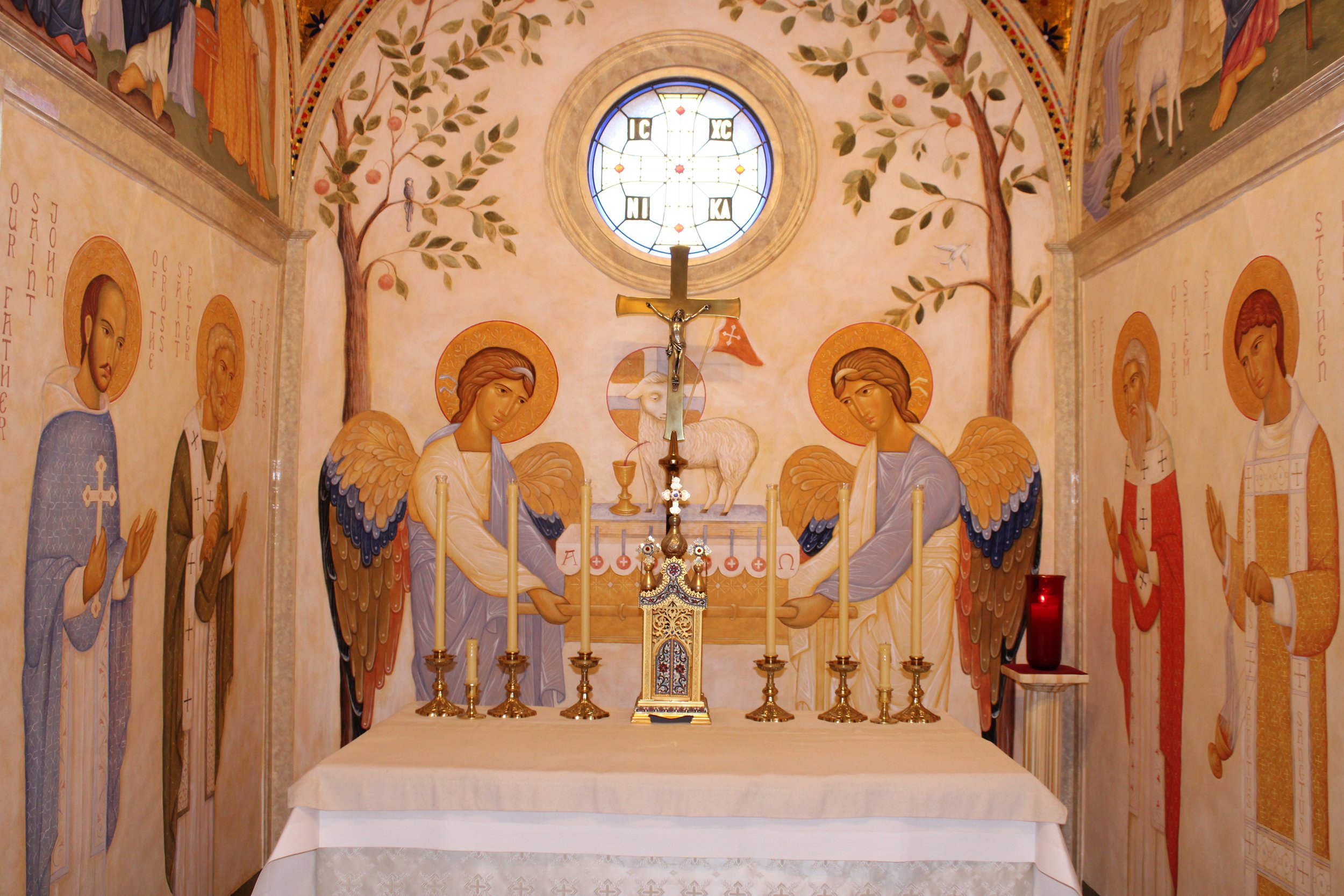
According to the Rule of St. Albert, at the center of every Carmel, there is to be an oratory which is to “be built in the midst of the cells” for the purpose of coming together (“con-venire” in the Latin) to celebrate the Eucharist. In this synaxis, Christ is made present in the midst of the Brothers. The chapel is sacred space – a place “…where you shall come together every day early in the morning to hear Mass (ad audienda missarium), where this can be done conveniently.” (Rule of St. Albert Ch. 10).
Worship of God is at the heart of daily life in a Carmelite monastery. It is the principal event which begins each day of observance. In this regard, it is worthwhile to recall the teaching of the Church concerning the significance of the Eucharist in the life and mission of the Church – in the life of every Christian.
“At the Last Supper, on the night he was betrayed, our Savior instituted the Eucharistic sacrifice of his Body and Blood. This he did in order to perpetuate the sacrifice of the cross throughout the ages until he should come again, and so to entrust to his beloved Spouse, the Church, a memorial of his death and resurrection: a sacrament of love, a sign of unity, a bond of charity, a Paschal banquet in which Christ is consumed, the mind is filled with grace, and a pledge of future glory is given to us.” (Sacrosanctum Concilium #47; cited in Catechism of the Catholic Church #1323)
By means of the Eucharistic sacrifice, Christ plants the Cross on the summit of Mount Carmel by which each Carmelite is able to be joined to the mystery of the Lord’s Passion and participate in it. Every Carmelite religious seeks to make a personal offering in the gift of self to God through the profession of the Evangelical counsels (the vows of chastity, poverty, and obedience). This sacrifice, which is nothing less than a holocaust and our spiritual worship, is taken up by Christ in the Eucharistic sacrifice and made perfect. Of note is the custom of signing handwritten vows after making profession in the hands of the Prior and placing those vows on the altar along with the gifts to be offered during Masses of religious profession.
The Second Vatican Council also explains that the Eucharist is the “source and summit of the Christian life.” In the Eucharist “is contained the whole spiritual good of the church, namely Christ himself, our Pasch.” (Lumen Gentium #11, Presbyterorum Ordinis #5 cited in Catechism of the Catholic Church #1324). The holy sacrifice of the Mass sums up and is the summary of Carmelite life just as it is the sum and summary of Catholic Christian life. At the altar, during the sacrifice of the Mass, we find ourselves at the summit of Mount Carmel calling down fire from heaven to transform the world through the love of God outpoured from the side of Christ. Jesus longs for the world to be already ablaze with such fire! Like Elijah, Carmelites are called to prophetic witness and it is at the altar of the Lord where we are most effective in opening the heavens to cast the fire of divine love upon the world.
As the sacrament of love, the sign of unity, and the bond of charity, the daily celebration of the Eucharist brings the members of a Carmelite community together as one in God. It is the cause of our union with God and with one another. The first hermits would come from their solitude to experience communion based on a common charism defined by allegiance to Jesus Christ, but also, a communion which was sacramental. We are most truly Carmelites when we find ourselves together at the celebration of the Eucharistic Sacrifice of the Mass. It was in receiving Holy Communion during Mass at the hands of St. John of the Cross that St. Teresa of Jesus attained the supreme grace of spiritual marriage. Teresa’s experience teaches us that the Eucharist is necessary for the perfection of Carmelite life. It is the catalyst which brings about union with God.
The moment of the daily Eucharistic liturgy is the moment in which we offer to God the adoration which belongs alone to the Most Holy Trinity. It is worship characterized by the total offering of all that we are to the Father, with and in the Son, through the Holy Spirit. A Carmelite community is most truly itself in this sacred moment.
Turning to the text of the Rule (Chapter 10), the words “…in the midst of…” bring to mind the presence of the Risen Christ, who spent forty days living with and teaching his disciples about the Paschal event before ascending into heaven. Think especially of that first evening of the resurrection when Christ appears to the apostles gathered in the upper room. We find Jesus in their midst bestowing his peace and dispelling their fears. At the Eucharist, Jesus is in the midst of our Carmelite community. We are in the upper room. This is true of every Christian community where Mass is celebrated.
In like manner, the phrase “early in the morning” is evocative of Mary Magdalene’s journey and that of the other women to the empty tomb on the first day of the week which then leads to their discovery of the Risen Lord.
Finally, the precept calls to mind Peter and the other disciples who have gone fishing and were at it all night. Jesus is waiting on the shore and at dawn will call them from their fruitless labor to break their fast. The Risen Christ, the Good Shepherd, gathers his flock together after the fright of his death on the Cross. The Shepherd had been struck and the sheep scattered each to their own place. Now he makes them come together around him – the shepherd standing in the midst of his flock as they are pastured peacefully in his presence. This very dynamic plays itself out in the tension between the solitude of the hermitage and the common space of the oratory. The Brothers are gathered each morning by the Good Shepherd to be refreshed and renewed in his presence.
The Eucharist is the daily miracle in our lives in which we experience the love of Jesus – his presence in our midst! In turn, the Lord asks as he asked Peter, “do you love me?” In the strength of the food that Jesus provides we journey with Elijah to the top of the mountain where God reveals himself. A similar question is asked: “what are you doing here?” The answer: to both questions is, “Lord you know everything, you know that I love you!” and “I have been zealous, for the Lord God of Hosts.” Hearing Mass then is the occasion for us to hear a call to love… From the altar, we go forth each day to love God – to love Love – to repay love for love. “Ita Missa Est!” Go forth you are sent!
Liturgy (Part 2) | Praying the Psalms
These articles on The Rule of Saint Albert are concerned with the pillars of Carmelite life: sacred reading, work, the liturgy, silence, solitude, self-denial, and unceasing prayer. We will now expand on the topic of the liturgy. It receives special note because, as was mentioned in the last article on the pillars of our life in Carmel, liturgy and its celebration is the sum and summary of Christian life. The Opus Dei (work of God) par excellence is the celebration of the Liturgy of the Hours in the chanting of the Divine Office. Seven times a day the Church gathers throughout the world to sing the praises of God, chanting the Psalms with one voice and one heart. It is the voice of the Bride calling in response to the love of the Bridegroom. The Church fulfills the prophetic exclamation of the Psalmist: "I will sing of your mercies, O LORD, forever; with my mouth I will proclaim your faithfulness to all generations." (Ps 89, 1).
Psalmody: Unceasing PrAYER
"…My soul sings psalms to you unceasingly…" - Ps 30, 13 (Grail Psalter)
Besides thinking of a mountain, when someone hears the word "Carmel" they will usually make associations with the brown habit, asceticism, prayer and contemplation, union with God, St. Teresa of Jesus, St. John of the Cross, and St. Therese. In short, the word "Carmel" elicits thoughts in the mind of everything that has to do with the mystical life. There is another dimension of Carmelite life which should not be overlooked because it is the atmosphere or environment from which all prayer in Carmel is born. I am speaking of the Psalms and the way they are used in the liturgy of the Church. Singing and praying the Psalms is central to the plan of Carmelite religious life. The Rule of St. Albert states the following as a precept:
"Those who know how to say the canonical hours with the clerics shall say them according to the institution of the Holy Fathers and the approved custom of the Church."
In the formula vitae of St. Albert (the primitive form of the Rule) the text is different in some significant respects, for example the precept above is introduced in the following manner:
"Those who know their letters and can read the Psalms…" rather than, "Those who know how to say the canonical hours with the clerics…"
In the first monastic experiment on Mount Carmel, St. Albert of Jerusalem (between 1207 - 1214) legislates for a semi-eremitical form of life, and did not make the praying of the canonical hours a juridical obligation. The formal requirement to pray the Divine Office is defined with the Innocentian reform of the Rule in 1247. The canonical hours, thus, become a definitive element of religious life in common. This change, in fact, reflects the transition towards mendicancy in the late 13th century as the Carmelites migrated from Mount Carmel to Western Europe. The first hermits, on the other hand, would pray the Psalms privately in their cells - it would not be as such, a formal participation in the liturgy of the Church, but a way of prayer learned from the example of the monastic fathers. Most likely, the hermits would pray the Psalter from memory. In the age of early monasticism, one could not make profession until all the Psalms had been memorized!
The text of the formula vitae continues: "…shall say for each of the hours those [Psalms] which are appointed for those hours…" Praying a certain number of Psalms at set hours in the day had always been an established element of monastic life. The Psalms, as mentioned, would be committed to memory, and the desert Fathers would meditate upon a verse of a Psalm outside formal times of prayer as they performed their manual labor. It was a means for remaining steadfast in the solitude of the cell. The praying of Psalms helped the solitary to persevere in continual prayer and to overcome temptation. Life in the desert is very simple and for that reason is susceptible to tedium and boredom. Praying Psalms at intervals helped to break up the monotony of monastic routine. The monk must always be wary of the noonday devil who seeks to discourage the spiritual athlete from persevering in the contest of the desert. For a moment, let us turn our eyes to Anthony the Great:
"When the holy Abba Anthony lived in the desert, he was beset by accidie, and attacked by many sinful thoughts. He said to God, 'Lord, I want to be saved but these thoughts do not leave me alone; what shall I do in my affliction? How can I be saved?' A short while afterwards, when he got up to go out, Anthony saw a man like himself sitting at his work, getting up from his work to pray, then sitting down and plaiting a rope, then getting up again to pray. It was an angel of the Lord sent to correct and reassure him. He heard the angel saying to him, 'Do this and you will be saved.' At these words, Anthony was filled with joy and courage. He did this, and he was saved." (Sayings of the Desert Fathers, Abba Anthony #1, trans. Benedicta Ward, SLG).
Praying the Psalms at intervals was a matter of his eternal salvation. Anthony was getting ready not just to leave his cell, but he intended rather to quit the desert all together. Prayer and work in combination saved his vocation and helped him to persevere in his cell. Work and prayer saved him in the tedium of his solitude. The alternation between prayer and work (what is called "ora et labora" in the monastic milieu) throughout the various moments of the day will eventually become the pattern for all forms of religious life. Praying the Psalms at set times creates structure in a monastic day, providing the basic rudiments of an horarium (hourly schedule). The Psalter is "the monastic prayer book" and the Psalms define a monk's prayer. It is the essential text which records the dialogue that transpires between God and the one praying. Psalmody provides a rhythm, which is supernatural in character, to the ebb and flow of contemplative life.
Elijah, the Psalms and Carmelite Tradition
In an ancient medieval Carmelite text familiarly known as The Ten Books by Felip Ribot (written around 1385), Elijah is set forth as the ideal of the eremitcal monastic life. He is the first to take up this way of life - in solitude, silence, renunciation; but, also in the perpetual singing of God's praises. Accordingly, the Psalter having a prophetic character transforms the singing of the Psalms into a kind of prophesying. Elijah is acting as a prophet when singing the praises of God in inspired song. This prophetic office will be passed on to every son and daughter of Elijah in the Carmelite family.
Elijah will hand over the pattern of the eremitical life to his disciples, who would be called "prophets." Prophecy in this sense is nothing other than singing in praise of God. The first disciples of Elijah would radiate the charism of eremitical monasticism to future generations, and especially to the hermits on Carmel named by the Scriptures as the "sons of the prophets." The spiritual heirs of this charism would then be every Carmelite in every place and time. (Felip Ribot, O. Carm., The Ten Books on the Way of Life and Great Deed of the Carmelites, pgs. 29-32). The role of Carmelite religious in the Church is defined thus by our spiritual fathers. The prophetic role which we play in the Church is the worship of God by praising him in song from our silent retreat on the slopes of Mount Carmel. The following quote from The Ten Books explains:
"…when the Wiseman said to holy Elijah, 'You make prophets to succeed you,' he did not mean that Elijah conferred on his successors the spirit of foreseeing or foretelling the future, but rather, that Elijah established monks as his successors after him not only to observe the monastic life according to the form given him by God but also to perform this office, that is they should prophesy, which is to sing Psalms and songs and hymns devoutly to God, and to praise God not only with their hearts and tongues but also with musical instruments. And therefore, they were called prophets, that is psalm-singers, and their life was called prophetic, that is, dedicated to singing psalms to the Lord with musical instruments. And because they sang such psalms to God and observed the monastic life in the form given to Elijah by God, they obeyed the holy prophet with a ready heart, and thus they merited the blessing of the Wiseman spoken to their father Elijah: 'Blessed are they that heard you, and were honored with your friendship.'" (ibid., pg. 30).
In the mind of medieval Carmelites, prophesying was equivalent with the singing of Psalms in choir. They believed that it was Elijah himself who put into their hands a primitive form of what we now call the Divine Office. The first hermits heard the voice of Elijah echoing in their wadi and they were glad to take up his song of chant and praise to God.
The Importance of Praying the Psalms
"Seven times a day I praise you for your righteous ordinances." - Ps 119, 164
St. Benedict in his Rule states: "Nothing is to be preferred to the work of God…" The opus Dei (Latin for the Work of God) is the liturgy of the Church, which includes the Divine Office; otherwise known as the Liturgy of the Hours. The present precept of the Rule of St. Albert along with what is said elsewhere about the oratory places the praying of the Psalms at the heart of Carmelite religious life. It is an essential pillar in the structure of the spiritual edifice that is being built. The current Constitutions of the Order of Carmel also indicate the importance of Liturgical prayer, especially in the praying of the Hours:
"As religious we are called after the example of the early Church to pray together liturgically in the Eucharist and the Liturgy of the Hours. Liturgical prayer is the highest encounter with God: the community experiences and celebrates God's mystery in communion, and makes it a reality in their lives. Personal prayer is intimately linked with liturgical prayer; one flows from the other." (Constitutions of the Order of the Blessed Virgin Mary of Mount Carmel 2019, #72).
Liturgical prayer is described here as the highest encounter with God and the fountainhead of all personal prayer. The praying of the Psalms and the Eucharistic sacrifice introduces the one who prays into the contemplation of God and his mystery. The Constitutions for the Order of Carmel go on to explain that, "Communal liturgical celebrations are moreover a central characteristic of our Rule." (ibid., #74). Carmelites are obliged by these Constitutions to grow "in love for liturgy and in… concern for its renewal." In this manner, it is hoped that each religious would experience a deepening in the contemplation of God's mystery which is celebrated in the liturgy. (ibid., #74). One cannot underestimate the value of the Liturgy of the Hours. St. Mary Magdalene de' Pazzi taught her sisters: "In comparison with the celebration of the Divine Office in choir any meditation or private prayer whatsoever is of little merit before God." (The Carmelite Directory of the Spiritual Life, p. 436). It is a tremendous privilege to have a place in choir and to participate in the official prayer of the Church. It is the best means for making intercession for all the people entrusted to our prayers.
The Psalms chanted in choir by the religious of Carmel is both a participation in the prayer of Christ and the prayer of the Church. In this song the voice of the Bridegroom is heard as Jesus sings to his Bride, the Church. The voice of the Bride is also heard as she extols her Beloved in song. Thus, the Liturgy of the Hours is a canticle of loving dialogue. Furthermore, it is a public work which is made on behalf of the Church - a work which sanctifies each hour of every day. Time is made holy as the Psalms are prayed. Singing the Psalms in choir is a continuation of the Eucharistic celebration recalling the mystery of redemption and making it present in each moment. The Carmelite Constitutions teach that:
"The public prayer of the Church is the manifestation of our participation in the Church at prayer, which, together with Christ, 'is ceaselessly engaged in praising the Lord and interceding for the salvation of the world.' From its pre-eminence as the public and official prayer of the Church, it is a fruitful source for the spiritual life of those who share in it…'The Liturgy of the Hours extends praise and prayer to the different hours of the day, making present the mysteries of salvation, the prayers of intercession, and the foretaste of heavenly glory which are offered to us in the Eucharistic Mystery.' Together with the Eucharistic celebration, the Liturgy of the Hours unfolds for us continuously throughout the liturgical year the mysteries of the redemption accomplished for us by Our Lord Jesus Christ, so that we may encounter them and thus be filled with the grace of salvation."
St. Albert exhorts all those who are able to say the canonical hours to join in the prayer of the Church because it is so vital for the life and spiritual welfare of the individual, the community, the Church, and all peoples and nations. Praying the Psalms is truly a pillar of Carmelite life. By these prayers, a Carmelite intercedes for the whole world with the voice of Christ and his Church and brings down upon all the grace of salvation.
Silence (Part 1) | In Silence you will Find Peace
When coming to the monastery became a known fact and my decision to enter a definitive choice, everyone had questions for me. One of those questions was about silence. In some instances, the people asking about silence were more terrified of what I might have to face in the quiet than I was myself. Funny!... For example, one individual really thought that I would be taking a vow of silence, and that I would never be able to speak again as long as I live. I tried to explain that this was not the case. This person was convinced, and insisted that I reconsider my decision to venture into the silence of monastic life - I was told that I would lose the ability to use my vocal chords if I became a monk! This is a common misconception. As we will see in this article and the one to follow on Pillars of Carmelite Life, silence is a support for the life of prayer as a whole. It is not the whole of our life as Carmelites and neither are we keeping silence perpetually. We will note the subtle strains of rhythm in our silence - a quiet for the day and a stillness for night, an all encompassing atmosphere for the work of God in prayer, our holiness.
Returning to the question of silence…. It can be a terrible question. The specter of silence is perhaps a little too much to countenance for many in our own times. Let's face it, silence is hard for a world constantly communicating by any number of devices. The world changed with the advent of the printing press. It changed even more greatly with the coming of the internet, satellite communication, and the smart phone. Everyone is connected and everyone is sharing instantly at every moment on a number of platforms throughout the global village (imagine now, in the background, the Grinch's refrain as he thinks about Christmas in Whoville: "noise, noise, noise!"). Okay, this is only a sketch and at best a generalization. However, it is true to say that silence is a challenge today, and for that reason it has value for our lived experience as members of the human family, especially as Christians who are called to transform the world by our presence in it. The Rule of St. Albert, Carmel's formula for life, sets the practice of silence up as an essential support in the life of prayer and contemplation - a pillar of Carmelite Life.

Turning to the Rule of St. Albert we find that the chapter "On Silence" follows immediately after Albert's precept "On Work". In fact, the preceding chapter on work ends with an exhortation: "in the Lord Jesus Christ to earn [their] bread, working in silence. This way is holy and good: follow it." The structure of the Rule is telling us that silence itself is a work. It is an essential exercise of Carmelite life - a great work of the spiritual life, in general. St. Albert outlines for us the way of silence. It is good for us to follow him in the way.
He begins: "The Apostle recommends silence…" Albert recommends silence by way of apostolic command. It is a dimension of life and prayer fundamental to Christian experience. Silence is based upon the authority and example of St. Paul the Apostle. In other words, silence is an apostolic institution (i.e. a teaching, principle, guideline) in the mind of St. Albert. It is valid as a way of Christian spirituality because it rests upon the foundation of apostolic teaching and example. The life of the Apostle includes intense activity (work) and deep stillness (silence). In the Rule of Carmel, work and silence complement one another just as contemplation and the apostolate combine to form the fullness of Christian life and mission in the Church.
I mentioned that the practice of silence is a work. What kind of work? The practice of silence is described as the "cultivation of justice" by the Rule. The phrase appears twice and forms an inclusion within the rule, setting off silence as its own particular exercise of Carmelite life. The inclusion begins with "As the prophet also testifies, 'Silence is the cultivation of justice…'" and closes with, "let him try attentively and carefully to practice the silence in which is the cultivation of justice." What kind of work is being undertaken in the soul? What particular task does silence perform within the field of the soul? It is a work that cultivates virtue and holiness. Themes from Isaiah are playing in the background of the text. Here is just one example:
"Then justice will dwell in the wilderness, and righteousness abide in the fruitful field. And the effect of righteousness will be peace, and the result of righteousness, quietness and trust forever." (Is 32, 16-17).
There are some wonderful words here: peace, quietness, and trust. Silence cultivates these gifts in the enclosed garden of Carmel. Who wouldn't want to experience such blessing? Silence creates the atmosphere for the experience of God and his peace. It teaches trust which is realized not in the frantic activity prompted by the impulsive suggestions of an anxious mind, but in the quiet of a heart that is at rest in God.

Thinking about the value of silence, we recognize that silence is an act of worship because it is nothing other than surrender to, and trust in the loving influence (dominion) of the Lord in our lives, individually and as a people. Silence is also a work of trust. Silence, by an act of surrender, brings about right relationship with God. Silence teaches us to listen to the Word of God, to meditate upon his Law, and follow in his way. In silence, we let God speak - even command the direction and course that our lives take. When we choose our own way, we silence God. We shout until we have our own way… we attempt to speak over God and his counsels until our will is done. The way of Carmel is different - it is the way of silence in which the only word said is "fiat!", that is "let it be done unto me according to your word!" Or, "Your Will be done"… "not my will… but yours!" And finally, in silence we are able to cry out, "Yes, Father!" God cannot begin his work of transformation in the soul, until we learn to practice silence.
Think about how different our lives would be if we learned to live in this atmosphere of quiet and rest. It is a guarantee that there would be more peace in the day, if we learned to refrain from entering into the constant noise in the environment which surrounds us. The guarantee evidences itself, for example, when we allow ourselves to enjoy the quiet beginnings of a day as the sun rises silently on the horizon. Picture the first rays of dawn pouring into the windows of your kitchen as you take in that first cup of coffee or tea. The promise of peace renews itself at the end of the day, after all the activity ceases… savor that sunset! God wants our peace. Silence teaches us how to enter that peace. There is a living silence to be found in the dead of the night when the whole house is at rest. Silence is a refusal to enter into a world of disquiet, unrest, and sin (remember for a moment memories of hard words spoken, arguments, and shouting matches). Life is different when we keep our peace and silently trust in God, who speaks to us moment by moment. In the silence we let him be Lord of our life. Let's end now with a few verses from a Psalm:
"O LORD, my heart is not lifted up, my eyes are not raised too high; I do not occupy myself with things too great and too marvelous for me. But I have calmed and quieted my soul, like a child quieted at its mother’s breast; like a child that is quieted is my soul. O Israel, hope in the LORD from this time forth and for evermore." (Ps 131, 1–3)
Silence (Part 2) | In Silence you will Find God
What one practice of the Christian life is the best practice? By this question, I am asking what is the best means to arrive at Christian perfection? If I may, I would like to answer this question by proposing the example of some brothers in the deserts of early Christian Egypt.

Someone related that three spiritual brothers, philoponoi, became monks. The first chose to bring peace to those who were fighting, according to what is proclaimed in Scripture: Blessed are the peacemakers (Mt 5:9). The second chose to visit the sick (Mt 25:36), while the third went away to live a life of contemplative quiet in the desert (cf. Mk 1:35). Although the first labored mightily to resolve conflicts between people, he was unable to remedy all of them. Discouraged, he went to see the one who was ministering to the sick; he found him dispirited and not even close to having fulfilled the commandment (cf. Mt 25:36). The two of them agreed: they went to see the hermit, told him their sorrows, and urged him to tell them what he had accomplished.
After remaining silent a short while, the hermit put water in a basin and said to them, "observe the water". It was disturbed. A short time later he again said to them, "Observe that the water is now calm". When they looked closely at the water, they observed their own faces as if looking in a mirror. Finally he said to them, "It is the same with someone in the midst of people. On account of disturbances, he does not see his own sins, but when he has contemplative quiet, especially in the desert, then he sees his own defects". (Becoming Fire, Through the Year with the Desert Fathers and Mothers, ed. Tim Vivian, January 1).
In the contemplative quiet, the three brothers came face to face with themselves in self-knowledge. The quiet allowed their souls like the water in the basin to settle in peace. For all of us, silence is beneficial. It leads us to a humble knowing of ourselves - the soul becomes a mirror. In this mirror there is something more to see than our own defects. In the depths of the soul we come to see the image of God, the face of Christ as we arrive at purity of heart. To arrive at this condition we need silence, even though it might be hard to remain in that quiet. There are many things that we could try to do in order to arrive at Christian perfection. This episode from the deserts of Egypt displays the value of setting aside all activity in order to gaze quietly into our souls. They are vessels (although earthen) of grace, which contain the presence of God and his gifts.
In this article we return to the practice of silence in Carmelite Life. We will give some practical directives for silence and the "why?" behind this pillar of the Rule.
Difficulties with Silence
But before we do that, another comment on the difficulty of silence. A frustration often recorded in the lives of the desert fathers and mothers is the reality of going into the desert to find God, and instead finding one's self only. For a moment, imagine the disappointment of someone setting out on the way of prayer in order to move beyond themselves so as to seek "higher things"; and, rather than finding peaceful interior prayer and the presence of God, they only arrive at the place where the journey first started - self! Perhaps, you have experienced something like this. First of all, don't be discouraged. Stick with the silence and you will find God in the end, along with the peace of his presence. Peace is only found in relationship to God, and prayer is that relationship - a relationship that can only be cultivated and enjoyed in silence. As St. Albert explains in the Rule: "Silence is the cultivation of justice…" That is, in silence we work towards right relationship with God, which is the essence of holiness, and of being just. Silence allows us to just be before God!
As for the difficulty of quiet, sometimes we avoid solitude precisely for the reason mentioned above: we are afraid of what we might find within the deeps of our hearts… difficulties and disturbances of all kinds, the presence of things we just do not want to admit as actually present. Yet, it is entering into these murky waters that we will acquire the necessary purity of heart to see God. Silence helps all the dust within the vessel of the soul to settle. Only then do the waters become still enough for us to see the image of God reflected in our souls as in a bright mirror.
Night Silence and Day Silence

Now, for what the Rule of Carmel has to say about the forms of silence in our way of life.
Albert's directive on silence is twofold, concerning what is called the night silence and the day silence. Yes, we are to attempt a quiet which lasts all day and all night! We begin with the first period designated as the great silence:
"Therefore, we direct that you keep silence from after compline until prime of the following day." (Rule of St. Albert)
This is a description of how the night silence is to be undertaken. This is a privileged period in the twenty-four hours of a Carmelite day, which is why the adjective "great" is applied to this time of night silence. It is a time for retirement in the cell, the reading of Sacred Scripture, keeping vigil, and rest. The silence enjoined upon the religious community in this period is necessarily more strict.
For your own purposes, it might be worth thinking about how you might create a space where you can go apart so as to enter into the great silence. Find a little desert for yourself in your home or some-place else where you can be alone in solitude… like taking a walk by yourself without the company of any devices. It is important to be disconnected at times. Secondly, it might also be valuable to create a rule of silence in your own routine - to decide when everything is powered off; when, how, and where you take care of business; regulating your encounters with other people; discerning when contact with the world is necessary. Such practices will help you to not only engage God in prayer, but it will also help you to interact with other people in your life. Ultimately, it will help you to live intentionally, in a refusal to be driven by all the stimuli which surround us in our environments. After some silence and solitude, you will be more ready to jump back into all the activity of life with greater energy and focus.
The Rule now proceeds to speak of the silence which is kept during the day:
"At other times, however, although you need not observe silence so strictly, you should nevertheless be all the more careful to avoid much talking…" (Rule of St. Albert)
While the day silence is less strict, we must first of all note that what is implicit in this precept is that silence is to be kept "night and day", that is, continually! The allowance for speech during the day is not simply a relaxation of the silence. Speaking is permitted, but it must be measured:
"Let each one, therefore, measure his words and keep a tight rein on his tongue…" (Rule of St. Albert)
Notice the character of monastic speech: it is concise, to the point, and not idle. Even at times designated for recreation, speech must never devolve into idle chit-chat. At recreation, we speak not just to relieve ourselves in an overflowing torrent of words, but to re-create just as God created all things by speaking his Word in the beginning (cf. Gn 1; Jn 1). Idle talk can lead to all kinds of trouble. As the letter of St. James tells us: the tongue, although a small member of the human body, can start great fires and possesses the potential of becoming a world of sin. Other reasons for speech in the Christian life would be to praise God, and to proclaim the Gospel - just to say the name Jesus is to glorify God! The Rule provides much material for our own discernment in the use of the spoken word in our own lives, especially in the contemporary culture of social media. Enough said… Now another question…
Why all the Silence?
At this point, you might be asking: "Why all this talk about silence?" It's a good question. Why spend so many words on this exercise of Carmelite life? The rationale for all this silence is twofold just like the regulation of silence in a Carmelite day is twofold.
The first reason: silence is necessary for acquiring purity of heart. The universal testimony of Scripture provides ample evidence of the evil caused by harmful speech from the confusion of tongues at the tower of Babel in Genesis to the blasphemies of the beast and his followers in the Book of Revelation. The dangers of the tongue are enumerated by St. James:
So the tongue is only a tiny part of the body, but its boasts are great. Think how small a flame can set fire to a huge forest; The tongue is a flame too. Among all the parts of the body, the tongue is a whole wicked world: it infects the whole body; catching fire itself from hell, it sets fire to the whole wheel of creation. Wild animals and birds, reptiles and fish of every kind can all be tamed, and have been tamed, by humans; but nobody can tame the tongue—it is a pest that will not keep still, full of deadly poison. (Jm 3:5-8)
Paul the Apostle enjoins silence upon the Thessalonians because there are persons within their number who are acting as "busybodies" and "living in idleness…and not doing any work" (2 Th 3:11). The Rule of St. Albert, presenting proof from both Scripture and lived experience, explains:
Where there is much talk sin will not be lacking; and he who is careless in speech will come to harm; and elsewhere, he who uses many words injures his soul…"
The remedy provided by Carmel's Rule for all this harm is silence! Within text of the Rule of St. Albert, there is a reminder of coming judgement on the last day - we will have to render an account "for every idle word" that is spoken - what has been called by Raniero Cardinal Cantalamessa: "the word without effect", those words which have nothing to do with God or the coming of his kingdom in the person of his Son, Jesus Christ.
The evil caused by speech can prove fatal (causing spiritual death), causing a fall in the spiritual life that is irreparable. Albert's exhortation is that we must "watch our ways", and to "try attentively and carefully to practice silence". The first task in the attainment of purity of heart is to free ourselves from all actual sin. Silence and its practice has as its goal this very freedom that we might become receptive to the gift of God, which is his Word. We exchange the multiplicity of all our words for this one Word, his Son.
The second reason: silence is the condition for receiving the gift of God - his Eternal Word. Scripture points to the reality that man stands above the rest of creation because he was created in the image and likeness of God. The Father created all things with his Eternal Word. God spoke and all creation came into being from nothing.
The Book of Genesis describes man's unique place and role among other creatures:
…God said, ‘Let us make man in our own image, in the likeness of ourselves, and let them be masters of the fish of the sea, the birds of heaven, the cattle, all the wild animals and all the creatures that creep along the ground.’ God created man in the image of himself, in the image of God he created him, male and female he created them. (Gn 1:26-7)
The unique status of human creation is a preparation for the singular reality of the Incarnation, namely that God would become man. Two texts will help us to understand the importance of our humanity and its relationship with the Eternal Word of God made flesh. Our first text is from the apostle Paul who, in his letter to the Colossians, writes of Jesus the only Son of God:
He is the image of the unseen God, the first-born of all creation, for in him were created all things in heaven and on earth: everything visible and everything invisible, thrones, ruling forces, sovereignties, powers—all things were created through him and for him. (Col 1:15-16)
Our second text is from the Gospel of John in which it is proclaimed that:
In the beginning was the Word: the Word was with God and the Word was God. (Jn 1:1)
What this means is that the human person is an image of "the Image of God"… the Word made flesh. This truth has powerful implications for the faculty of human speech. The ability to speak, to communicate in a rational manner is a direct consequence of the fact that man and woman are created after the image of God. Our goal is to arrive at greater likeness to this image as our lives unfold.
The greatest gift of human life, in general and of Carmelite life in particular, is our capacity for God and his Word. God speaks to us and we can speak to him. Prayer, loving dialogue and communion with God leads man to a covenant relationship with the Creator (cf. Catechism of the Catholic Church, #'s 355-357). Our full capacity for the Word of God can only be arrived at through silence. Silence helps us to calmly look within to find the face of Jesus imprinted in the depths of our souls. There is no greater gift in silence than to find not ourselves, but the living God who dwells within us and is always speaking to us.