
The Art of Remembering God in Daily Life
Distraction and forgetfulness are death for the faithful disciple, but continual remembrance of God brings him life and frees him from every evil. —anonymous Desert Father (from The Evergetinos)
Consider how heavenly our life would be if our heart and mind continually dwelt upon God. No internal division but only the peaceful thought of God at all times—such was how He intended it be. It was a state of simplicity (that is, undivided), that our first parents enjoyed before the Fall.
In our times, remembering God can be a challenge. Besides the daily whirlwind, many things compete for our attention and prevent us from looking Beyond. Let us not despair, though. The following methods are time-tested and, with God’s grace and our labor, will lead us toward lost simplicity. Let us begin by entering the school of St. Diadochos of Photiki (c. 400-486).
St. Diadochos and the Art of Remembering God
When it comes to the art of remembering God, this 5th-century monk and bishop is a true master. In his book, 100 Chapters on Spiritual Perfection, he analyzes our tendency toward forgetfulness and offers sound advice on how to regain this lost ability. But how was it lost in the first place?
He explains: “The very fact that we can know divine things tells us that originally there was one natural sense of the soul which as a consequence of Adam’s disobedience was divided into two operations (energeiai)” (Ch. 25).
The single focus we once possessed—knowing, loving, and enjoying God—was dis-integrated and fragmented after the Fall. Consequently, humans have two competing movements within their intellect: one toward God and goodness, the other toward base desires and evil. The devil tries to stretch this duality—our hard task is to eliminate it.
The Door of Obedience
Diadochos identifies the cause of this impaired ability to remember God: “Because the spiritual intellect (nous) has fallen into a state of cognitive duality, it is obliged to experience both good and evil thoughts even when it does not want to. This is especially true of those who have highly sensitive powers of discernment. Every time the mind tries to think of something good it immediately also remembers something evil, because the human memory has also been split into a kind of duality in consequence of Adam’s disobedience” (Ch. 88).
Thus, if disobedience brought about fragmentation, then obedience brings the soul back together. Diadochos calls obedience “a door leading to the love of God” (Ch. 41). Our Lord enables us to enter this door through his own obedience upon the Cross. He “leads back to the blessedness of eternal life all who live in obedience” (ibid).
Obedience expresses itself by choosing good over evil at every step: “Let us make sure that our soul directs itself deliberately only towards what is good, so that we always consume our remembrance of evil with good thoughts” (Ch. 5). This good choice on our part gradually reverses the effects of our first parents’ poor choice, as revealed in the lives of the saints.
Healing the Memory
The heart of Diadochos’ spiritual teaching is the healing of the memory through an active effort to remember God always. This habit counteracts the negative impulses of nature and the devil’s influence. He says, “When we have blocked all its outlets by means of the remembrance of God, the intellect requires of us—with commanding necessity—some task which will satisfy its need for activity. For the complete fulfillment of its purpose, we should give it nothing but the prayer ‘Lord Jesus’” (Ch. 59).
The repetition of the words “Lord Jesus,” enables the mind to refocus upon God. In this recommendation, St. Diadochos is a forerunner of the Jesus Prayer: “Lord Jesus Christ, Son of God, have mercy on me a sinner.”
He continues: “Let the intellect continually concentrate on these words within its inner shrine with such intensity that it is not turned aside to any mental images (phantasiai). Those who meditate unceasingly upon this glorious and holy name in the depths of their heart can sometimes see the light of their own intellect. For when the mind is closely concentrated upon this name, then we grow fully conscious that the name is burning up all the filth which covers the surface of the soul; for it is written: ‘Our God is a consuming fire’” (Heb 12:29; Ch. 59).
He asserts that little by little, we can eliminate evil and attain glory by this method: “It is a mark of one who truly loves holiness that he continually burns up what is worldly in his heart through practicing the remembrance of God, so that little by little, evil is consumed in the fire of this remembrance and his soul completely recovers its natural brilliance with still greater glory” (Ch. 97).
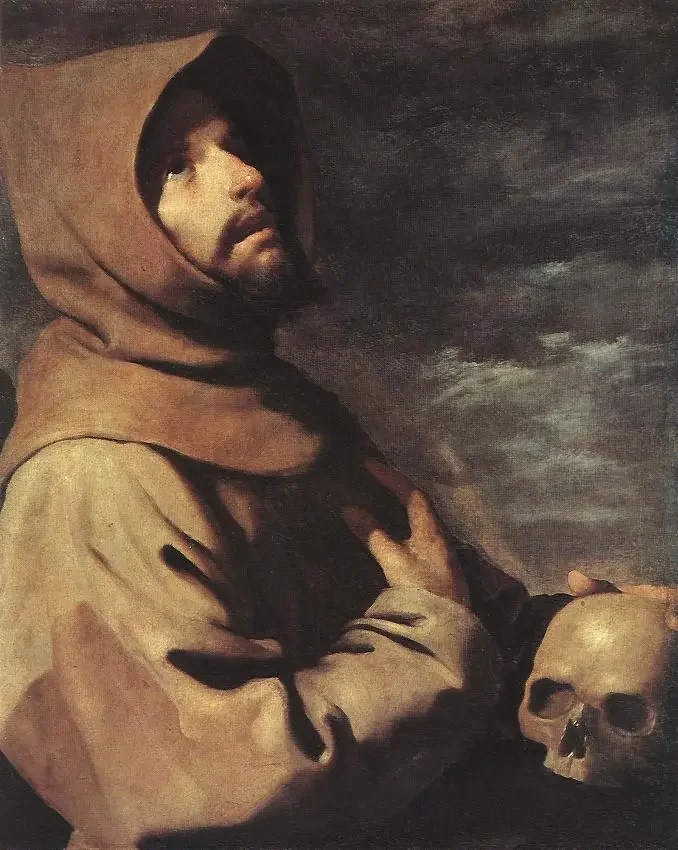
St. Francis by Francisco de Zurbaran (1598-1664)
However, in order to remember God, it is not enough to form a habit of prayer, we must also identify impediments to this goal. One of the chief struggles is distraction.
The Struggle of our Times
In the Screwtape Letters by C.S. Lewis, the power of distraction is foremost among the demons’ arsenal of weapons. The elder demon Screwtape advises Wormwood: “The best thing, of course, is to keep him from praying altogether” (Letter 4). It is the ancient strategy of ‘divide and conquer.’
If such is the case, what are we to do in our times? After all, the internet is a veritable ocean of interesting distractions. Even consecrated souls are not immune to the allure of so much good stuff. But are such tidings a treasure? Yes and no. While much is valuable, there are perils to such abundance. We may innocently step into the water only to have a rip current sweep our attention down a vortex of topics and images. Such a path is a sure way toward restlessness. Yet, are we not all guilty of it?
Nonetheless, for persons seeking God, this presents a serious obstacle. In the first place, when the soul becomes so saturated that it is unable to perch on a single good thought, prayer becomes a challenge. Resting in God requires a quiet intellect and peaceful heart. The Desert Fathers referred to this state of stillness as hesychia.
Is there any practical way to remember God more frequently? Using the acronym, P.R.A.I.S.E., here is a step-by-step method to cultivate the art of remembrance:
Six Ways to Remember God: P.R.A.I.S.E.
Pause: A simple way to remember God is to briefly disengage from our occupations, however busy we may be. Fr. Jean-Pierre de Caussade puts it this way: “One must act with calm, with gentleness, without haste and without strain, seeking the peace of one’s heart only in God. To this end, we must make frequent pauses so as to give the Holy Spirit time to work in us what He wills, and as He wills.” (Collected Letters, Bk II, Letter XV).
Repeat: This is one of the Desert Fathers’ specialties. They recommend the repetition of a monologistos (from Greek mono, "single," and logos, "word" or "phrase"), with an emphasis on brevity. When trying to train the restless mind, multiplicity begets confusion, while singleness brings repose.
The single word (or phrase) may be likened to a soul-anchor. When the mind drifts on the sea of distraction, such a phrase anchors the soul back into God. Various options include a Psalm verse, the Jesus Prayer, a simple aspiration, or even a single meaningful word. Perhaps some may prefer to schedule a different prayer or word for each day of the week.
Awaken: Beyond fixed moments of prayer, such as the Divine Office or Mass, little reminders are a great help to awaken the memory of God. These include keeping sticky-notes in our home or workspace, setting a chime on our watch or phone, placing the open Scriptures on a table, or lighting a vigil candle before an icon or statue.
Moreover, each day includes minor miracles that only require an awakened faith to appreciate: the song of the sparrow, the buzz of a bee, the splendor of the sky, the gifts of food and drink. Awakened faith sees God in everything. As St. Peter says “I think it is right to awaken your memory as long as I live in the tent of my body” (2 Peter 1:13). Note: the verb awaken here is often translated as ‘stir up’ or ‘refresh,’ but it literally means to awaken (cf. Luke 8:24).
Ignore: We all have a hardwired thirst for knowledge. This is an exceptional gift when properly directed. But we must be selective because our memory chews on whatever we feed it. If our brain consumes sensational, gossipy, and worthless news, we may end up with spiritual indigestion. With discipline, we can ignore worthless distractions and follow St. Paul’s counsel to focus our thoughts on whatever is true, noble, right, pure, lovely, and admirable (Phil 4:8).
However, if it requires self-control to turn away from outward distractions, far greater is the strength needed to quiet interior noise. The clamor of worry, anger, sadness, or resentment can grab our attention, making prayer impossible. Often, the best way to handle these sentiments is to ignore them.
Sow Good Seeds: If you have ever kept a garden, then you know that rewards come at a price. It takes sweat to prepare the ground for what is good and to pull out what is bad. As it turns out, our mind is quite a fertile field—it naturally grows whatever we plant there. We just need a little wisdom because “bad seeds bring forth weeds, while good seeds produce meeds (rewards).” What are good seeds? Scripture is foremost: The seed is the word of God (Luke 8:11). Also, the beauty of nature, beautiful art, music, people, and all that edifies and directs our thoughts toward heaven, are good seeds.
Enter: Our faith teaches us that God is everywhere present and filling all things. Alas, how often do we recall this basic truth? St. Augustine once lamented, “You were within me, but I was outside, and it was there that I searched for You. In my unloveliness I plunged into the lovely things which You created. You were with me, but I was not with You” (Confessions, 10:27).
St. John of the Cross teaches that God is present within the soul of even the worst sinner (Ascent, Book II, Ch. 5, §3). How much more is He present within a soul in a state of grace! To enter His presence involves no special breathing technique or unusual posture. It only requires an ounce of faith and the practice of recollection. This word derives from the Latin verb, recollegere, which literally means "to gather back together."
The Example of Our Lady
Some may say, “Sure, it is easy for Carmelites to think of God all day long—they have no spouse or children to worry about.” In a certain sense, the life of a Carmelite is ordered toward remembrance. Nonetheless, our lives in the monastery can also be hectic and a whirlwind of activity. Amid multiple duties, we try to maintain contact.
This is where Our Lady’s example is so precious. She was a mother, spouse, and very busy. According to the customs of the times, she was responsible for fetching water, preparing meals, and keeping the house in order. Yet, her soul was completely simple—there was no division whatsoever. As the “new Eve,” she managed to take care of all her responsibilities while yet remaining totally absorbed in God. As St. John says, “He who abides in love, abides in God and God in him (1 John 4:3).
May she, who pondered God’s mystery in her heart, lead us back to simplicity!
Recommended reading:
The Philokalia, Volume I, which contains St. Diadochos’ book, 100 Chapters on Spiritual Perfection
The Name of Jesus by Irénée Hausherr, S.J., Cistercian Publications, 1978