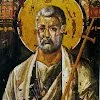
Is it You...?
Re-Encounter
Elijah announces that he is going to meet Ahab… He reassures Obadiah with an oath: "As the Lord of hosts lives, whom I serve, I will present myself to him today." (1 Kgs 18, 13). Upon seeing the prophet the King asks: "Is it you, you disturber of Israel?" (1 Kgs 18, 17).

King Ahab of Israel
Not the happiest of greetings. The Hebrew word used here is okheri and denotes the idea of one who causes disturbance or stirs up trouble. ( Faithlife Study Bible, footnote: 1 Kgs 18, 17). Ahab names Elijah as a disturber of the peace - a troublemaker. The king blames all his troubles on the prophet. He projects the disturbance both within himself and without in his kingdom onto Elijah. Ahab wants to lay hands on him just as hands are laid onto the scapegoat on the day of atonement. Clearly, Elijah is the king's number one enemy. Later Ahab will greet the prophet with: "Have you found me out, my enemy?" (1 Kgs 21, 20).
Elijah counters quickly with an answer to the king's query: "It is not I who disturb Israel, but you and your father's house, by forsaking the commands of the Lord and you by following the Baals." (1 Kgs 18, 18). The true source of all the disturbance is the apostasy of the king who has lead the people into the worship of foreign gods.
Summons

Elijah the Prophet
Now, the issue comes to a head. Elijah is ready to confront all the people in a kind of liturgical showdown. The Lord God will enter into a contest with Baal. The result of the contest will be to demonstrate who exercises true authority over the heavens and the rains. God through Elijah is challenging Baal, "the cloud-rider" in his own domain. The Lord will demonstrate that dominion belongs to him alone. Polytheism was virtually universal throughout the cultures of the ancient near east. Israel's monotheism was unique among these peoples and kingdoms. Israel was called to exclusive worship of the Lord. On Mount Sinai, God announced: "You shall not have other gods beside me." (Ex 20, 3). This commandment is a decree stating that no other gods exists except the God of Israel. God demands Israel's exclusive worship and allegiance. Elijah will once more summon the people to the exclusive worship of God, recalling them to covenant fidelity and allegiance to the Lord. (NABRE, footnotes: Ex 20, 3; 1 Kgs 18). The summons follows:
"Now summon all Israel to me on Mount Carmel, as well as the four hundred and fifty prophets of Baal and the four hundred prophets of Asherah who eat at Jezebel's table." (1 Kgs 18, 19).
Note in the summons itself how the odds are stacked up against Elijah. He is one man and he alone will face all the prophets of Baal and Asherah. That is 850 against 1. It seems that Elijah has no chance at all. Yet, as Elijah's name indicates the Lord is his God! He stands always in his presence and is before his face. Another contrast is immediately apparent. Elijah speaks of all these pagan prophets as men who have eaten at the table of Jezebel. I wonder what the fare was like in these years of drought, or did they feed sumptuously as the rest of the population starved. Most likely all these men were foreigners and not Israelites. Elijah, on the other hand, has survived on the meager means placed on the table of the widow of Zarephath. God put food on that table and sustained the whole household. God raised the widow's son from death, having heard the prophet's desperate prayer. For years Elijah has witnessed God's powerful providence. Perhaps, it is this experience that is at the heart of Elijah's present confidence. He is ready to take on Jezebel and her prophets because God is with him and he knows it.
The place of the summons is arranged: Mount Carmel. "So Ahab summoned all the Israelites and had the prophets gather on Mount Carmel." (1 Kgs 18, 20).
Back to the Original Question

Lucas Cranach the Younger - “Elijah and the Prophets of Baal” (Attribution: Dguendel, CC BY 4.0 <https://creativecommons.org/licenses/by/4.0>, via Wikimedia Commons)
So, who is it that is disturbing the peace? Who? God has stirred up the heart of his prophet and has caused unrest in the hearts of his people. It is not man who does these things, it is God! God wars on the hearts of those who belong to him, and will drive out of the hearts of his people all that is contrary to his will. Just think of Jesus in the Temple with the whip of cords driving out the money-changers and tradesmen. The reason for Jesus' action is given by John: zeal for his Father's house has consumed him. Jesus desires to set the whole Earth on fire - he wishes that it were already ablaze. He has not come to bring peace but the sword. The Gospel forces all who hear it to choose sides. Elijah is tired of the people limping around with two opinions. He is now going to force the question: "Whose side are you on?" It is God who disturbs the false peace of a superficial prosperity. Israel will truly prosper when it returns to the Lord.