Have some pictures or statues of the saints in your home and prize them with your crucifix more than any of your possessions. Often, it only needs a glance at a picture to bring to our minds the characteristics of the saints during their life on earth. We learn from them lessons of faith, courage, penitence, and the love of God. —The Curé d'Ars, Sermon for All Saints Day
Throughout the centuries, Catholic popes, doctors, and saints have upheld the value of sacred art. Where words fail, images and statues often give wings to the soul, lifting it to heaven. Indeed, many saints arrived at greater perfection through the power of images, such as St. Teresa of Avila.
In our effort to promote sacred art that inspires, we are pleased to share with you the beauty of our new marble statues that adorn the eastern facade of our chapel. The whiteness of this marble is something to behold. With virtually no veins or blemishes, the crystal-like surface makes them sparkle like snow in the sun.
This installation brought to close an arduous process of design, planning, and frequent communication with the company who fabricated the statues and tympanum. But where were they made?
How It All Began
The architect of our chapel designed niches on the eastern facade to hold statues one day. To this end, we made contact with sculpture studios in Pietrasanta, the notable carving capital of Italy. However, the resulting prices and samples were disappointing. Given our shoestring budget, we figured this feature would be the proverbial icing on the cake, perhaps decades in the future. Not so!
It came to pass as one of our brothers was assisting our Carmelite sisters in rendering watercolor designs for their new addition. He searched online for a statue of Our Lady of Mount Carmel as reference material. It was then that he discovered some beautiful statues from a company called Youfine. It is a Chinese company based in Quyang County, Hebei Province—a few hours southwest of Beijing.
The said brother asked permission to inquire about their prices. Not only was the cost very reasonable, but the company was willing to work with our unique designs. Nonetheless, we remained cautious—would the statues be devotional? However, our fears were unfounded because the project was in good hands.
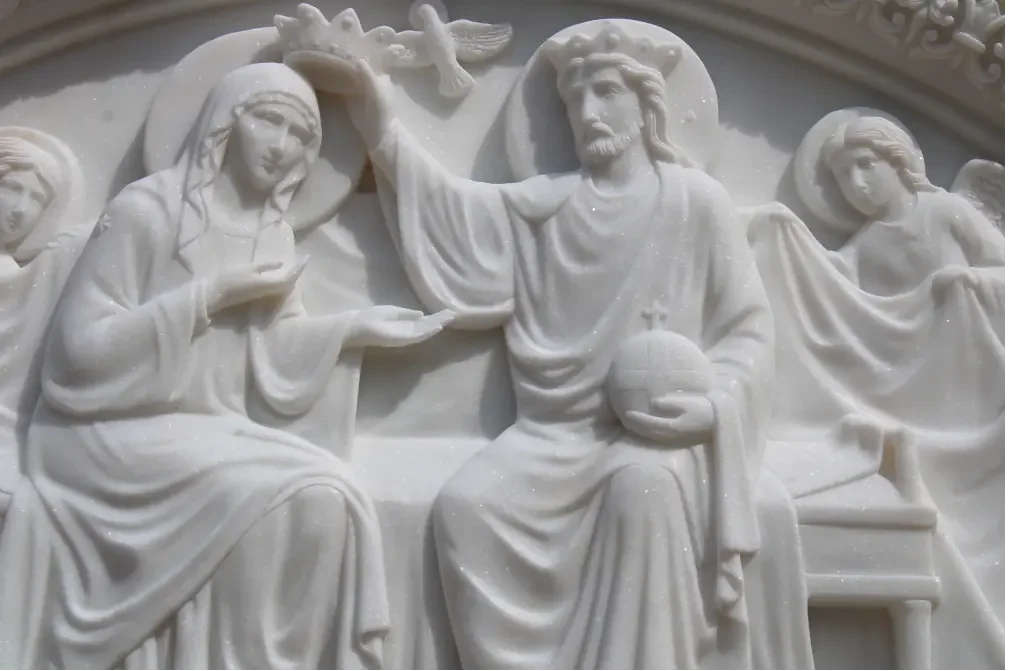
Detail of the tympanum—note how it sparkles in the sun.
Mr. Yuan refines a marble replica of Michelangelo’s Pietà.
It ends up that their chief sculptor, Mr. Yuan, is a devout Catholic. Miss Vincent, the Youfine representative who handled this order, wrote of him: “Our headmaster, Mr. Yuan, is also a Catholic Christian and he is very good at carving this kind of sculpture. He has been in this area 34 years. He always carves every sculpture with a fear of God, and he takes every detail very seriously, including the hair, fingers, and wounds of Jesus after the Crucifixion.”
Moreover, Mr. Yuan uses his free time to carve statues for poor Catholic parishes in China. His work is a form of prayer, and he puts his whole heart and soul into each piece. This fact was important to us.
A Guided Tour: The Tympanum
The main sculpture of the eastern facade sits above the main entrance and is called the tympanum, a Greek and Latin word meaning “drum.” This semi-circular piece depicts the Coronation of the Virgin Mary. In community discussions, we wrestled with various options for the design of the tympanum, but settled on the Coronation. It represents the culmination of Our Lady’s life on earth and the reward for her virtues and sufferings. The design itself is based on a fresco of the same subject in our first chapel.
Our Lord holds a globe representing the world, while Our Lady extends her hands in a gesture of gratitude: “The Almighty has done great things for me” (Luke 1:49). Beneath the majestic throne is a remarkable cloud footrest. The latter is a modification from the fresco, since rendering a footrest in three dimensions proved to be too difficult.

The tympanum of the Coronation of the Virgin Mary above the main entrance
Behind the main figures, angels gaze in adoration as they hold up the throne cloth. A dove, representing the Holy Spirit, hovers above the crown as the ultimate blessing for Our Lady’s life. The border design is especially noteworthy and required much painstaking effort to bring to perfection.
Saint Elijah
Flanking the main entrance are statues of the venerable patriarchs of Carmel, the prophets Elijah and Elisha. Both wear the prophetic mantle, similar to the traditional mantle that Carmelites wear. They also gaze towards heaven and gesture with their free hand in an act of adoration.
Elijah holds a flaming sword which has a multi-layered meaning. It principally refers to his fiery spirit, which several times called down fire from heaven. The Book of Sirach says that Elijah “arose like a fire and his word burned like a torch” (48:1). Secondly, it alludes to his effectiveness as a preacher while he wielded the "sword of the Spirit, which is the Word of God" (Ephesians 6:17). Finally, it refers to the execution of the 450 prophets of Baal (1 Kings 18:40). The bird at Elijah’s feet is the faithful raven that brought him food each morning and evening (1 Kings 17:2–6).


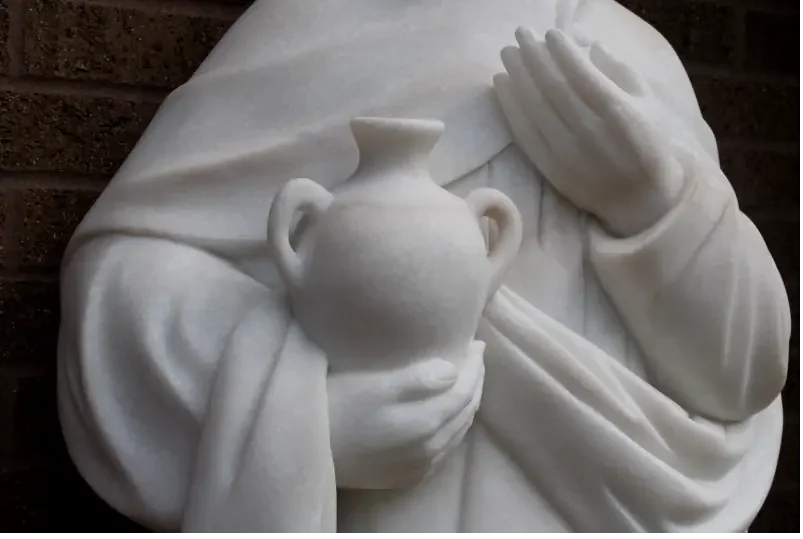
Saint Elisha
St. Elisha is depicted as bald-headed (2 Kings 2:23) and holds a jar, which is his typical iconographic symbol. Why does he hold a jar? There are no less than three jar-references in Scripture concerning this feature:
2 Kings 4:1-7 recounts how he multiplied the widow's jar of oil so that she could pay off her creditor.
2 Kings 2:19-22 speaks of a jar of salt: "Elisha said, ‘Bring me a new jar, and put salt in it.’ They brought it to him. He went out to the spring of the waters, and cast the salt into it, and said: ‘Thus saith the Lord: I have healed these waters, and there shall be no more in them death or barrenness.’"
2 Kings 3:11 describes a jar of water that he used as Elijah's attendant: “But Jehoshaphat said, ‘Is there not here a prophet of the LORD, that we may enquire of the LORD by him?’ And one of the king of Israel's servants answered and said, 'Here is Elisha the son of Shaphat, which poured water on the hands of Elijah.'”

Our Lady of Divine Grace
Finally, at the peak of the gable, Our Lady of Divine Grace gazes down upon all who come to pray at her chapel. She appears like the white cloud seen by St. Elijah (1 Kings 18:44). Our Lady’s open arms echo St. Catherine Labouré’s vision of the Miraculous Medal. So also, her arms are a visual gesture of welcome.

Our Lady of Graces at the gable
You are Invited!
You are cordially invited to the blessing of our statuary which will take place on Sunday, September 27, 2026. Guided tours will be from 2:30-4:00 PM, with the blessing at 3:00 PM. Though our chapel is a construction zone and quite untidy, we believe that you will be inspired to see our beautiful statues first-hand.