5 Encounters With Solitude in the Life of St. John of the Cross
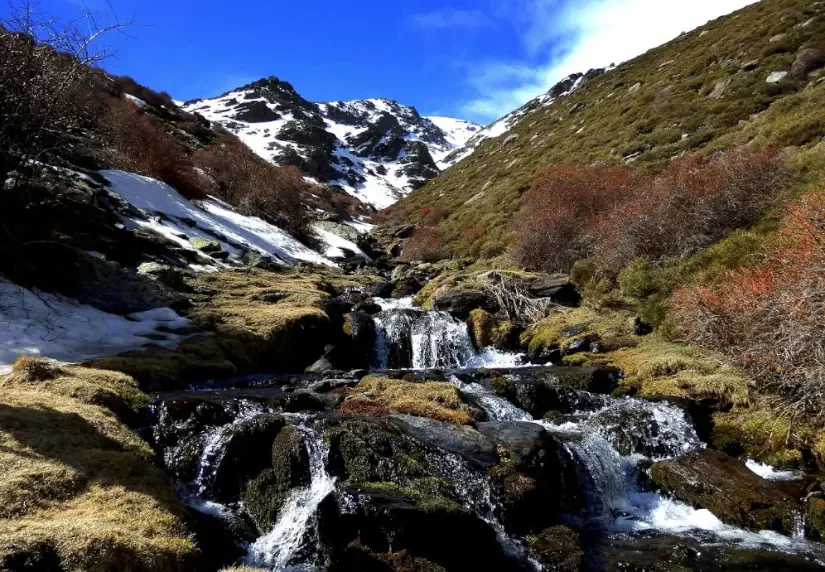
Mountains of Andalucía, Spain
Vapor shrouds the pines of the Sierra Morena, Andalucía, as Fray Juan emerges from his monastic cell. The crisp night air of La Peñuela awakens his mind after only a few hours of sleep. He makes his way to the huerta (monastery garden and orchard) until he reaches a stand of slender willow trees. Beside the soft gurgling of the garden’s acequia, he joins his hands against his chest, closes his eyes, and is soon immersed in God.
As morning splendor displaces the darkness, he is still absorbed in silence. Only when the pressing heat of summer becomes too much does he return to the monastery. He then devoutly says Mass and returns to his cell to pray until summoned to the Divine Office. At other times, desiring even greater solitude, he asks permission of the prior, Fray Diego de la Concepción, and goes out to the mountains to drink more deeply of divine contemplation near a natural spring. When the bell rings for a community event, he returns.
Such moments of stillness were the crown of St. John of the Cross’ final days. For most of his life, however, he had to seek solitude amid crushing responsibilities.
Why Solitude?
When we desire to pray, Our Lord advises us to enter into our inner room and shut the door (Mt 6:6). The general sense is an invitation to solitude. But for monastics such as St. John of the Cross, this injunction contains a deeper meaning. To “shut the door” means to close the mind to distracting thoughts and the “inner room” is the sanctuary of the heart. While a truly devout soul may enter this interior silence anywhere, most of us require physical solitude to help free the mind.
Yet, the inner room for John of the Cross was more like an “upper room, furnished” (cf. Mark 14:15). His soul feasted sumptuously when he entered solitude. Indeed, had not the hand of Providence hastily intervened in the person of St. Teresa of Ávila, St. John of the Cross would have become a Carthusian at the age of twenty-five. When they first met, the newly ordained Carmelite priest expressed his desire for "higher perfection and a life of solitude" as a way to "separate himself from the world and hide himself in God."
With fiery words, St. Teresa convinced him to choose otherwise. She explained that his desires could be fulfilled in Our Lady’s Order as a founding member of her reform. Though St. John would later serve key roles in the Order as confessor, master of novices, spiritual director, vicar provincial of Andalucía, and major definitor, he still managed to find plenty of time for solitude and silence.
His desire was certainly not a matter of misanthropy or escapism. He simply preferred the company of God above all. The same Spirit that led Jesus into the wilderness guided Fray Juan to enter the dynamic life of the Trinity, apart from the crowd.
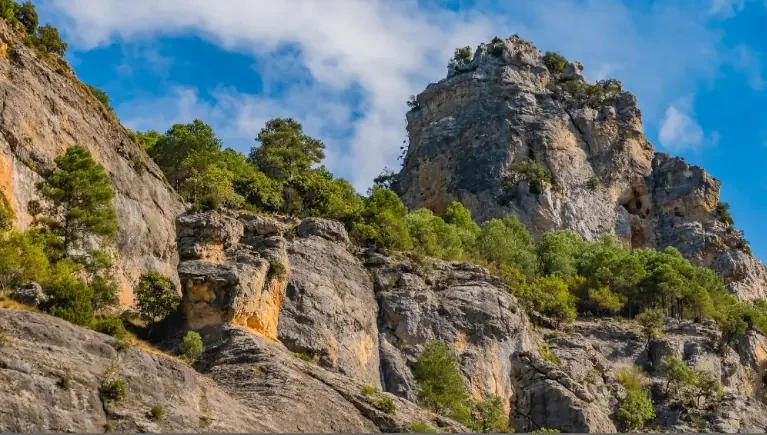
The rugged mountains of Sierra de Segura, Andalucía, Spain
Nonetheless, when called upon, he was considered by all to be a superb community man. He sought to create a calm atmosphere as prior and no task was too lowly for him. He had a particular knack for cheering up ill or melancholic brothers and was fond of staging reenactments of the martyrs’ trials during recreation. Because of his humor and deep spirituality, the community missed his presence when business kept him away. In other words, his solitary communion with God enabled him to replenish the souls of those he encountered in daily life.
5 Encounters with Solitude in the Life of
Fray Juan de la Cruz
1. The Prison at Toledo (1577–1578)
Because of fierce tensions between Carmelite friars of the Ancient Observance and the Discalced, Fray Juan was abducted from his quarters in Ávila on December 2, 1577. For the next nine months, he was confined to a suffocating six-by-nine-foot closet that had only a tiny slit of light near the ceiling.
Here, amid so much privation and enforced solitude, he mentally composed what is arguably the most lyrical poetry in the Spanish tongue. While it is undoubtedly difficult to read of Fray Juan’s sufferings there, his own perspective was radically different. He regarded his jailers as benefactors, acknowledging later that he had never experienced such an abundance of supernatural light as when incarcerated. As he later told the Carmelite nun Ana de San Alberto, "Ana, my child, one single grace of all those that God granted me there could not be repaid by many years of imprisonment."
At least twice, a mysterious light shone through the cracks of his prison door. His jailer went to tell the prior, Fray Maldonado, who came to see it with two other friars. “Whence comes this light?” asked the prior, “I forbade you to have any!” As he spoke, the light gently faded. Fray Maldonado said to his confreres as they walked away, “He is either a saint or a sorcerer!”
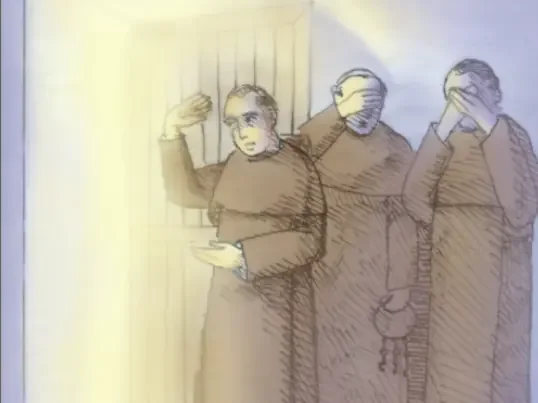
“Whence comes this light?”
2. The Monastery of El Calvario—Jaén, Andalucía (1578–1579)
If the prison of Toledo was the place of his cauterization, the monastery of El Calvario was a sanctuary of healing. Fray Juan loved the wild beauty of this isolated monastery, perched among the wooded hills of the Sierra de las Villas. The seven months he spent amid the sweeping valleys, fresh mountain air, tranquil streams, and open skies helped to heal his nine months of imprisonment.
As superior, he introduced the custom of leading the brothers out into the countryside for prayer. Rather than reading from a spiritual treatise. the landscape itself became the text.
He spoke to them of the divine beauty reflected before their eyes: the birds, sunlight, and the clear streams. Then, closing his reflection, he would encourage the brothers to seek God in silence near a peaceful stream or mountain crag. For Fray Juan, love for solitude was not a matter of being antisocial, but of walking with the truest Friend.
3. The Monastery of Los Mártires—Granada, Andalucía (1582–1588)
It was at this monastery that Fray Juan wrote the majority of his prose commentaries. While local tradition points to an ancient cypress tree in the garden as his preferred study, it is more likely that he wrote in the solitude of his cell late at night. By day, his hours were consumed with supervising the construction of a stone cloister and a 242-foot-long aqueduct that remains to this day.
Like El Calvario, Los Mártires was situated in a beautiful location. Fray Juan frequently led his friars out into the open air. When one of the brethren asked why he took them into the country so often, the Prior replied that it was to prevent their wanting to leave the monastery through spending too much time in it. He would lead them up the small hill behind Los Mártires toward the outlying spurs of the Sierra Nevada.
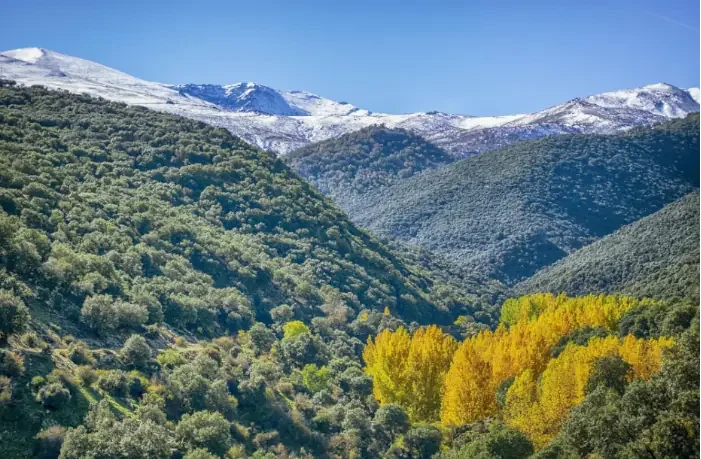
The Sierra Nevada mountain range near Los Mártires
At the foot of the majestic snow-crowned mountain, he spent some time with them in spiritual conversation. Then he told them, “Today, each one is to go alone through the mountains and spend the day in solitary prayer and in speaking to our Lord from his heart.”
4. The Monastery of Santa Cruz—Segovia, Castille (1588–1591)
While Fray Juan was prior of Segovia and First Definitor among the Consulta, or governing body of the Order, he was entrusted with the expansion of the old monastic complex, previously owned by the Trinitarians. He purchased the rocky hillside adjacent to the monastery and built everything on higher and healthier ground. When not occupied with administrative duties or major construction works, he often retreated to a high cave that overlooked the Eresma River and the wide Castilian sky. The view was magnificent, but more importantly, it offered pure silence.
When his presence was required for some business matter, the brothers would ring the large bell. If this failed to summon him, a padre or lay brother went up there to bring him down. ‘Leave me, for the love of God,’ Fray Juan would often reply, ‘for I am not in a fit state to transact business with people.’ When he came down, people noticed that he was so immersed in God that he could barely comprehend what was said to him. At other times, instead of going up to the cave, he went to a small hermitage hidden in the woods.
His secretary, Padre Juan Evangelista, would come across him at night absorbed in prayer beneath the trees, his arms stretched out in the form of a cross. He was so withdrawn from the world that he did not notice the presence of his secretary, nor could he be ‘awakened’ by his entreaties.
At other times, Padre Evangelista would find him in his cell, looking out at the stars on a calm summer night. His efforts to pull the prior out of his ecstasy were in vain. When Fray Juan came to himself again and saw Padre Evangelista at his side, he said to him with surprise, ‘What are you doing here?’ or ‘What have you come for?’ The effect of his prayer lasted throughout the day.
5. La Peñuela—Jaén, Andalucía (1591)
In the final chapter of his life, Fray Juan was removed from office for opposing Prior General Nicolás Doria’s efforts to alter the nuns’ constitutions and to dismiss Padre Gracián from the Order. As a result, one of the Church’s greatest mystics was sent to the remote monastery of La Peñuela. He did not object. Having poured out his soul on behalf of the Order, he thirsted for the living springs that flow only in solitude.
For Fray Juan, this desire required no justification; Our Lord Himself frequently sought solitude in the hills. Though a fierce campaign was underway to expel him from the Order, he remained unconcerned. Freed from administrative burdens, he spent his mornings in the huerta and nearby mountain springs, drawing ever closer to the Source—where the noise of controversy dissipated through the whistling of love-stirring breezes (Spiritual Canticle, stanza 14).
The Key Takeaway
St. John loved solitude because he loved to be with God. Like Moses entering the tent of meeting (Ex 33:7–11), friendship with the Beloved was best fostered in a quiet place apart. The fruits he gained in solitary communion with God, he freely offered to strengthen his neighbor.