
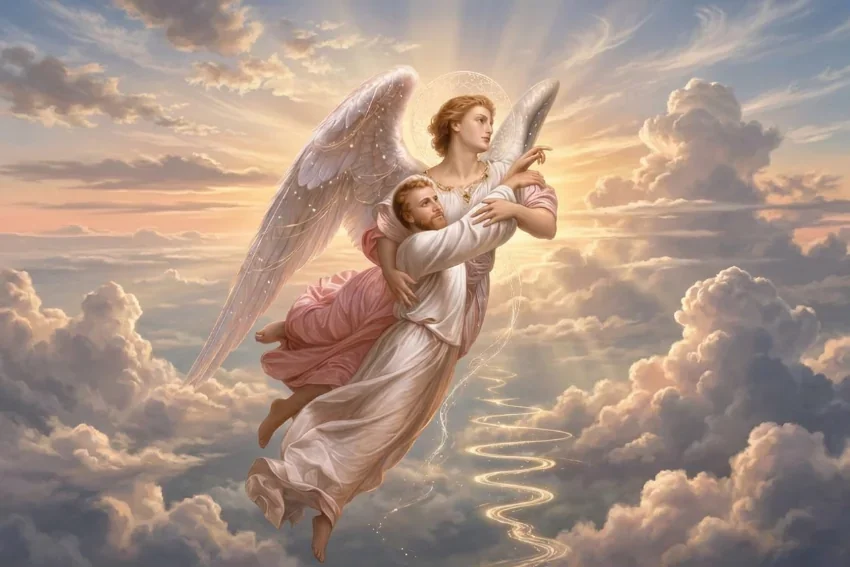
“May the angels conduct thee into Paradise…and lead thee into the holy city Jerusalem” (In Paradisum, Roman Ritual).
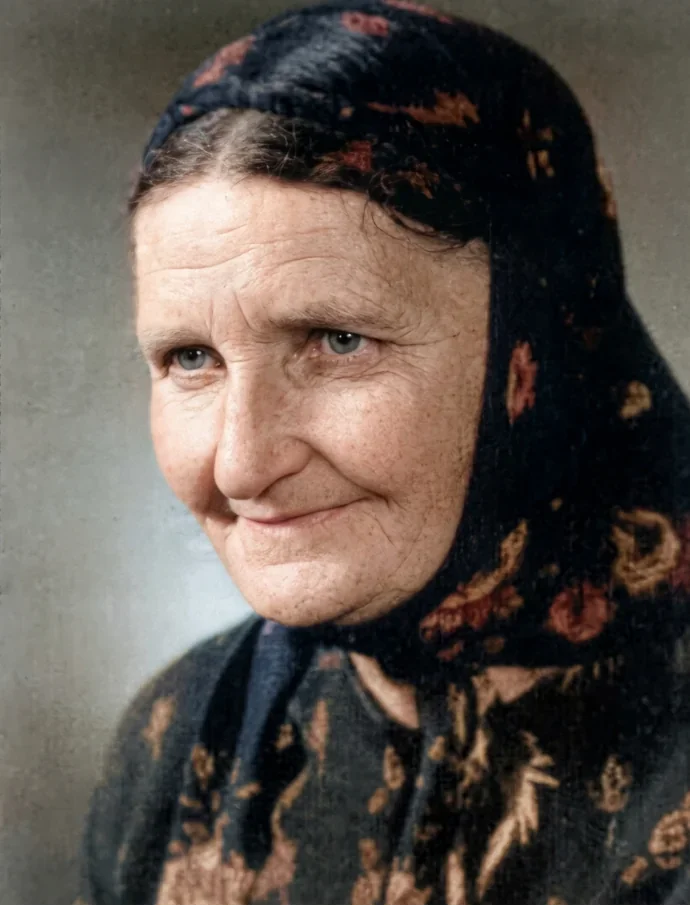
Maria Simma (1915-2004) was living a quiet, simple life in Austria until one night in the year 1940. At that time, she was awakened by the sound of someone entering her bedroom. Slowly looking up, she saw a stranger pacing back and forth in her room. Being a fearless farm girl, Maria angrily shouted at him, "How did you get in here? Go away!" But the man continued walking back and forth, as though deaf. She asked him again, "What are you doing!?" Still no answer. So, she sprang out of her bed and tried to grab him, but her hands wrapped around air.
She wondered, “How can I see this man, but not grab him?” Later that morning, she told her pastor about the experience, and he advised: "Rather than say, 'Who are you?', ask, 'What do you want from me?'"
The following night, the spirit indeed returned and Maria asked him, "What do you want from me?" He replied, "Have three Masses celebrated for me and I will be delivered." She then understood that he was a soul from Purgatory. With the approval of her pastor and bishop, Maria went on to assist thousands of such souls in the course of her lifetime.
Is she the only person to have allegedly helped departed souls? Is Purgatory even real? Is it true that souls are happy there? These and other questions hang over this mysterious realm like early morning fog. Yet the sunshine of our faith and the experiences of mystics like Maria help dissipate much of the mystery. Indeed, it is a cause for giving thanks to God’s merciful designs.
1. What is Purgatory?
Maria Simma answers: “I’d say that it’s a marvelous invention of God.”
How so? In unclouded justice, God could simply exclude blemished souls from His company, as nothing unclean enters heaven (cf Rev 21:27). Rather, our good heavenly Father provides a way of final purification for persons who die in His friendship yet retain certain blemishes. Through this merciful cleansing, souls become fit to enter the joy of the Lord with radiant garments.
“Purgatory” derives from the Latin verb, purgare, which means to purify (English = purge). While thought to be an exclusively Catholic doctrine, the understanding of a place of post-mortem purification is also found in Judaism, Islam, and several other religions. Protestants generally deny its existence as the word purgatory is not found in Scripture. However, some Protestants believe it "makes sense," as professor Jerry Walls wrote in his book, Purgatory: The Logic of Total Transformation.
While the Catholic doctrine developed slowly, the concept was clearly taken for granted by early Christians. For example, Tertullian, writing in AD 208, comments that Jesus' parable of the "last penny," refers to a place of expiation and penitence after death: "No one will hesitate to believe,” he says, “that the soul undergoes in Hades some compensatory discipline" (A Treatise on the Soul, Ch. 58). Two centuries later, as St. Augustine's mother Monica was dying, she requested Masses after her departure. Why request Masses unless there is a concern of detainment?
2. Is Purgatory Scriptural?
In broad terms, we know that nothing unclean enters heaven (Rev. 21:27) and that a person's works will be tested after death: "If anyone's work is burned up, he will suffer loss, though he himself will be saved, but only as through fire" (1 Cor 3:15). In addition, Jesus says, "Make friends quickly with your accuser while you are going with him to court, lest your accuser hand you over to the judge, and the judge to the guard, and you be put in prison; truly I say to you, you will never get out till you have paid the last penny" (Matthew 5:25-26). The Greek word employed here for ‘prison’ is phulakē (φυλακή), which is the same word that Peter used to describe the holding place where Jesus went after his death to free the detained souls (1 Peter 3:19).
Jesus also speaks of the sin against the Holy Spirit that cannot be forgiven in this age or the age to come, implying that certain sins may be forgiven after death (Mt 12:32). Going back farther in Scripture, we find an episode where Judas Maccabeus and members of his army discover pagan amulets under the garments of their fallen comrades (2 Maccabees 12:39-46). Rather than despair over a blatant violation of God's law, Judas takes up a collection to send to Jerusalem to expiate their sin. The men also offer supplication to God. In doing this "he acted very well and honorably…therefore he made atonement for the dead, that they might be delivered from their sin" (v. 43, 45).
3. What are the pains of Purgatory?
According to Maria Simma, souls in Purgatory retain the memory of God's beauty and benevolence. Their ravished souls completely yearn to return to His presence but understand their unworthiness. Hence, the foremost pain in Purgatory is an intense longing for God. The second aspect is a purifying fire.
Here we encounter a mystery—saved souls most willingly go to purgatorial fires to receive a hot bath. St. Catherine of Genoa (1447-1510) states in her Treatise on Purgatory: "God stands before us with open arms to receive us into His glory. But well I see the divine essence to be of such purity, far greater than can be imagined, that the soul in which there is even the least note of imperfection would rather cast itself into a thousand Hells than find itself thus stained in the presence of the Divine Majesty. Therefore, the soul, understanding that Purgatory has been ordained to take away those stains, casts itself therein and seems to itself to have found great mercy in that it can rid itself there of the impediment which is the stain of sin" (Ch. 8).

4. What saints received visitors from Purgatory?
Many saints and blesseds met with souls from Purgatory. St. Teresa of Avila, Blessed Anne Catherine Emmerich, St. Margaret Mary Alacoque, and others encountered departed souls who asked for prayers or Masses. Here are three notable examples:
1. St. Nicholas of Tolentino (1245–1305): an Augustinian friar who is the patron saint of the souls in Purgatory. He began his lifelong ministry to the departed souls after an encounter with a deceased confrere named Pellegrino di Osimo. This friar asked Nicholas to say a Mass for him in the morning because he was suffering in purgatorial flames. The friar explained that if he had a Mass said, great numbers of detained souls could be released. He then showed him a vast multitude of souls suffering in Purgatory. St. Nicholas said Masses for seven days and was then shown a radiant vision of Pellegrino and a multitude of freed souls.
2. St. Pio of Pietrelcina (1887-1968): Among the many interesting accounts of St. Pio’s ministry on behalf of the departed souls, one is particularly intriguing. One night at the Capuchin friary in San Giovanni Rotondo in 1944, the friars heard loud shouting at night: "Viva Padre Pio! Viva Padre Pio!" The friars went to see who had come in since the doors were bolted shut. No one appeared in the hallways. They asked Pio and he said they were soldiers who were killed on the battlefield who were coming to give thanks for prayers. He added: "There are more souls of the dead coming up that road to ask for my prayers than souls of the living."
3. St. Faustina Kowalska (1905-1938): This Polish nun received many visits from departed religious sisters who begged for her prayers. Her compassion for the departed souls began early in her religious life, when her guardian angel transported her to a misty place filled with fire. Faustina understood that it was Purgatory and asked the suffering souls about their greatest torment. They responded in unison that it was an intense longing for God. Notably, Faustina said the Virgin Mary visits the souls there to bring them refreshment. They refer to her as the “Star of the Sea.” While Faustina pondered this scene, she heard a distinct voice: "My mercy does not want this, but justice demands it" (Diary, #20).
5. Do the souls in Purgatory experience greater joy than that found on Earth?
Despite the experience of intense suffering in Purgatory, the holy souls know a happiness that is beyond that of Earth. How can this be so? St. Catherine of Genoa explains: “No happiness can be found worthy to be compared with that of a soul in Purgatory except that of the saints in Paradise...day by day this happiness grows as God flows into these souls more and more as the hindrance to His entrance is consumed. Sin's rust is the hindrance and the fire burns the rust away so that more and more the soul opens itself up to the divine inflowing” (Ch. 2, Treatise on Purgatory).
According to Maria Simma, no soul in Purgatory desires to return to earthly life. She says: “They have knowledge which is infinitely beyond ours. They just could not decide to return to the darkness of the earth. Here we see the difference from the suffering that we know on Earth. In Purgatory, even if the pain of the soul is terrible, there is the certitude of living forever with God. It's an unshakeable certitude. The joy is greater than the pain. There is nothing on Earth that could make them want to live here again, where one is never sure of anything.”
6. How can I best avoid a lengthy stay in Purgatory after death?
For our benefit, God has permitted many saints to visit Purgatory in their lifetimes. St. Mary Magdalene de Pazzi, St. Frances of Rome, and St. Faustina Kowalska are but a few. In reading their accounts, one is motivated to clear all debts while there is time.
“How terrible are the pangs of Purgatory!” says St. Mary Magdalene de Pazzi (1565-1607), “Never could I have believed it had not God manifested it to me...And, nevertheless, I cannot call them cruel; rather, they are advantageous, since they lead to the ineffable bliss of Paradise.”
When asked what sins most lead to Purgatory, Maria Simma responded: “Sins against charity, against the love of one's neighbor, hardness of heart, hostility, slandering, calumny—all these things. Saying wicked things and calumny are among the worst blemishes which require a long purification? Yes.”
It is notable in this context that Jesus' discourse on the ‘last penny’ (Mt 5:25–26) and the parable of the unforgiving servant (Mt 18:23-35) who must pay all his debt, are related to lacking mercy toward our neighbor.
In order to acquire a merciful heart, we do well to live a sacramental life and devote much time to prayer. Frequent meditation on the Passion of Jesus (such as in making the Stations of the Cross), praying the Divine Mercy chaplet, and cultivating a sincere devotion to the Blessed Virgin, St. Joseph, and St. Michael are all great means to mitigate Purgatory. In addition, almsgiving and all charitable acts toward our neighbor help clear away debts: “Love covers all offenses” (Proverbs 10:12).
Finally, to lessen or even eliminate the need for future purification, the practice of penance is recommended. This explains why so many saints willingly endured pain on earth and lived austere lives. While God instantly forgives the repentant sinner, He ordinarily wills that the temporal effects of sin be healed through penance, charity, and patient acceptance of suffering. In practice, this does not necessarily mean scourging oneself to blood but joyfully accepting the daily annoyances of life.
7. Why do I need further purification if the Lord has forgiven my sins in confession?
Assuredly, when you receive absolution in Confession, God's mercy completely forgives the guilt of your sin and remits eternal punishment. However, there remain the consequences and wounds of sin, which require satisfaction to heal in this life through prayer and penance, or afterward in Purgatory.
The Roman Catechism, published after the Council of Trent, explained this doctrine at great length. The modern Catechism summarizes the same teaching more concisely: "every sin, even venial, entails an unhealthy attachment to creatures, which must be purified either here on earth, or after death in the state called Purgatory" (CCC 1472).
Scripture illustrates this element of satisfaction when the prophet Nathan tells King David, "The Lord has taken away your sin; you shall not die" (2 Samuel 12:13). Yet, while the guilt was forgiven, the temporal consequences still followed: the death of the adulterous offspring and the subsequent rebellion and death of his son Absalom.
An objector might ask: "But Jesus paid the price for my sin; why do I need to satisfy justice?"
To answer this, the Roman Catechism hearkens to St. Bernard, who observed that sin produces two effects: a stain on the soul and a wound. The stain is removed through God's mercy, but healing the wound requires the remedy of penance. When a wound has been healed, some scars remain which demand attention; likewise, with regard to the soul, after the guilt of sin is forgiven, some of its effects remain, which still require cleansing (Rom. Cat., Part II, Ch. V).
Consider a child who breaks a neighbor's window and apologizes. The neighbor instantly forgives him and the relationship is restored. However, the window is still broken. Sweeping up the glass and purchasing a new window repairs the disorder.
In sum, the need for restoration does not imply that Christ's sacrifice on the Cross was insufficient. Rather, it is the merciful application of the Cross to our lives. Simply put, His Sacrifice brings the grace of pardon, while our loving acceptance of daily crosses heals the consequences of sin. Seen in this way, suffering is a manifestation of God’s mercy—by being chastened in this life, we are spared extra purification in the next. The key is to consciously offer up everything and so accelerate the healing before we depart from this world.
A Work of Mercy
One of the most compassionate works of mercy is to assist the suffering souls in Purgatory. These souls can no longer help themselves or gain merit, so they depend completely on our intercession to help them (CCC 1032).
As St. Francis de Sales says, "To assist the souls in Purgatory is to practice in a sublime manner all the works of mercy together." Notably, a religious congregation was founded in the 19th century by Blessed Eugénie Smet for this express purpose—to pray, suffer, and labor for the benefit of the souls of the faithful departed.*
While some people are not able to perform corporal works of mercy, no one is prevented from performing a spiritual work of mercy, such as praying for the Poor Souls. By doing so, we can hope to hear on the Day of Judgment, "Come, you that are blessed by my Father, inherit the kingdom prepared for you from the foundation of the world; for I was hungry for God and you gave me food, I was thirsting for consolation and you gave me something to drink...I was in purgatorial prison and you visited me" (cf Mt 25:34).
* They are known today as the Society of Helpers and have about 500 members.