Our Black Currant Harvest
Hermit Harvesters
It is not without significance that our black currants come to maturity during the time of the novena (July 7-15), leading up to the feast day of Our Lady of Mt. Carmel. This sweet connection will be explained further on.
How do we know when to pick these gems? When they appear plump and dark night black. If they are slightly reddish, we wait for a week or so. Thus, black currant harvesting requires a discerning eye.
Given the heat of July, the harvesting of these berries is not quite as pleasant as picking apples in the Fall. Still, this harvest has its particular joys. What a surprise it is, for instance, when one lifts a cane and discovers great clusters of juicy fruit under the leaves! These berries are somewhat like hermits—well hidden.
It is as though God understood the need to conceal the fruit from the birds, in particular, wild turkeys. Otherwise, the bushes would be picked clean before the brothers get to them. On one occasion, a brother was peacefully picking currants in the evening, when a wild turkey hopped up on the wooden fence, practically in his face. Who startled whom more? Hard to say!
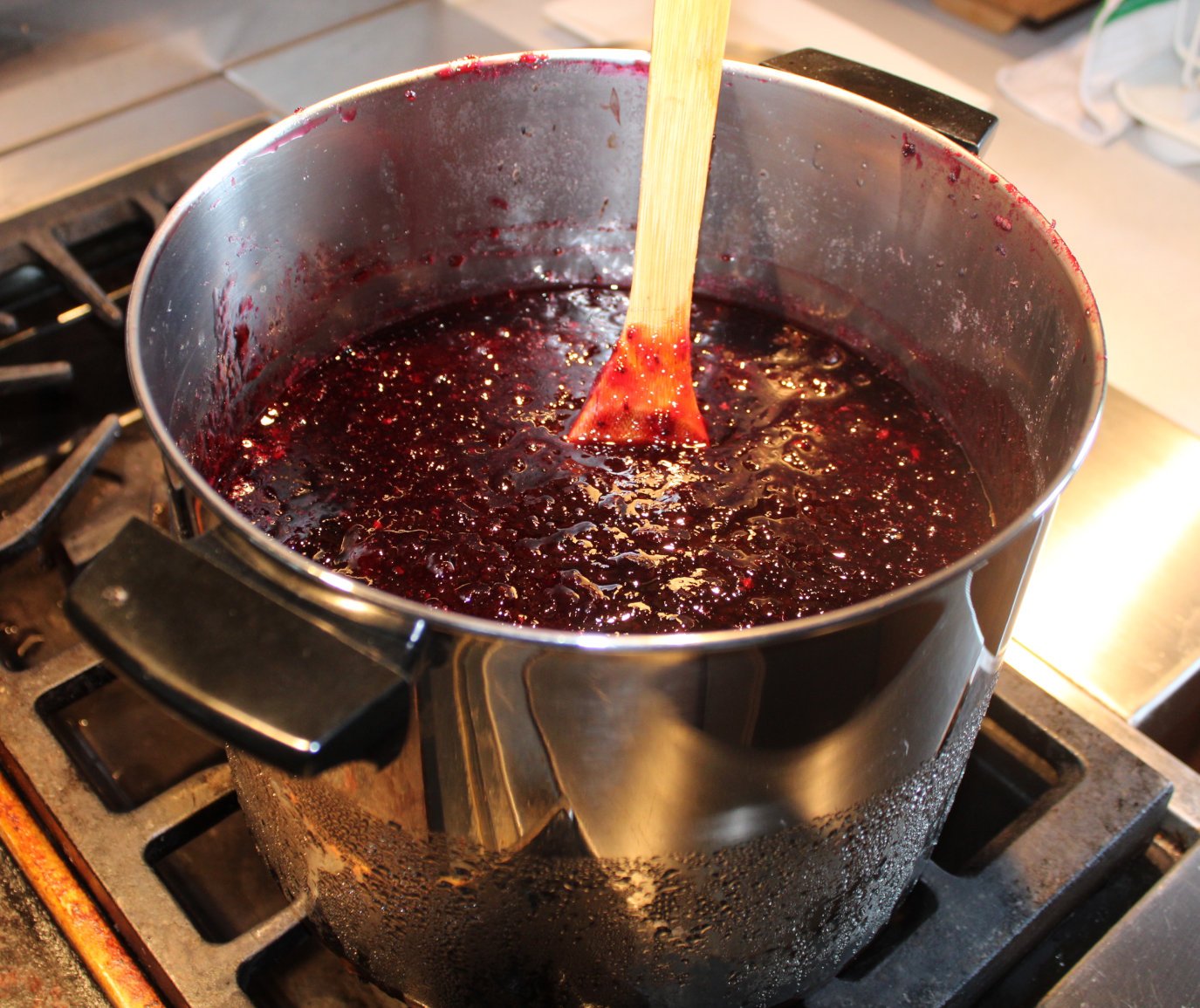
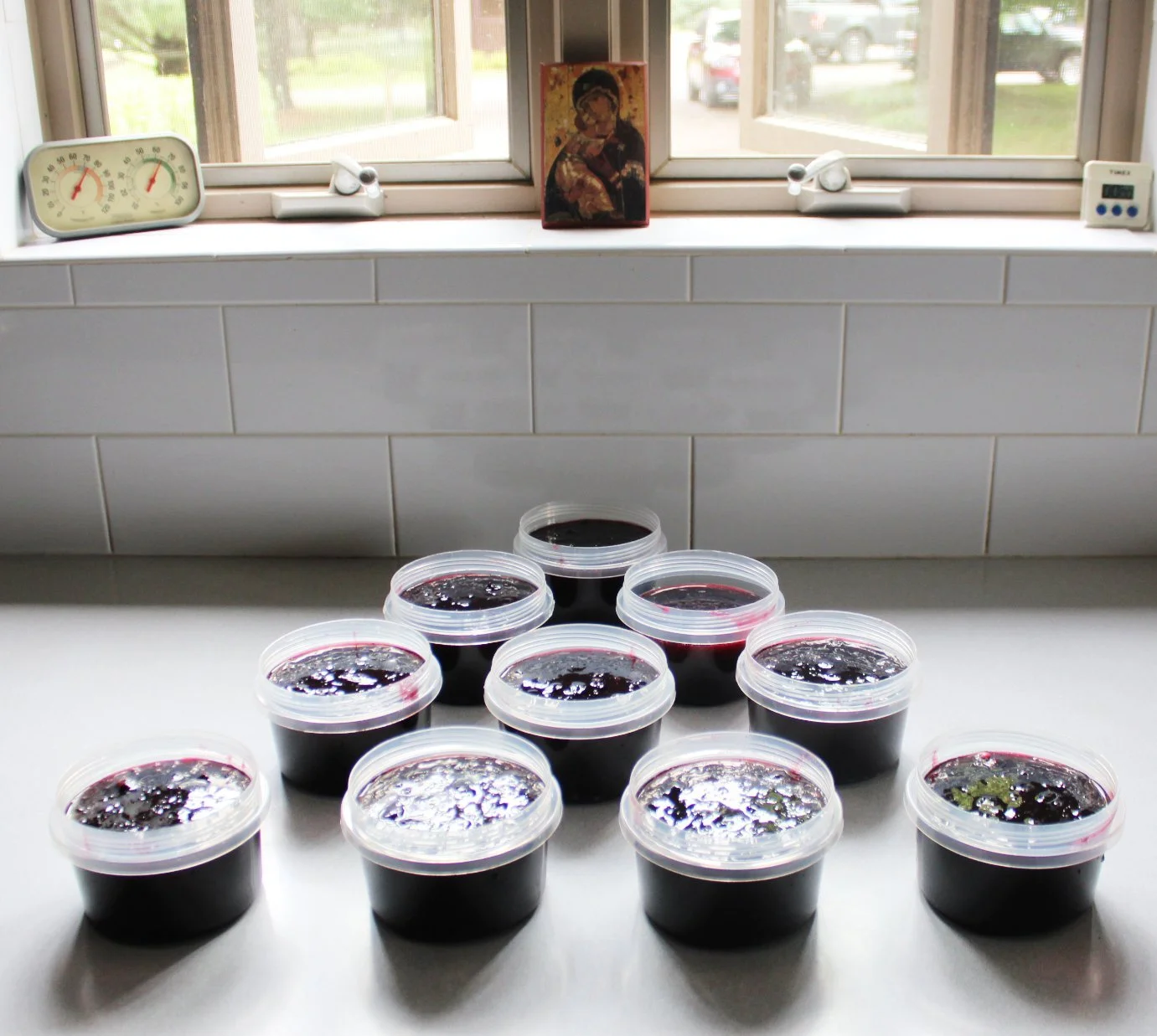
Our harvest generally goes into the freezer or is immediately turned into homemade jam. It makes for a high-powered breakfast when spread on our homemade bread. While black currants may be eaten raw, such as on oatmeal, they are slightly sharp due to their high vitamin C content. We cook them down and add sugar to balance their natural astringency.
America’s Forbidden Fruit
Most Americans are quite unaware of black currants. These berries are not likely to appear on the shelves at popular grocers such as Cub or Hy-Vee. What is the reason for this obscurity?
The reason dates back to 1911, when black currants were outlawed across the United States. Later, the federal government permitted individual states to regulate its cultivation in 1966, but by then it was a forgotten fruit. The true turning point came in 2003, when a landmark legislative breakthrough in New York officially overturned the state's 92-year-old ban.
Despite this revival, the forbidden fruit status lingers: multiple states—including North Carolina, Massachusetts, Maine, and Rhode Island—still maintain strict prohibitions on cultivating Ribes nigrum. Other states, such as Michigan and New Jersey, require special permits to grow them.
Why Was it Banned?
Early cultivars of black currant were host to a lethal fungus known as white pine blister rust (WPBR). Whole forests of white pines were eradicated through this disease until the timber industry put pressure on the government. The Plant Quarantine Act of 1911 officially banned the commercial cultivation, import, and transport of Ribes nigrum.
However, modern cultivars, such as Titania or Consort, are completely immune or highly resistant to WPBR, making them safe to grow alongside pine trees.
Note: if you are looking to order these plants from an online nursery, try to select rust-resistant varieties to ensure ecological safety. We bought our Titania bushes from Raintree Nursery in Washington.
|
The Most Nutritious Fruit on the Planet?
Certain fruits top the list in particular categories. For example, pomegranates or acai berries are rich in antioxidants, which are especially helpful for the cardiovascular system. However, when it comes to scoring high across all metrics—vitamins, minerals, antioxidants, and healthy fats—few fruits compare to the black currant berry.
A report from Carandale Farms puts it this way: “Black currant may be the most nutritious fruit of all. While most superfruits are high in specific nutrients, black currant is exceptional in the full range of nutritional components.” European Black Currant – Uncommon Fruit
While blueberries often receive the superfood spotlight in reviews, they must recede to the shadows when brought face-to-face with the humble black currant. Here is how they compare per 100g serving:
The Superfood Showdown: Blueberries vs. Black Currants
| Metric | Blueberry | Black Currant |
|---|---|---|
| Vitamin C | 9.7 mg | 181 mg (20x more) |
| Anthocyanins | 160 mg | 700 mg (4x more) |
| Potassium | 77 mg | 322 mg (4x more) |
| Iron | 0.28 mg | 1.54 mg (5x more) |
| Calcium | 6 mg | 55 mg (9x more) |
| Magnesium | 6 mg | 24 mg (4x more) |
| Dietary Fiber | 2.4 g | 4.3 g (Nearly double) |
| Sugar Content | ~10.0 g | ~7.4 g (Lower sugar) |
Data Source: USDA FoodData Central database.
The Land of Carmel
As mentioned, the harvest usually occurs during the time of novena for Our Lady of Mount Carmel. Hence, it is a fruitful time to meditate on a certain Scripture passage. As our Rule tells us, “Meditate on the Law of the Lord day and night.”
Which Scripture verse? It comes from Jeremiah: “I have brought you to the land of Carmel to enjoy the fruits and blessings of it" (2:7). This verse is incorporated into the liturgy itself as the Communion chant for July 16: "Et induxi vos in terram Carmeli, ut comederetis fructum ejus et optima illius…"
The meaning goes beyond the consumption of nutritious fruit for the health of the body. It calls to mind the blessing of a beautiful vocation and partaking of the Fruit that gives life to our souls.
Carmel: The Garden of God
The biblical word Carmel is often translated as ‘garden,’ ‘orchard,’ or ‘fertile field.’ However, some scholars suggest Carmel means “Garden of God.” The linguistic reasoning goes like this:
Kerem (כֶּרֶם), is the standard Hebrew word for a ‘vineyard,’ ‘orchard,’ or ‘walled garden.’
El (אֵל): is one of the names for God in the Hebrew Bible (as seen in Emmanuel or Bethel).
By fusing Kerem and El, the word can literally be read as "The Garden of God." In a particular sense, Our Lady is the Garden of God. She brings forth the most nutritious Fruit of all time, Jesus, who nourishes our souls in Holy Communion with the living sustenance of faith, hope, love, and every good virtue.
Blessed by the Lord are you, O Virgin Mary, for through you we have been made partakers of the fruit of life, Alleluia. (1st antiphon for matins and vespers for the feast day of Our Lady of Mt. Carmel)